- Place
- Varėna District Municipality
- Region
- Dzūkija National Park
- Type
- ethnographic homestead of Dzūkija National Park
- Address
- Miškininkų g. 4, Marcinkonys
- Coordinates
- 54.06090, 24.40470
Marcinkonys Homestead, Dzūkija National Park Ethnographic Homestead
Marcinkonys Ethnographic Homestead: a sandy-forest Dzūkian village
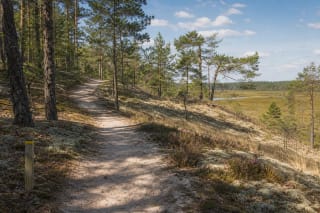
Marcinkonys Ethnographic Homestead operates in Dzūkija National Park, in one of Lithuania's clearest forest villages. Its value is not scale but precision: through a small homestead world you can understand life in a region of pinewoods, sand, mushrooms, berries, and crafts, known in Dzūkija as the šilai, and its people as šiliniai dzūkai, sandy-forest Dzūkians.
Marcinkonys is not an ordinary village. According to the Universal Lithuanian Encyclopedia, by area it is one of Lithuania's largest villages and has been known since 1637, when a forest-scout settlement of 8 households was mentioned. When Dzūkija National Park was established in 1991, its directorate settled in the village, so the ethnographic homestead became a natural part of park interpretation.
The 1905 homestead and its opening to visitors
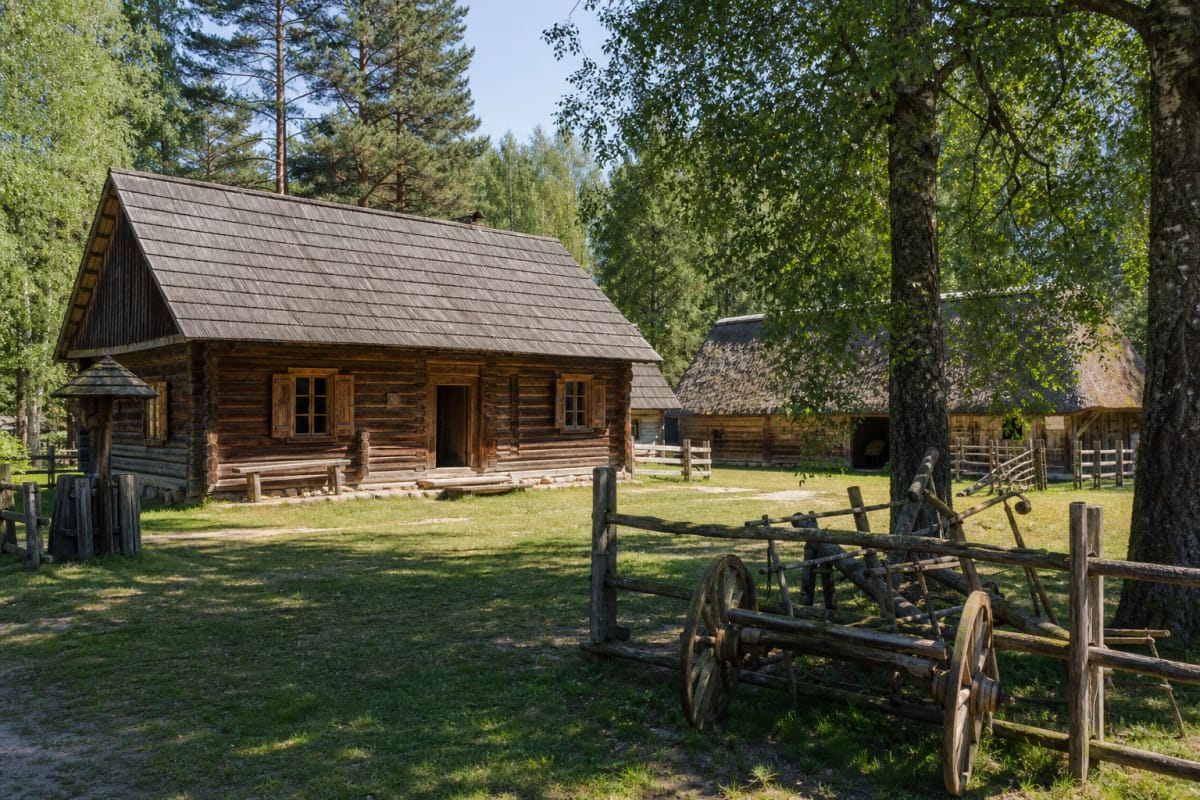
The homestead consists of a dwelling house and barn built in 1905, authentic forest-village buildings that let visitors see a real, not reconstructed, early twentieth-century Dzūkian homestead structure. Collecting exhibits began in 1991, and the homestead opened to visitors in 1994, the same year as the Marcinkonys Ethnography Museum.
This precise combination of buildings and objects matters: the homestead tells not about abstract Dzūkija but about people of a specific place who had little arable land and relied on forest work, crafts, and, from the late nineteenth century, mushroom and cranberry gathering and trade.
What to see at the homestead
The exhibition presents Dzūkian everyday life: a wooden house, barn, furniture, work tools, home textiles, and local crafts. Among the oldest exhibits is a hollowed corner cupboard from the first half of the nineteenth century; forest-produce objects are also shown, such as a large basket for chanterelles, fishing gear, and everyday work tools.
This exhibition helps explain not only what objects looked like, but also what rhythm of life the forest dictated. Ask what each tool was for, how food was stored, and what place weaving, straw gardens, candles, mushroom picking, or beekeeping had in household life.
Education programmes: candle casting and straw gardens
Dzūkija National Park offers craft education programmes at the homestead, including candle casting with wax preparation and straw-garden binding. During research, each programme lasted about 3 hours and cost about 7 EUR per person for groups of up to 15. These programmes are especially valuable because, without explanation, a rural-life exhibition can look like only a collection of old objects.
A specialist's commentary shows the links between work, seasons, and local nature: how wax and candles came from the pinewood world, why straw gardens carried ritual meaning, and how mushroom picking became not only food but also family memory and trade.
Tickets, opening hours, and route
During research, the official page listed a regular adult ticket at 2 EUR, concession at 1 EUR, and a 5 EUR day ticket covering several park visitor sites. Opening hours were listed as Tuesday-Friday 8:00-17:00 with a lunch break 12:00-12:45, Saturday 9:00-16:00, and closed Sunday and Monday. A specialist talk or education programme may cost extra and require advance booking.
Allow about an hour for the homestead, and if combining it with the Marcinkonys visitor centre and Zackagiris trail, plan half a day. Before going, check the current schedule and prices on the official Dzūkija National Park page, because they vary by season.