- Place
- Varėna District Municipality
- Region
- Varėna District
- Type
- Lithuania's largest raised bog and a strict nature reserve
- Address
- Čepkeliai educational trail, Marcinkonys area, Varėna District
- Coordinates
- 54.02175, 24.42734
Čepkeliai State Strict Nature Reserve
Čepkeliai Mire: Lithuania's largest raised bog
Čepkeliai Mire is one of Lithuania's strongest wild-nature places. Saugoma.lt presents it as the country's largest raised bog, and VLE gives the mire area as 5,858 ha.
VLE writes that the mire lies in Varėna District, about 4 km east of Marcinkonys, on the watershed between the Merkys and Katra rivers, at the southeastern edge of the sandy Dainava Plain. The mire stretches 14 km from east to west and is surrounded by sands, pinewoods, and remnants of inland dunes.
Čepkeliai has a deep geological history. Saugoma.lt says the mire lies in the bed of ancient lagoons that existed here at the end of glaciation, about 15,000 years ago; after the waters receded, lakes remained, gradually paludified, and began forming the mire about 11,000 years ago. Over millennia, the peat layer accumulated to about 6.5 m. VLE counts about 20 relict small lakes, the largest being Ešerinis at about 14.9 ha and up to 4.7 m deep, and about 80 small sandy islands called grendos.
A strict reserve, not an ordinary trail
Čepkeliai is a state strict nature reserve, established in 1975, although part of the mire had already been declared a botanical-zoological reserve in 1960. Saugoma.lt gives the reserve area as 11,266 ha. Since 1993, Čepkeliai Mire has been protected as a wetland of international importance under the Ramsar Convention, and the reserve is also part of the European Natura 2000 network. The aim is not only to protect a beautiful mire, but also natural processes, so access is stricter than in regional parks.
That means Čepkeliai cannot be visited like an ordinary forest or lake shore. Visitors move only in designated places, and seasonal restrictions protect the most sensitive areas.
Small lakes and sandy islands
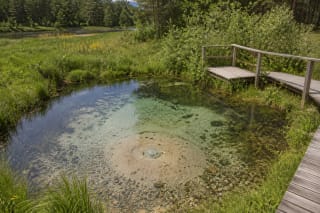
Saugoma.lt highlights relict small lakes, sandy islands, and islets that are remnants of inland dunes. The raised bog is ringed by forested inland dunes, so the Čepkeliai landscape is not just a flat reedbed.
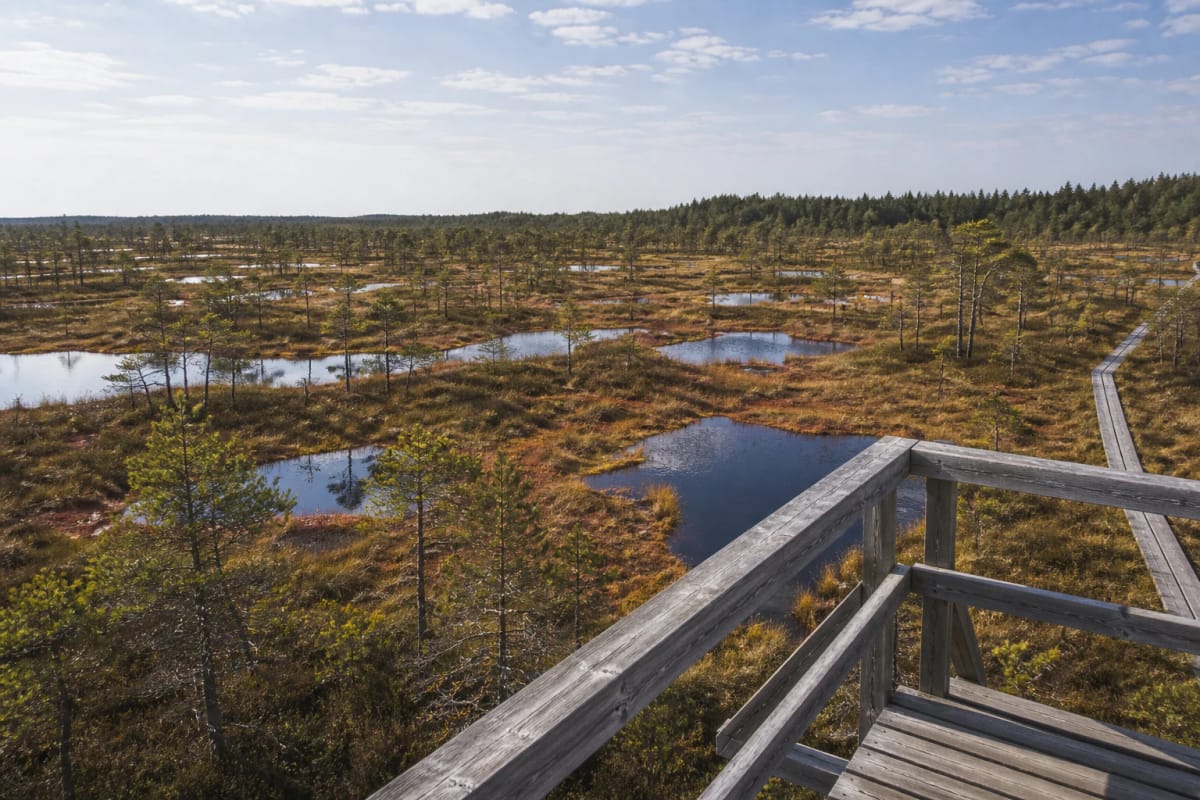
In the open mire you can see dark bog lakes, sphagnum mosses, heather, cranberry patches, dwarf pines, and mineral islands. This mosaic is important for birds, reptiles, insects, and mire plants. Saugoma.lt records 183 bird species in the reserve, including Lithuania's largest surviving populations of capercaillie, cranes, and great snipe, as well as 41 mammal species; Čepkeliai forests are one of the country's main winter grazing areas for elk.
Čepkeliai also has a cultural layer. Saugoma.lt mentions 15 surviving hollow pines in the reserve, relics of old tree beekeeping, and eight Stone Age settlements found on the islands and nearby, included in the Register of Cultural Property. They show that people have lived here since very ancient times.
The Čepkeliai educational trail
The key visitor infrastructure is the Čepkeliai educational trail. Saugoma.lt gives the trail coordinates as 54.021751, 24.427337 and describes access rules that depend on the season.
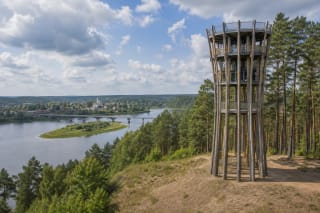
The trail lets visitors see the mire edge, pine forest, more open bog areas, and viewing infrastructure, but it does not cross the whole reserve. That is intentional: the best of Čepkeliai is protected not from human eyes, but from excessive trampling.
When you may visit
According to the rules provided by Saugoma.lt, from March 1 to August 1 the educational trail may be visited only when accompanied by a directorate specialist. From August 1 to March 1 the trail may be visited independently, but only along the marked route and during daylight hours.
Before going, check the latest information from Dzūkija National Park and the Čepkeliai Reserve directorate, because reserve access rules can be adjusted for nature protection, trail condition, or border-zone requirements.
How to behave in the mire
Do not step off the boards or marked route, even when the surface looks dry. A raised bog surface is sensitive, and waterlogged places may lie under the sphagnum mat. Leaving the trail can also disturb nesting birds.
Bring comfortable footwear, water, mosquito protection, and patience. Čepkeliai reveals itself slowly: by listening to the sounds of the mire, looking at small plant forms, and not expecting a loud entertainment route.