- Place
- Griežionėlės, Anykščiai District Municipality
- Region
- Anykščiai District
- Type
- wooden memorial homestead built around 1820, preserving a hidden cache for banned Lithuanian publications, Didžiuliai family objects, and an exhibition on book smuggling
- Address
- 1 Griežionėliai Village, LT-29330, Anykščiai District
- Coordinates
- 55.63438, 25.02436
- Visit duration
- 45-75 minutes; about 1.5-2 hours with an education session and a separate stop at the Didžiuliai graves in Padvarninkai
- Best time
- May, June, or September after confirming the visit by phone; the exhibition is temporarily closed in July 2026
Didžiuliai Homestead Museum, Didžiuliai Memorial Homestead, L. and S. Didžiuliai Museum
The house, built around 1820, is an exhibit rather than merely its container
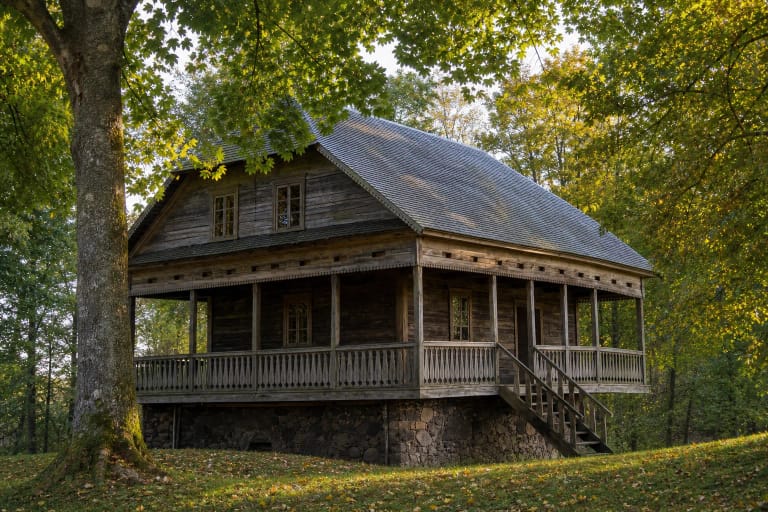
The Didžiuliai family house was built around 1820, with a south-eastern extension added around 1880. It is a long, low example of vernacular architecture, with log walls, porches on the north and south sides, and a half-hipped roof covered in wooden shingles.
Rooms are arranged in an enfilade around a central chimney containing a smokehouse. Look beyond the display cases: aligned doorways, junctions between old walls, the chimney, and the later extension show how the family home evolved before it became a memorial exhibition.
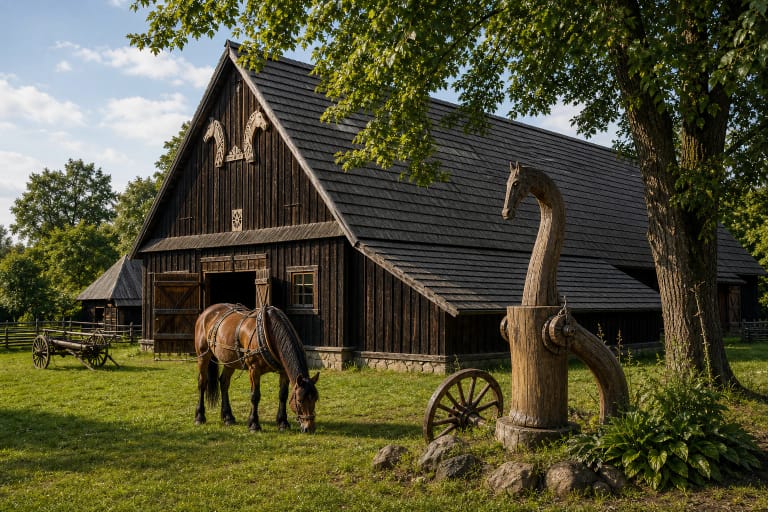
The homestead is listed in the Cultural Heritage Register as complex 10478. It comprises the house, separately numbered 33364, and the combined barn and carriage house, numbered 33453. In 2025, the Cultural Heritage Department initiated the process of declaring the complex state-protected, so this should not be misreported as a status change completed long ago.
An entrance-hall cupboard concealed a real banned-press cache
During the 1864-1904 ban on Lithuanian publications in the Latin alphabet, book-smuggling routes converged at Griežionėlės. Members of the Garšviai network, including Jurgis Bielinis and Kazimieras Ūdra, brought publications from Tilsit and Ragnit; the homestead gave them food and lodging before the publications were redistributed.
A surviving old cupboard in the entrance hall concealed access to a cavity between the walls. Banned Lithuanian publications were stored there before distributors including Jonas Šaučiūnas, Juozas Mickūnaitis, Juozas and Jurgis Baranauskas, Juozas Maldžius, and Antanas Justinavičius carried them into nearby and more distant communities.
This was a documented function of the house, not a later legend. The museum's virtual exhibition says unexpected searches by tsarist gendarmes led Liudvika Didžiulienė to destroy some of her manuscripts, while legally held books taken for censorship could be sent as far as Saint Petersburg and were difficult to recover.
The Lithuanian studies library and the work of Liudvika and Stanislovas Didžiuliai
From 1870, Stanislovas Didžiulis secretly built a Lithuanian studies library, distributed Aušra and other Lithuanian publications, collected folklore, and compiled bibliographic indexes of Lithuanian print and Lithuanica. The museum describes it as the richest Lithuanian studies library in the provinces at the time; Jonas Jablonskis, Jonas Basanavičius, Mykolas Biržiška, and Mečislovas Davainis-Silvestraitis used it. Before his death, Stanislovas transferred its most valuable part to the University of Lithuania.
Liudvika Didžiulienė-Žmona settled at Griežionėlės in 1877, distributed banned publications, collected folklore, and published stories and journalism in Varpas and Ūkininkas. VLE highlights her story Dėl tėvynės, novella Atgajėlė, play Lietuvaitės, and memoir Ką aš beatmenu. From 1896 to 1907 she ran a hostel for Lithuanian pupils in Jelgava, and during the First World War worked in a hospital and organised Lithuanian cultural activity in Yalta.
Reliable sources disagree on Stanislovas's birth date. VLE gives 20 November 1850, while a parish register entry newly reported by the museum in 2013 records 14 November 1856; the museum's current page also uses 1856-1927. One date should therefore not be repeated as undisputed without acknowledging the conflict.
The exhibition opened in 1968 and tells the story of an entire family
The memorial museum opened in the homestead in 1968. Its story extends beyond Liudvika and Stanislovas to their children, who included writers, doctors, a translator, and a teacher. For the museum's fiftieth anniversary in 2018, new panels were added on family relationships and Stanislovas's personal library.
Displays include photographs of the family and their circle, copies of Liudvika's manuscripts, letters, books, issues of banned publications, dishes, needlework, and her dress. Original family furniture survives in the neighbouring room: a piano, chest, bed, small table, mirror, and paintings. The central object, the cupboard and cavity behind it, is best understood with a museum guide's explanation.
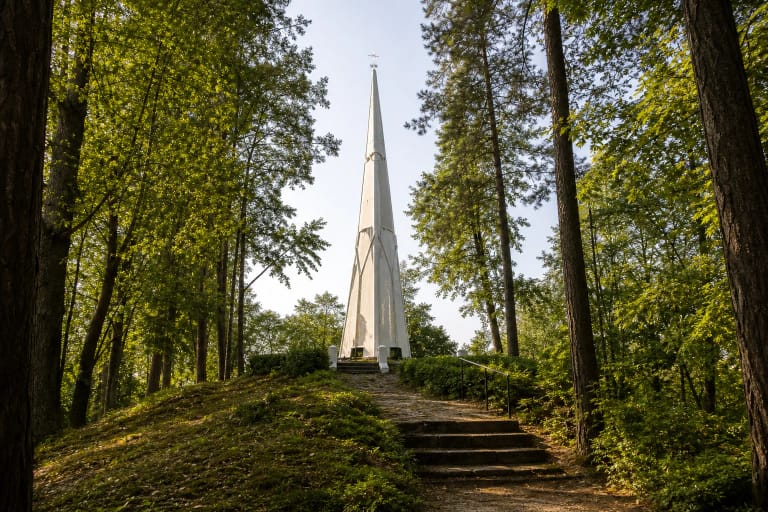
Liudvika and Stanislovas are buried near the homestead in the old burial ground on Padvarninkai Hill, consecrated by Juozas Tumas-Vaižgantas. The graves are not inside the museum exhibition, so plan them as a separate respectful stop and do not seek shortcuts across private land.
The July 2026 closure takes precedence over the regular timetable
On 29 July 2026, the official museum website stated that the exhibition was closed throughout July because the museum attendant was ill. This temporary exception overrides the regular timetable printed on the same page. Call the official number before travelling to confirm that the exhibition has reopened.
The regular schedule published for May-October is Tuesday-Saturday, 8 am-5 pm; from November to April, visits are by prior arrangement. The listed tour price is €2, with a €1.50 concession and a €5 family ticket; the education session is €3, or €2 concession. Recheck hours, prices, and eligibility before visiting because all can change.
The homestead is in the secluded settlement of Griežionėlės at 1 Griežionėliai Village. The official coordinates 55.63438, 25.024363 mark the museum complex itself. No detailed step-free route, adapted toilet, or guaranteed visitor-parking arrangement is published, so discuss mobility needs, thresholds, assistance, and parking before the journey.