- Place
- Anykščiai, Anykščiai District Municipality
- Region
- Anykščiai District
- Type
- two-writer memorial homestead with a historic granary, an authentically preserved house, and a stone-painting exhibition
- Address
- 2 A. Vienuolio Street, Anykščiai
- Coordinates
- 55.52701, 25.09779
A. Baranausko ir A. Vienuolio-Žukausko memorialinis muziejus, Baranauskas and Vienuolis Museum, Antanas Baranauskas Granary, Antanas Vienuolis Memorial House
One Anykščiai museum comprises three exhibitions at two nearby addresses
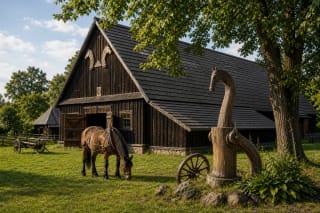
The principal memorial homestead stands at 2 A. Vienuolio Street, coordinates 55.5270124, 25.0977935. The green timber house of Antanas Vienuolis shares the grounds with the Baranauskas granary, now enclosed by a protective pavilion. Stanislovas Petraška's stone-painting gallery is a short distance away at 6A Muziejaus Street, so a combination ticket does not mean three rooms inside one building.
This is more than a paired literary biography. Vienuolis himself collected objects associated with his relative Baranauskas, protected the granary, and received visitors between the wars; his own home later became a memorial in turn. The authentic homestead, grave, original furniture, and separate exhibition by a modern folk artist create several different layers of interpretation.
A crucial exception applies on 13 July 2026: the granary's protective pavilion is being repaired and its display renewed. The official closure runs until 1 August 2026. The Vienuolis house and Petraška gallery are separate spaces, but visitors should call ahead to confirm the day's available route and precisely what the ticket currently covers.
The 1826 granary was hewn without a saw or nails and moved across the Šventoji in 1839
The poet's father, Jonas Baronas, built the granary at Jurzdikas in 1826 and carved the date into its door frame. Its timbers were worked with an axe alone, without a saw or iron nails. As a working farm store, it held flax, better clothing, tools, and grain; chalk marks recording household calculations still survive on the frame.
The family dismantled the building in 1839 and transferred it to its present site at Ažupiečiai on the opposite bank of the Šventoji. Larger numbered logs were floated along the river and smaller parts carried. This move explains why an agricultural building of 1826 now stands beside Vienuolis's house of 1925, although the two originated in different homesteads.
While studying at the seminary in Varniai, Baranauskas read and worked in the granary during his holidays. He wrote the two parts of his poem Anykščių šilelis, known in English as The Forest of Anykščiai, here in the summers of 1858 and 1859. The structure therefore matters not as a generic tableau of rural life but as the documented birthplace of a particular work.
Vienuolis opened the granary in 1927 and began Lithuania's first memorial museum
Antanas Žukauskas-Vienuolis inherited the Baranauskas homestead plot in 1921 and undertook to preserve the granary. He collected objects belonging to the poet and family, including furniture, a suitcase, violin, bed, dowry chest, shelf, and weapons associated with the 1863 Uprising. They gave the building memorial content, though not every object belonged to its original agricultural use.
On 1 May 1927, Vienuolis began a visitor book and formally opened the collection. The institution identifies it as Lithuania's first memorial museum. From 1945 until his death in 1957, Vienuolis served as its official director, making the site's creator, custodian, and first guide one and the same person.
Construction of a pavilion to protect the granary began in 1957 to a design by architect Ignas Kvašys and ended in 1958, after Vienuolis's death. The timber structure itself was conserved in 1976. The shell shelters a fragile building from precipitation and changing temperatures, but also alters its appearance: visitors first see a twentieth-century pavilion, with the old granary revealed inside.
The house of 1925 preserves Vienuolis's study at the time of 17 August 1957
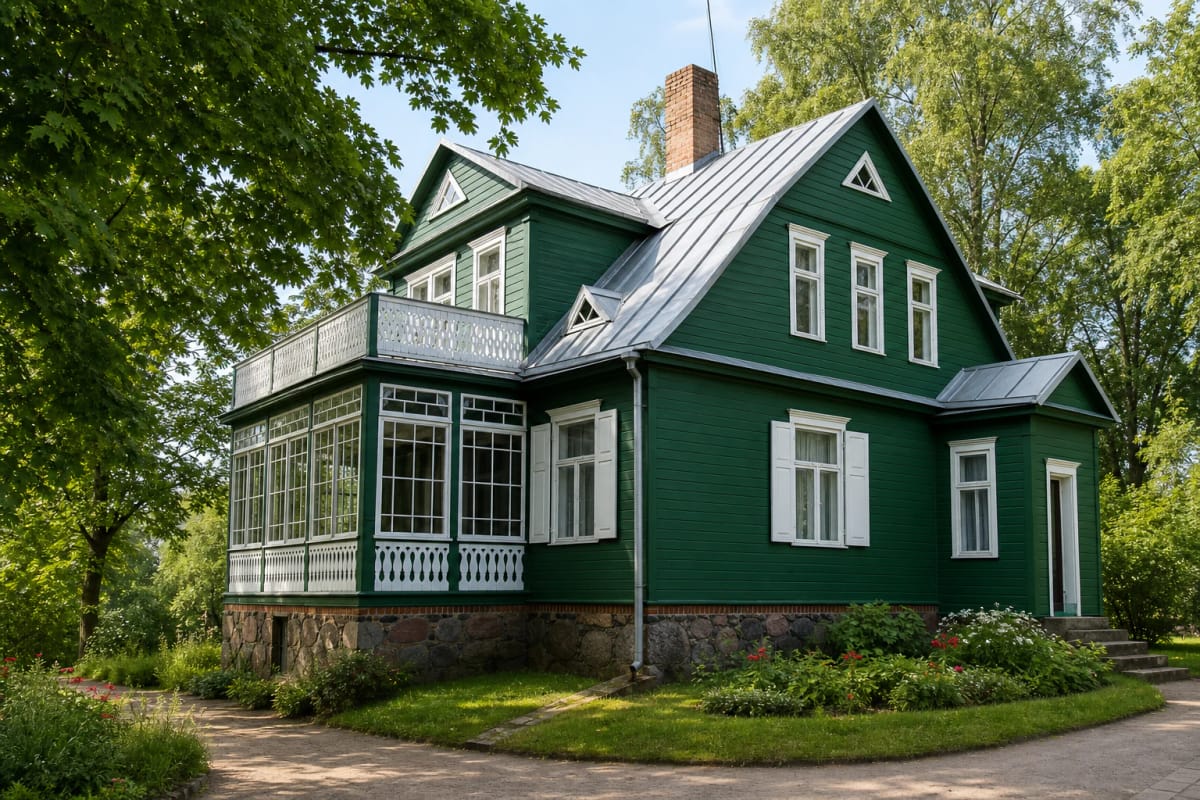
After approximately twenty years abroad, Vienuolis returned to Anykščiai in 1922 and designed a family home with his wife on the inherited Baranauskas property. Completed in 1925, the green timber house has white window trim, a glazed veranda and balcony, several gables, a sheet-metal roof, brick chimney, and fieldstone base. The writer lived here until his death.
The ground floor interprets his intertwined lives as writer and pharmacist, his travels, public activity, and experience of the Caucasus. Memorial rooms upstairs include the study, Leokadija's room, the foster children's room, and a small kitchen. An open book, spectacles, calendar leaf dated 17 August 1957, and clock stopped at 15:50 deliberately reconstruct a moment from his last day.
Vienuolis wrote or completed works including Kryžkelės, Prieblandoje, 1831 metai, Tvirtovė, and Išdukterė at this desk. The interior also contains his portrait by Adomas Varnas, portraits of the children by Kazys Šimonis, and Viktoras Vizgirda's painting Mikalojaus bažnyčia. These details reveal a specific working environment and family art collection rather than a vaguely frozen domestic scene.
The garden grave and Petraška's pictures made from stone extend the literary memorial
Vienuolis was buried in the homestead garden, as requested in his will of 1955. He wanted a fieldstone marked by a cross, but Soviet authorities refused permission for the cross in 1957. It was finally placed on the monument and blessed on 13 June 1989, so the grave seen today reflects both the original wish and its late historical restoration.
The writer's house opened to visitors in January 1958, after his death, and the granary and house were merged as one institution on 1 December 1962. The house was restored in 1982. A neighbouring administration and exhibition building was added later and renovated in 2021, while the memorial rooms retain the deliberately protected scale of a lived-in home.
The museum's third component presents Stanislovas Petraška, who lived from 1935 to 2009. His so-called stone painting uses no paint: rock of different colours is crushed and sieved, then the grains are glued to a support. One picture required three to six months, and recurring subjects include Anykščiai, the Šventoji, Puntukas, local writers, the forest, and other Lithuanian landscapes.
The daily summer schedule varies, while combination admission cost EUR 4 in 2026
The official summer notice for June-August 2026 lists Monday-Friday 08:00-17:00, Saturday 10:00-18:00, and Sunday 10:00-17:00. An older permanent visitor page lists 08:00-17:00 on September weekdays, 10:00-18:00 Saturday, and 10:00-17:00 Sunday, followed by daily 08:00-17:00 from October through May. Holiday exceptions and renewal works change, so verify opening on the official site.
The 2026 tariff set combination admission to the granary, Vienuolis house, and Petraška exhibition at EUR 4, with a EUR 3 concession and EUR 11 family ticket for three to eight people. One selected exhibition cost EUR 2 or EUR 1.50 concession. The tariff does not explain which combination the desk sells while the granary is closed, making direct confirmation necessary.
Historic thresholds and narrow spaces affect both the house and granary, while the official website offers no comprehensive step-free route description. Contact the museum on +370 686 47099 about a wheelchair, individual help, or a group visit. On 13 July 2026, the Google Maps entry carried 233 reviews averaging 4.7 out of 5; the figure will change.