- Place
- Vilnius City Municipality
- Region
- Vilnius
- Type
- late Baroque church and concert venue
- Address
- Vilniaus g. 30, Vilnius
- Coordinates
- 54.68180, 25.28120
St Catherine's Church in Vilnius
A Baroque ensemble on Vilniaus Street
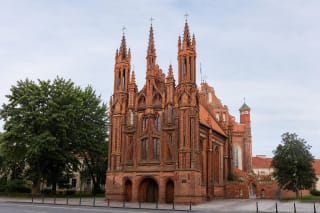
St Catherine's Church stands on Vilniaus Street, one of the busiest old-town routes, and belongs to a sixteenth- to nineteenth-century architectural ensemble joining the church and Benedictine convent. Its vertical twin-towered facade, with five-tier towers and Rococo decoration, is one of the city's most recognizable Baroque silhouettes.
The church is Baroque, single-naved, with a centrally planned Chapel of Divine Providence on the southwest side. Inside are nine late Baroque altars with sculptural Rococo decoration, a pulpit and baptismal font with Baroque and Rococo sculptures, and the memorial plaque of J. and E. Valavičiai from 1769.
From the Benedictines to Glaubicas
In 1619-1621, Grand Hetman Jonas Karolis Chodkevičius built a small church for the Benedictine nuns who had settled in Vilnius; it was consecrated in 1632. In 1640-1650 two naves were added, one wide and one narrow for the nuns' prayers. In the mid-seventeenth century the church burned during the war with Russia, was rebuilt in 1670-1694, consecrated in 1703, and badly damaged again in the great Vilnius fire of 1737.
The present form was created in 1741-1753 by Jonas Kristupas Glaubicas, the renowned architect of the Vilnius Baroque school. He raised the towers to five tiers, built ornate gables, constructed the interior vaults, and rebuilt the chapel. In 1752-1753 the altars and chapel were decorated by artists J. Herdegen, J. Woszczyński, and the Hedel brothers, and in 1761 a Baroque organ prospect was installed.
The convent ensemble and its treasures
The convent's two- and three-storey wings surround three enclosed courtyards. Rooms are covered by barrel vaults with lunettes, cross vaults, and crystal vaults; the facades have pilasters, and the southwest wing has an ornate Baroque portal. The ensemble also includes sixteenth-century buildings, among them the S. Kęsgaila Palace.
In 1759, fifteen paintings by Szymon Czechowicz were brought from Kraków to the church and convent; surviving works are kept by the Lithuanian Art Museum. The church was damaged during the events of 1812 and the Second World War, many artworks disappeared, and in 1945 the Soviet authorities deported the remaining nuns and turned the building into a warehouse.
Concert space since 2006
Since 2002 the church has belonged to the Vilnius Archdiocese curia, and after restoration it opened in 2006 as a cultural and concert venue. The main nave was adapted for concerts, so sacred acoustics now meet the city's cultural programme. It is one of the clearest examples of how Vilnius links heritage with living culture.
A concert schedule is not the same as regular museum opening hours, so entering the interior depends on the official event programme or guided-visit opportunities. Even when attending a concert, arrive early enough to look at the facade, towers, and interior as heritage.
What to see even without a concert
Even if you cannot enter, the exterior deserves a stop. From Vilniaus Street you can study the twin-towered Baroque facade, the silhouette of the towers, and the church's relationship with the narrow old-town fabric; the small square by Vilniaus Street lets you view it from farther away.
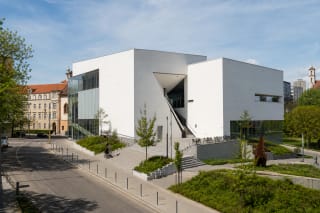
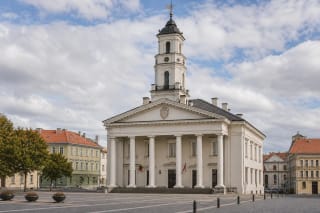
The church combines well with MO Museum, cafes on Vilniaus Street, the university ensemble, and the route toward Town Hall Square. It is a good example of how a Vilnius culture walk can join the old and contemporary city.