- Place
- Žvirgždėnai, Daugai eldership, Alytus District Municipality
- Region
- Dzūkija
- Type
- a state-protected botanical natural heritage object - a low roadside pine with an exceptionally broad crown
- Address
- Beside Road 1104 Daugai-Ūta, Žvirgždėnai village, Daugai eldership, Alytus District
- Coordinates
- 54.40215, 24.34192
- Visit duration
- 15-30 minutes to view the silhouette, trunk, and roadside setting from a safe distance
- Best time
- a dry spring or summer morning, when the crown is clearly lit and visitors are easier for drivers to see; avoid storms, strong winds, and darkness
Žvirgždėnų pušis, Ghost Pine
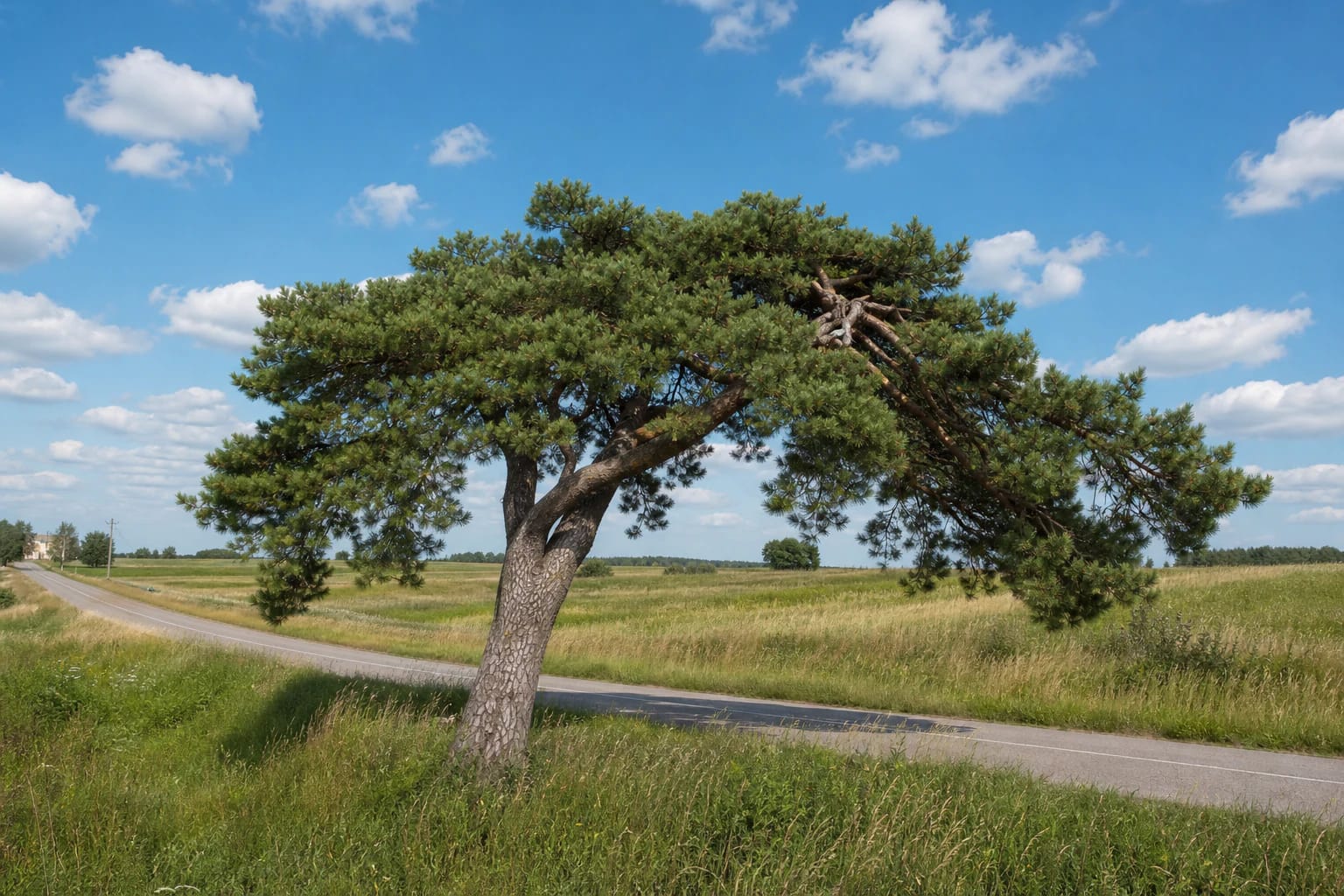
Žvirgždėnai Pine Tree is recognised by its umbrella-shaped crown, not by record-breaking height
Žvirgždėnai Pine Tree stands neither deep in woodland nor in a designed park, but beside an open village road about 3 kilometres from Daugai. It is visible from district Road 1104 Daugai-Ūta, at Žvirgždėnai, immediately beside the asphalt among meadows and scattered homesteads. A visit is therefore a short roadside stop rather than a walk along an interpretation trail.
Historic and more recent photographs show a highly distinctive silhouette. A thick trunk leans upwards, divides into several heavy directions at a low height, and sends long limbs almost horizontally across the sky. From the side, the crown resembles a broad green umbrella: its span and low branch lines create a stronger sense of scale than the top of the tree.
The exact Google Maps place has ID ChIJOXAKRL-t4EYRAuJ8HQWG4B8 and marks 54.4021542, 24.3419232. This differs by only a few metres from GPS points published in regional guides, so visitors should navigate to the named attraction rather than merely to the centre of Žvirgždėnai.
A height of 13-14 metres is a useful guide, but the different trunk figures cannot be merged
A 2017 guide to the Alytus area describes the tree as 13 metres high with a trunk diameter of 1 metre. Another widely circulated description gives a circumference of 2.6 metres measured at 1.3 metres above ground and a total height of 14 metres. Both sets suggest a low, thick-trunked tree rather than an exceptionally tall pine.
Those figures cannot simply be converted into one precise current measurement. A diameter of 1 metre would imply a geometrical circumference greater than 2.6 metres, yet the public descriptions provide no measurement date, chosen trunk position, tape direction, or explanation of rounding. This guide therefore presents 13-14 metres as a height range and keeps the diameter and circumference claims visibly separate.
The official VSTT and legal lists checked for this page call the object simply Žvirgždėnai Pine Tree; they give no exact species, age, or planting year. One local media account says a Žvirgždėnai resident named Milius planted it, but no planting date, archival record, or dendrological study was found to corroborate that statement. Neither the named planter nor a precise age should therefore be repeated as established fact.
Protection dates back to the twentieth century, while the current status rests on a valid 2022 order
Alytus regional publications consistently say the pine first received protection in 1960. Continuity is also visible in the 2000 national list of protected natural landscape objects, which names Žvirgždėnai Pine Tree, Alytus District, and Žvirgždėnai village. This is a documented protection history, although the category names used at the time are not identical to today's system.
The present legal basis is Environment Minister Order D1-184 of 14 June 2022, in a consolidated edition current from 12 September 2025. Žvirgždėnai Pine Tree appears among protected botanical objects as item 1.5.417, and its boundary scheme is approved under item 2.700. The same order repealed the former 2002 list, which is why current status should be read from the newer act rather than only from old visitor brochures.
VSTT's Alytus District list, updated in 2025, places the pine among botanical natural heritage objects. Some visitor texts use the more attractive phrase natural monument, but the precise wording in the current official lists checked here is a state-protected botanical natural heritage object. Protection concerns more than timber: digging around roots, carving bark, fixing objects to the trunk, and climbing the limbs are incompatible with preserving the site.
Beggars' coins and ghosts are local stories, not a verified catalogue of archaeological finds
The best-known story grows directly from the roadside setting. Beggars are said to have sat beneath the pine and asked travellers for alms. Coins tossed by passers-by supposedly vanished into the road dust, and local residents are said still to find some today. The tale explains why money became part of the tree's identity, but it is not a dated account of a coin hoard or an archaeological excavation.
A second story gave the landmark its Ghost Pine nickname. In a version recorded by an Alytus regional museum specialist, local people supposedly avoided passing after dark because they said the place was haunted. The wording is deliberately that of oral tradition: no named witness, date, or event is supplied for historical verification.
Both stories can be understood as roadside memory of an old route, almsgiving, and a place that felt different at night. Legend is not permission to dig within the root zone, search for coins with a metal detector, or leave modern money under the tree. The best way to encounter the tale is to observe the landmark and read its story without changing the site itself.
In 2024, the tree's name became an Alytus District symbol at Lithuania's Song Celebration
Žvirgždėnai Pine Tree lives beyond old legends. At the 2024 Lithuanian Song Celebration, Alytus District Municipality placed a pine sapling associated with this natural heritage object on the municipalities' table of local treasures. The municipality said the sapling would be planted in Daugai as a symbol of Lithuania, the Song Celebration, and Žvirgždėnai Pine Tree.
The official notice does not say that the sapling was a clone of the old tree or grown from one of its seeds, so no genetic connection should be inferred. What matters is the symbolic selection: a modest roadside tree at Žvirgždėnai was chosen to represent the district at the centenary Song Celebration. Its value therefore rests not only on trunk measurements but also on community memory.
A 24-hour map label does not provide a parking area, and daylight is the safest time to stop
On 15 July 2026, Google marked the place as accessible 24 hours a day, while the official sources checked listed no ticket, office, gate, or fixed opening hours. This is an outdoor tree beside a road, so visitors should not expect an admission charge. The map schedule is not a guarantee that stopping will be safe at every hour; check the current card, weather, and local signs before travelling.
Photographs do not show a large dedicated visitor car park beside the tree. Do not stop in the traffic lane, on a bend, or where a homestead entrance would be blocked; leave the car only in a legal, sufficiently wide, clearly visible place. Cross the road only when drivers can see you, and never step backwards into traffic while composing a photograph.
The Alytus visitor directory marks the attraction as suitable for disabled visitors but gives no dimensions for a bay, path surface, gradient, or kerbs. The tree is beside the road and requires no stairs, yet the final metres cross a grassy verge. A wheelchair or walking-frame user should check present ground conditions and visit with a companion.
The exact card showed a 5.0 out of 5 average from 11 reviews on the same verification date. This clears the 4.5 threshold, but one new rating can noticeably move such a small sample. Allow 15-30 minutes; in strong winds or a storm, do not linger beneath the wide, heavy limbs or attempt to climb the trunk.