- Place
- Marcinkonys eldership, Varėna District Municipality
- Region
- Dzūkija National Park
- Type
- Dzūkija National Park village by the Skroblus with a barn theatre
- Coordinates
- 53.99965, 24.28664
Margionys
Margionys by the Skroblus source
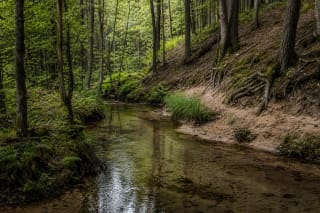
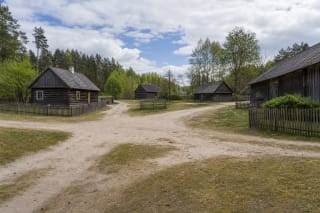
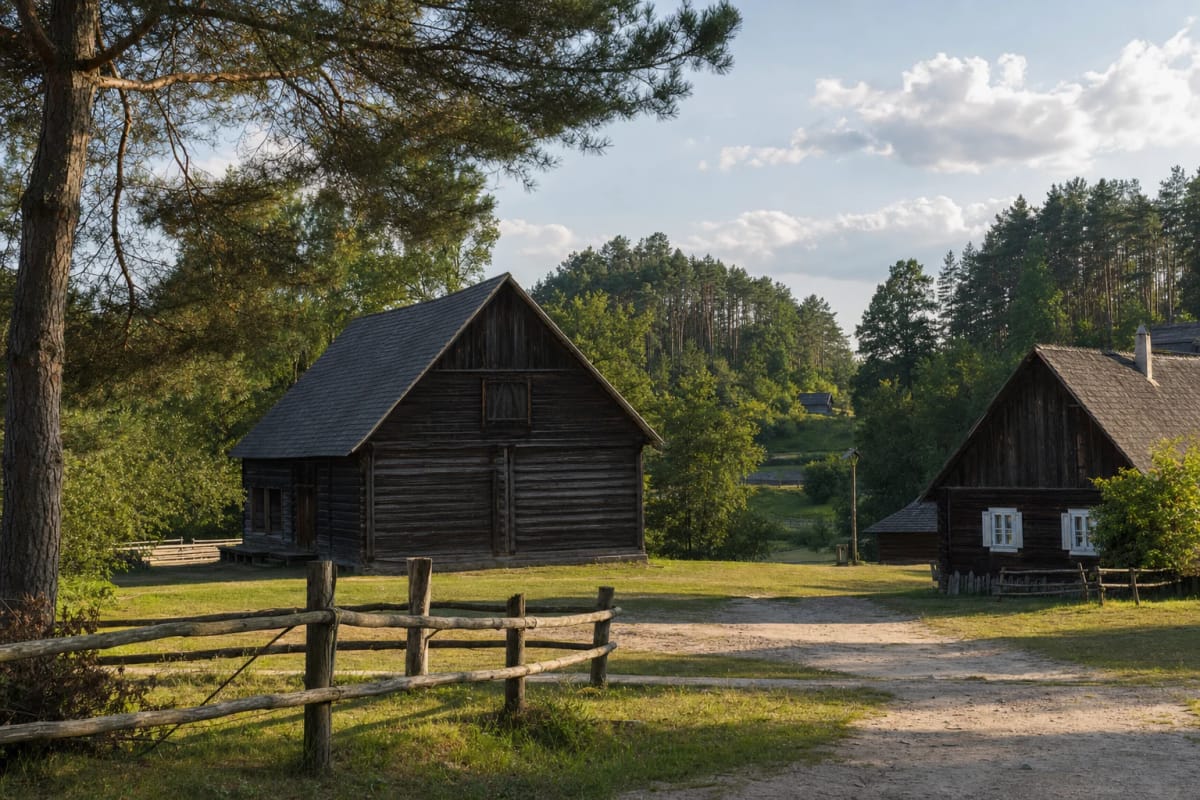
Margionys is a village in Dzūkija National Park, in Varėna District, Marcinkonys eldership, on the edge of Dainava Forest. It is closely tied to the Skroblus stream, because the river's source lies by Margionys in a marshy thermokarst hollow. VLE says Skroblus begins by Margionys, 9 km southwest of Marcinkonys, and is one of Lithuania's cleanest rivers.
For travellers, Margionys is not only a theatre stop or only a spring stop. It is best understood as a small route node where nature and village culture meet: from the village road you can walk to the Bobos daržas springs, follow the Skroblus valley direction, and return to the barn theatre and local memory. According to VLE, the entire Skroblus flows through Dzūkija National Park, so Margionys is the natural beginning of this valley.
Bobos daržas springs: Dzūkija's most beautiful spring
The main natural object in Margionys is the Skroblus springs, called Bobos daržas by local people. Saugoma.lt describes them as the most beautiful spring of the Dzūkija region, where underground water rises from deep intermorainic layers through small hollows that local people call burbaklės; a wooden path crosses the wet hollow to the spring. VLE states that the Skroblus springs are a hydrogeological natural heritage object and natural monument.
The springs also have an old local story. Saugoma.lt gives a legend that in this spring an old woman supposedly pulled all the children of Margionys village out of the water, which explains the name Bobos daržas. Keep that story separate from documented nature: it is a legendary name explanation, not historical fact, but it shows how deeply the spring is rooted in village self-understanding.
The Skroblus valley and Lietuvis Lime
VLE states that Skroblus flows north through the Dainava Plain, its natural channel 3-4 m wide and winding, with spring-rich and forested banks and a distinct valley that is in places 600-700 m wide and marshy. The upper course belongs to Kapiniškiai Landscape Reserve, while the middle course and part of the lower course belong to Skroblus Nature Reserve, so the stream that begins at Margionys quickly enters strictly protected nature.
VLE also notes that near the springs in Margionys grows Lietuvis Lime, a botanical natural heritage object and natural monument. The whole valley is encircled by the 13 km loop Skroblus Nature Trail, making Margionys not just a village but a convenient starting point for the whole Skroblus route. Stay on trails and protect wet spring-rich edges.
Margionys Barn Theatre since 1929
Margionys is best known for its barn theatre, one of the strongest phenomena of Lithuanian village theatre. The theatre history page states that the first acting group formed in 1929, when Teofilis Sukackas, teacher of Margionys primary school, staged A. Vilkutaitis-Keturakis's comedy Amerika pirtyje. VLE recalls that barn theatre in Lithuania gave rise to Lithuanian evenings and lasted longest in the Polish-ruled Vilnius region, to which Margionys belonged between the wars.
The central figure became local creator Juozas Gaidys, who died in 1992: poet, singer, artist, director, and playwright. He revived theatre evenings in the village during the Second World War, wrote the Margionys village anthem and Song about Skroblus, and premiered his play Ašarų pakalnė in the barn on June 20, 1941. Gaidys's work is now viewed as cultural resistance to Polonization, and since 2011 the village-theatre festival Citnaginė has been held in his memory.
Fire, rebuilding, and living tradition
The theatre history is also marked by loss. Margionys Barn Theatre sources state that a separate theatre building was built in 1991-1993, but it burned down during the night of September 9-10, 2022; after the fire, fundraising and community efforts to rebuild began. This reminds visitors that living village culture is fragile and depends first of all on local people.
Margionys is often named in connection with living Dzūkija village traditions: singing, community gatherings, theatre, and Vėlinės customs. The separate Margionys Barn Theatre page lets readers go deeper into stage history, while this village page should make clear that the theatre grew from a specific community's language, humour, and pain. If you travel for an event, check the programme in advance.
How to visit Margionys
Margionys village has no single opening time or ticket. Barn theatre events, tours, and park routes have their own rules, so before going check official Dzūkija National Park and theatre pages. For a short visit, the village and Bobos daržas springs are enough; for a longer visit, choose the loop Skroblus Nature Trail with wet sections, springs, and homestead landscape.
Walk public roads, respect residents, do not enter yards without permission, and do not park so that you block access. When going to the springs, stay on the wooden path and protect wet edges. Margionys combines well with Dubininkas, Marcinkonys, and the Skroblus trail, becoming part of the whole Skroblus valley cultural landscape.