- Place
- eastern edge of Margionys village, Marcinkonys eldership, Varėna District Municipality
- Region
- Dzūkija National Park
- Type
- spring group and start of a nature trail
- Coordinates
- 53.99965, 24.30080
Bobos Daržas, Bobos Daržas spring, Skroblus spring, Birono duobelė, Ploksco duobelė
The beginning of the Skroblus near Margionys
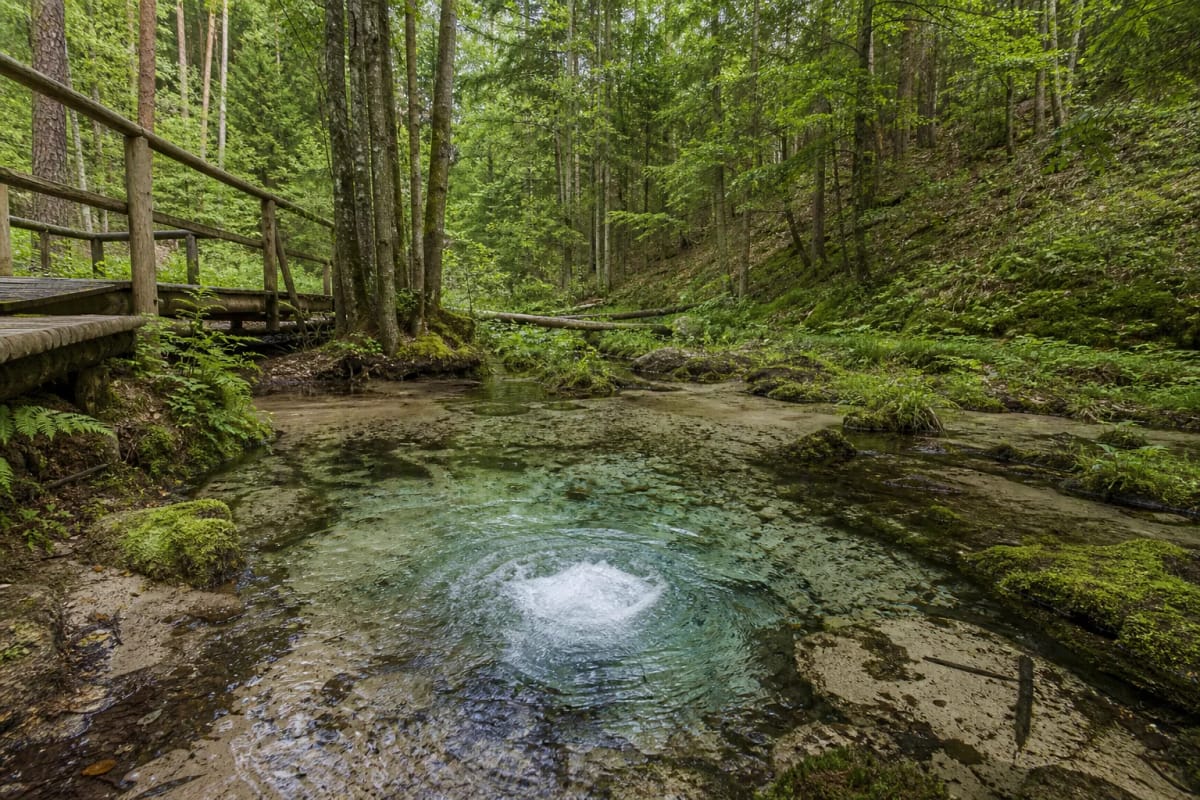
The Skroblus Springs are in Kapiniškiai Landscape Reserve of Dzūkija National Park, at the eastern edge of Margionys village. This is the upper Skroblus valley, where underground water rises to the surface through springs and small watery hollows.
Visitors know the Bobos Daržas spring best, but VLE describes a broader spring zone: Bobos Daržas, the Skroblus spring, Birono duobelė, and other watery points. The place is therefore better called a source area, not one spring only.
Thermokarst hollow
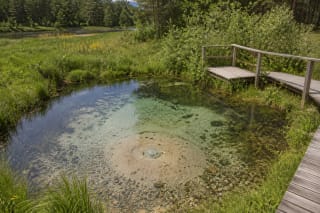
VLE states that several springs issue in a 5.64 ha marshy hollow of thermokarst origin. Water flows from fluvioglacial deposits, and part of the flow may be supplemented by confined intermorainic water.
This explains why the water here looks so steady and cold: the springs are not surface runoff from a puddle. VLE gives a water temperature of 7.4-9.0 C and discharge of 3-8 l/s.
Bobos Daržas and local stories
Saugoma.lt presents the Bobos Daržas spring as the source of Skroblus, the most beautiful Dzūkija stream. A boardwalk lets visitors approach the marshy hollow, where water flows from a cavity disappearing into the earth's depths.
A local story says that Margionys children used to appear here, pulled out of the spring by an old woman. This is a folklore layer that should stand beside geology, not be confused with the scientific explanation of the springs' origin.
Skroblus Nature Trail
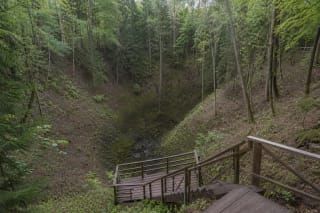
The Skroblus Nature Trail begins at the springs. VLE gives a 13 km loop route with wooden stairs, boardwalks over marshy areas, and shelters.
For a short stop at Bobos Daržas, 30-45 minutes is enough, but the whole trail is a several-hour hike. Before choosing the long route, consider weather, footwear, and return time.
How to protect the springs
The Skroblus Springs are a hydrogeological natural heritage object and natural monument. The most sensitive part is the wet hollow, so it is essential to stay on boardwalks and marked paths.
Do not step into the springs, wade through the source area, trample wet edges, or try to improve access. The most beautiful feature here is the natural, fragile movement of water.