- Place
- Ukmergė District Municipality
- Region
- Ukmergė District
- Type
- protected nineteenth-century manor palace with a privately operated restaurant, accommodation, and events complex
- Address
- 3 Beržų Street, Krikštėnai, Ukmergė District Municipality
- Coordinates
- 55.11924, 24.85895
- Visit duration
- about 1-2 hours for a pre-confirmed restaurant visit and exterior view; accommodation, sauna, and events require their own booking
- Best time
- a restaurant opening confirmed by telephone or a booked event; do not rely on the published table alone, as it contradicted itself on 21 July 2026
Krikštėnai Manor Palace, Roko virtuvė at Krikštėnai Manor
Krikštėnai Manor is not a public museum
The palace at 3 Beržų Street functions primarily as a privately operated hospitality venue. Roko virtuvė advertises a restaurant, event rooms, accommodation, and bookable leisure services, but does not publish a permanent manor-history display, a general ticket to historic interiors, or a regular timetable of palace tours.
That distinction matters when planning a stop. A published restaurant period may give access to a meal, not an automatic right to enter every hall, bedroom, sauna, or part of the private grounds. A closed event can restrict other access. Call +370 604 45255 before travelling and ask specifically whether the restaurant accepts unbooked guests that day and where independent visitors may walk.
The coordinates 55.119235, 24.858949 mark the palace building at 3 Beržų Street. They are not a verified entrance or parking position, which is why the map metadata honestly labels them as a site point.
From the Bogušas estate to Pamerneckis's palace
Sources mention the estate from the eighteenth century as the property of Ksaveras Bogušas, who lived from 1746 to 1820. After he moved to Warsaw, it was managed by Vilnius vice-governor Bagnevskis and later passed to Julijonas Pac Pamerneckis. Ukmergė District Municipality associates Pamerneckis with the mid-nineteenth-century predecessor of the present palace.
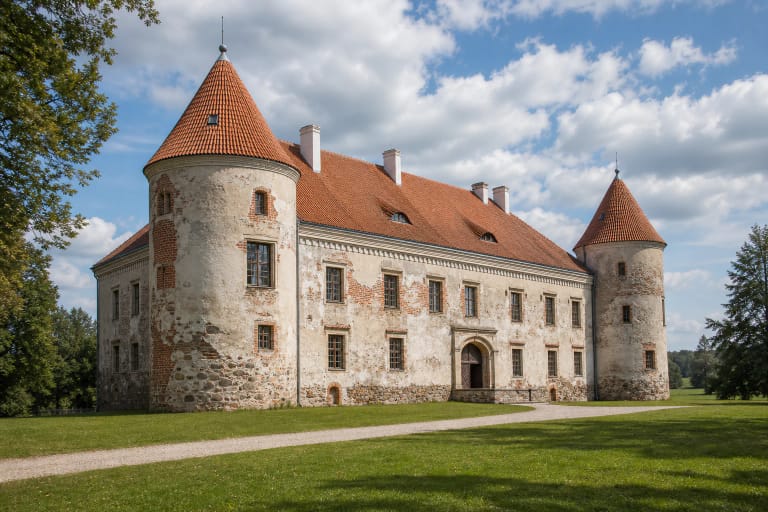
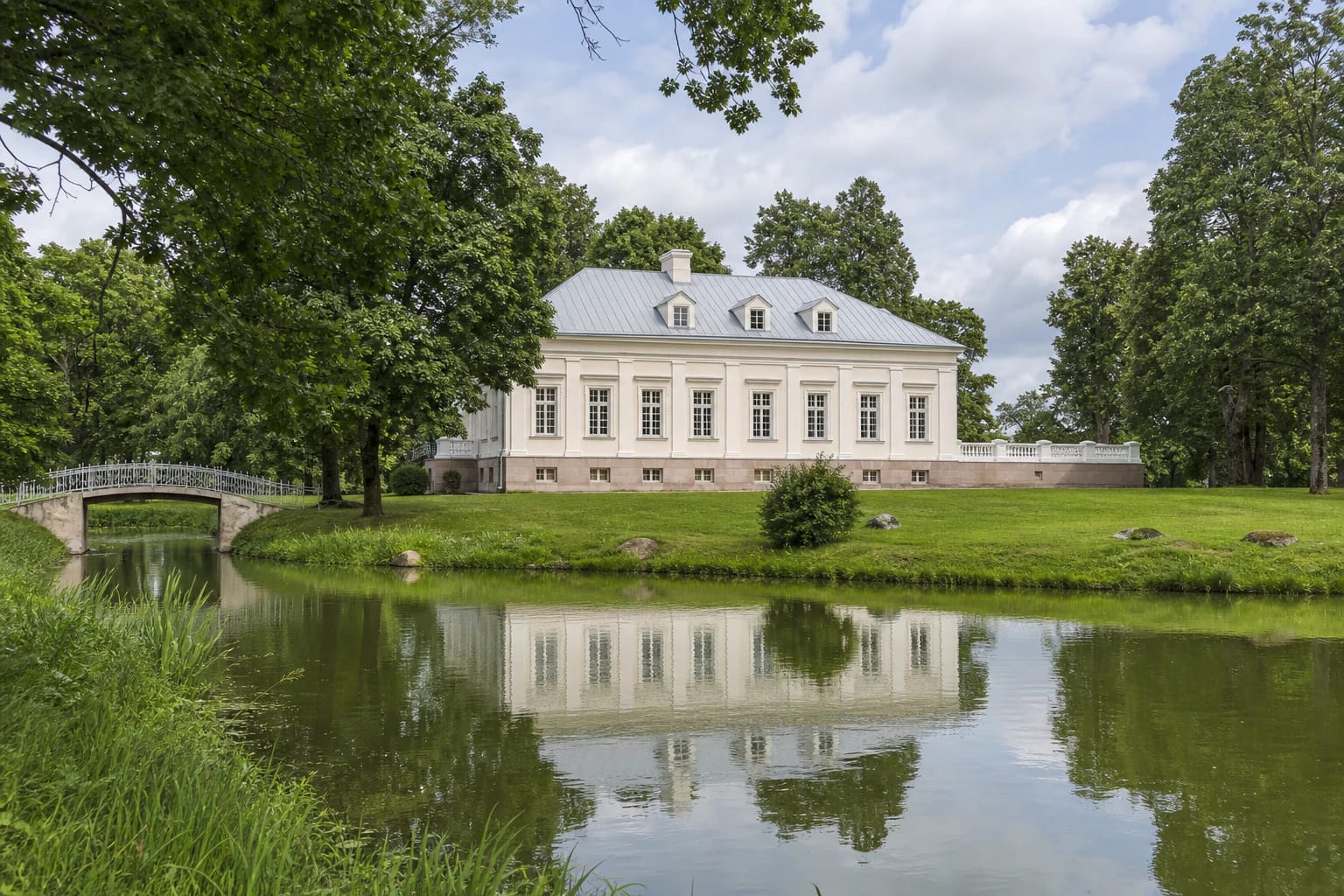
The municipal account describes a rectangular two-storey building with a terrace and balcony and calls it late Baroque. Other descriptions classify the same palace as Classical. It is better to acknowledge this difference in terminology and later alteration than to select the tidier label: the facade seen today was also strongly shaped by twenty-first-century reconstruction.
Cultural Property Register code 793 applies to the Krikštėnai Manor palace, a registered local-level architectural property. It does not make every modern service building, pond feature, or interior decoration on today's grounds part of the protected historic palace.
The de Bondi family, the 1941 killing, and restitution in 1994
Pamerneckis's descendants sold the estate to the de Bondi family, which was of French origin and held it until 1940. Sources disagree over the first buyer's given name and military rank: one names Admiral Ignas de Bondi in Russian imperial service, another Edvardas de Bondi. The sound conclusion is that the estate passed to the de Bondi family around the late nineteenth or early twentieth century; the disputed biographical detail should not be presented as settled.
Ukmergė District Municipality states that owner Eugenija de Bondi was killed by NKVD troops together with other prisoners from Ukmergė Prison on 24 June 1941 in Zarasai District. After the war, the palace was used by the Krikštėnai Soviet state farm, neglected, repaired, and neglected again.
The property was returned to de Bondi heirs in 1994. That date records legal restitution, not the instant return of the palace's earlier appearance or original rooms. Conversion into today's restaurant, accommodation, and events venue occurred in a later phase.
Reconstruction from 2008 and the operator's present role
A university study completed in 2018 named Vladas Algirdas Šemeta as the private owner at that time and recorded renovation beginning on his initiative in 2008. Comparing plans from 1923 and 2010, the researcher found the main palace and three auxiliary buildings on the later plan; a 2017 survey recorded renewed ponds, bridges, planting, and the palace in use for events.
This is useful evidence for the reconstruction period, but a 2018 thesis is not a 2026 land-register extract. The earlier owner is therefore not presented here as the unquestionably current legal owner. Roko virtuvė can be identified as the operator publicly offering services now, but its website alone does not establish title to the real estate.
The restaurant hall, guest rooms, and spaces decorated for celebrations belong to the modern hospitality use. They should be read as an adaptation of a protected building, not as unchanged nineteenth-century de Bondi domestic life or a room-by-room museum reconstruction.
Restaurant hours, booking, prices, and accessibility
On 21 July 2026, the Roko virtuvė contact page simultaneously said that the Krikštėnai restaurant was closed Monday-Saturday and listed Friday 10 am-6 pm, Saturday 10 am-8 pm, and Sunday 10 am-6 pm. Because the first statement contradicts the Friday and Saturday rows beneath it, the table cannot be trusted without a telephone check. Private events, holidays, and seasonal changes may further affect access.
The operator advertises a dining room for up to fifty, a warm-season terrace for up to fifty, accommodation for up to fifty guests, sauna, whirlpool baths, fishing, and active leisure. These are not bundled into a general heritage-admission ticket. Meals, rooms, event spaces, spa use, and other services are booked and priced separately, so request the current offer directly.
The public manor pages provide no reliable detailed audit of step-free access, accessible toilets, lift provision, door widths, or support for blind and Deaf visitors. Accessibility should not be inferred from photographs or a generic claim that the venue is adapted. Discuss the exact entrance, room, bathroom, and route to the restaurant before booking if you have individual access requirements.