- Place
- Ukmergė District Municipality
- Region
- Ukmergė District
- Type
- Classical manor palace, park, and historic estate ensemble
- Address
- 41 Mechanizatorių g., Taujėnai, Ukmergė District Municipality
- Coordinates
- 55.39698, 24.75999
Why stop at Taujėnai Manor
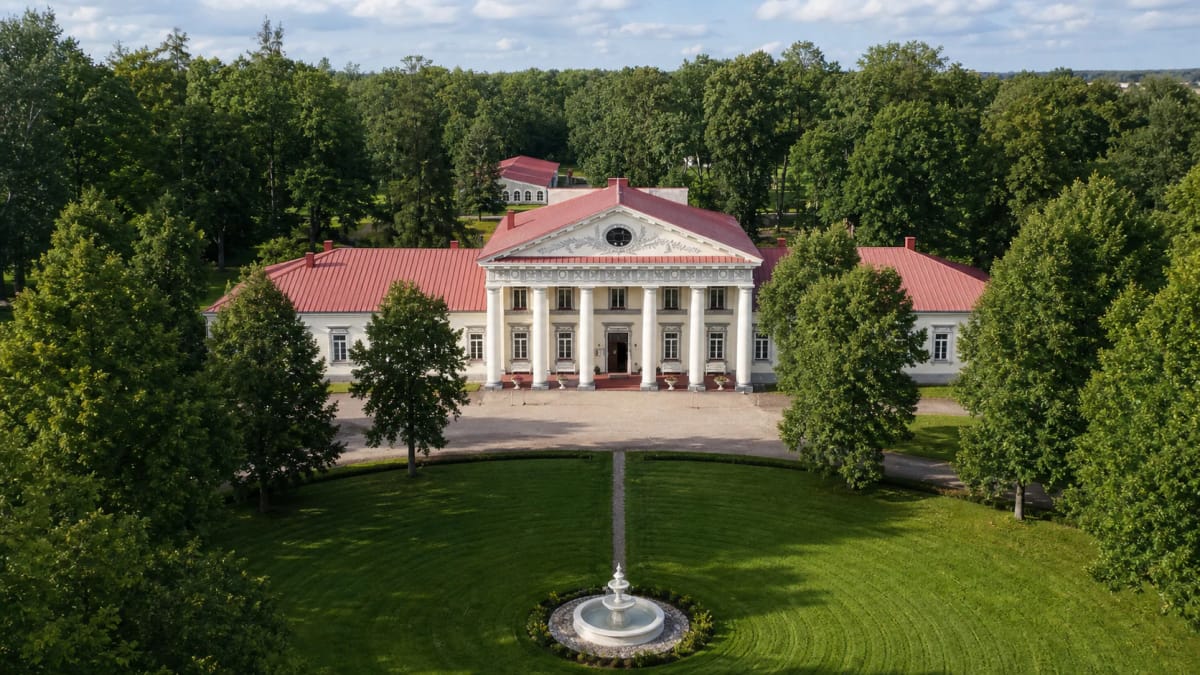
Taujėnai Manor is an easy Ukmergė District stop for travellers who want more than a map tick. The strongest first impression is the palace facade axis: broad lawn, fountain, tree-framed space, and Classical portico with six columns.
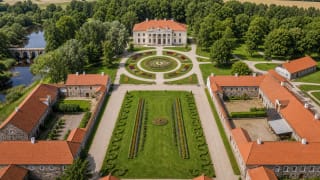
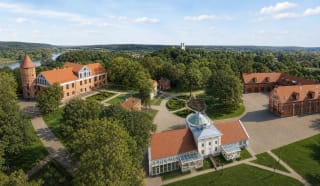
The place works for a short stop or a longer park visit. The official park description emphasises about 15 ha of grounds, a small zoo, stone park, ponds, alleys, and an old three-storey wooden granary.
Beginnings and owners
Historical sources mention Taujėnai Manor from the second half of the sixteenth century, when it was owned by the Ploniańskis. In the seventeenth century it belonged to several families: Nonhartai, Masalskiai, Pacai, and Eperješai. VLE adds that Taujėnai district is mentioned in the first half of the sixteenth century, the manor in the second half, and that until 1785 and again from the early nineteenth century to 1940 it belonged to the Radziwiłłs.
In the eighteenth century the Radziwiłłs acquired the manor. When Marija Viktorija Radvilaitė married Benedykt Moriconi in 1786, Taujėnai passed to the Moriconi as part of the dowry, explaining the close connection of both names in the estate's history.
Benedykt Moriconi and the Classical palace
The present palace core is linked with Benedykt Moriconi. In the late eighteenth century he built the surviving Classical palace, designed by Italian-born architect Pietro de Rossi. VLE dates the palace precisely to 1785 and names P. de Rossi; it also lists the smithy from the late seventeenth century, two workers' houses, an officina from the early nineteenth century, and a granary from 1871.
The central facade shows the design best: six columns, triangular pediment, symmetrical representative composition, and one-storey side wings. Historical descriptions note that the original composition differed slightly, with a two-storey central body aligned with one-storey wings linked by galleries.
Interiors and Radziwiłł-era wealth
Around 1820, as the Moriconi had no children, the manor was left to relative Marija Grabauskaitė. After she married Motiejus Konstantinas Radvila, Taujėnai returned to the Radziwiłł family.
In the nineteenth century Taujėnai was known for wealth. Historical descriptions mention Radziwiłł portraits, sculptures, hunting trophies, and old weapons inside the palace. Roe deer, fallow deer, and various birds were kept in the park, and swans swam in the large pond in front of the manor.
Park, granary, and today's grounds
The park reshaped around the palace in Benedykt Moriconi's time became an English landscape park. This contrasts with the formal representative palace facade: behind and beside the palace, visitors enter a freer landscape of trees, paths, and water.
The official Taujėnai Manor park page gives about 15 ha and invites visitors to a mini zoo, stone park, peklužė, flowerbeds, ponds, and tree alleys. VLE gives the English park as 13.2 ha with a geometric parterre and cascade pond system, partly maintained under a 1973 project by architect V. Landsbergis-Žemkalnis. The more than 200-year-old three-storey wooden granary is presented as the only one of its kind in Lithuania.
What to see first
If time is short, start with the palace facade and park axis with the fountain. From here the manor's scale is clear: representative but not overwhelming, designed to be seen from the approach and main lawn.
Then walk around the side wings, enter the park paths, find the ponds and old granary. With children, the small animal area and stone park become natural parts of the route, but check the official website before travelling for current access to specific spaces.
Planning a visit
The address is 41 Mechanizatorių g., Taujėnai, Ukmergė District Municipality. Because the manor is in a settlement and works as an events and leisure space, check practical information on tickets, tours, events, and park access on the official manor website before leaving.
For a quick look at the palace and nearest grounds, about 1.5 hours is enough. For the park, granary, ponds, and extra attractions, plan 2-3 hours, especially in the warm season.