- Place
- Kelmė District Municipality
- Region
- Kelmė District
- Type
- state-protected glacial boulder and geological natural monument
- Address
- Vileikiai, Pakražantis Eldership, by the Kražiai-Jauniškė road
- Coordinates
- 55.54556, 22.76111
- Visit duration
- 25-45 minutes to walk around and examine the boulder
- Best time
- a dry day from late spring to early autumn, when the field approach is not waterlogged
Vileikiai Stone
Lithuania's third-largest boulder
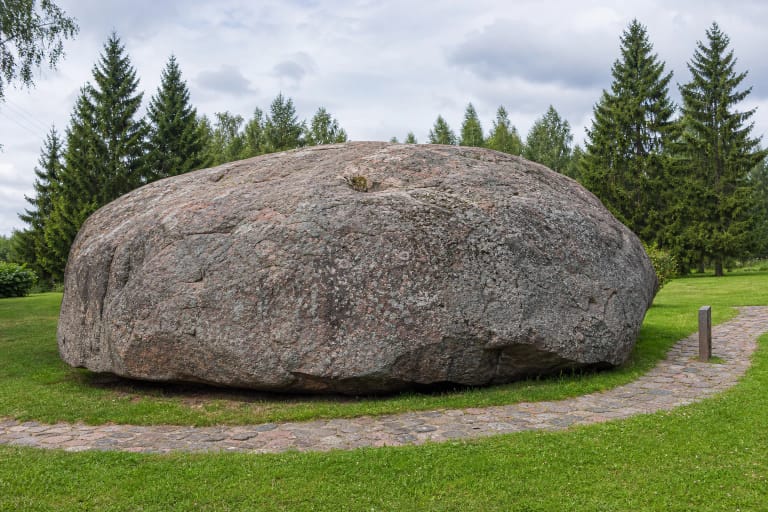
Kriaučius Stone is 7.84 m long, 7.65 m wide, and more than 4 m high. Its maximum horizontal circumference is 23.2 m, while the State Service for Protected Areas gives a weight of 356 tonnes. Those figures make it Lithuania's third-largest boulder after Barstyčiai Stone and Puntukas.
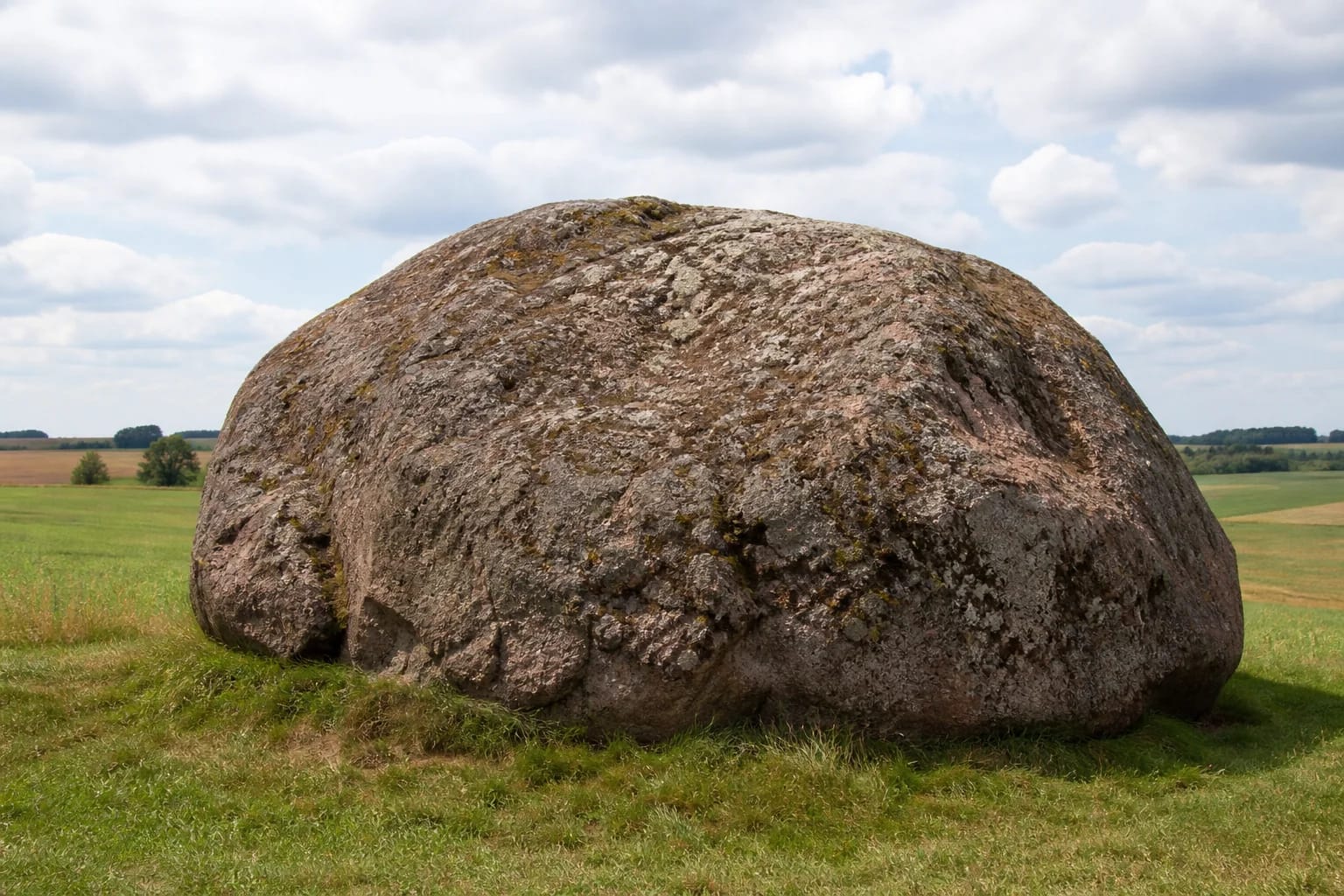
Its scale is easiest to grasp by walking around it at a safe distance. The irregular surface is mottled brown-grey, and the open field reveals the full block rising more than four metres. There is no need to climb it: a steep wet surface can be slippery, and a protected boulder must not be scratched, chipped, or otherwise altered.
Biotite garnet granitic gneiss from Fennoscandia
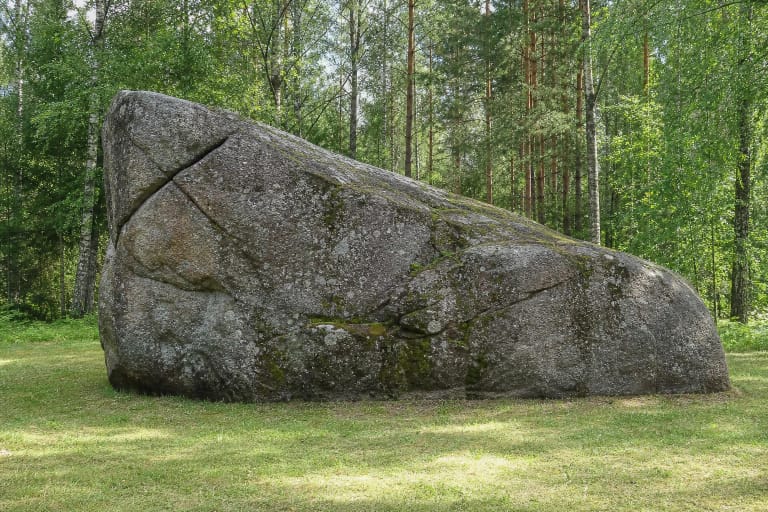
VLE identifies Kriaučius Stone as biotite garnet granitic gneiss. This is a crystalline, metamorphosed granite-type rock whose mineral grains and banding can be observed at close range. The boulder is not part of the local hill bedrock; continental ice transported it from Fennoscandia.
As the ice sheet melted, the block remained in what is now Kelmė District and was gradually covered by sediment. That origin explains how an immense fragment of northern crystalline rock came to rest in Lithuanian farmland. It has been recognised as a geological natural heritage object and natural monument since 2000 and remains state protected in the current official list.
From a tailor's field to an exposed hilltop
The boulder lay in land belonging to Vileikiai tailor Petras Jasulaitis, with only its upper surface visible for many years. Drainage workers excavated and exposed much more of it in 1974. The owner's profession also explains the name: kriaučius is an older Lithuanian word for a tailor.
Moving such a mass finally succeeded on 14 April 1989. The stone was shifted to a higher clay-rich hill at an elevation of about 157 m, so today's position is not the point where the ice sheet originally left it. Geologist Algirdas Linčius documented the boulder in 1990, after that relocation.
Finding and examining Kriaučius Stone
The boulder stands in open ground at Vileikiai by the Kražiai-Jauniškė road. Choose the exact Google Maps place card with its place ID, because navigating only to the village name may not lead to the object. The coordinates 55.54556, 22.76111 agree with the point published in public location references.
Official descriptions do not confirm a staffed visitor centre, ticket office, toilet, or lighting. Park only where it is legal and safe, without blocking farm access. Never drive across crops or cross cultivated ground when signs or an established approach indicate another route.
Season, not a timetable, determines access
Kriaučius Stone is an open-air field object, so no fixed opening hours or admission fee are published. Conditions nevertheless change: clay soil can become slippery and waterlogged after rain, snow can obscure the approach, and agricultural work takes place in spring and autumn. Daylight and dry ground are the safest choice.
Allow roughly 25-45 minutes to walk around the boulder and study its form and mineral texture. Check the latest Kelmė District or protected-area information before travelling, because access conditions can change much faster than the geological facts.