- Place
- Kaunas City Municipality
- Region
- Kaunas
- Type
- Kaunas Fortress fort, museum, and Holocaust memory site
- Address
- Archyvo g. 61, Kaunas
- Coordinates
- 54.91551, 23.92824
VII Fort, Seventh Fort
Seventh Fort with two heavy layers
The Seventh Fort is part of Kaunas Fortress, so first it can be read as late nineteenth-century military engineering of the Russian Empire. VLE calls it the last masonry fort of Kaunas Fortress; according to the official fort history page, it was built in 1883-1890 and is considered the best-preserved two-rampart fort from the first construction stage. The Cultural Heritage Register code is 10662.
But visiting this fort cannot stop at architecture. During the Nazi occupation, the Seventh Fort became one of the early killing sites of Kaunas Jews, so today it is also a Holocaust memory space. Engineering and memory are inseparable here.
Seventh Fort engineering and its place in the fortress
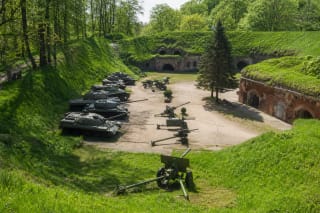
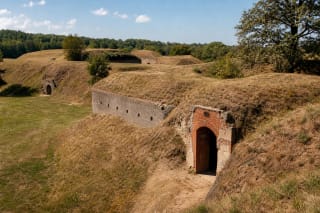
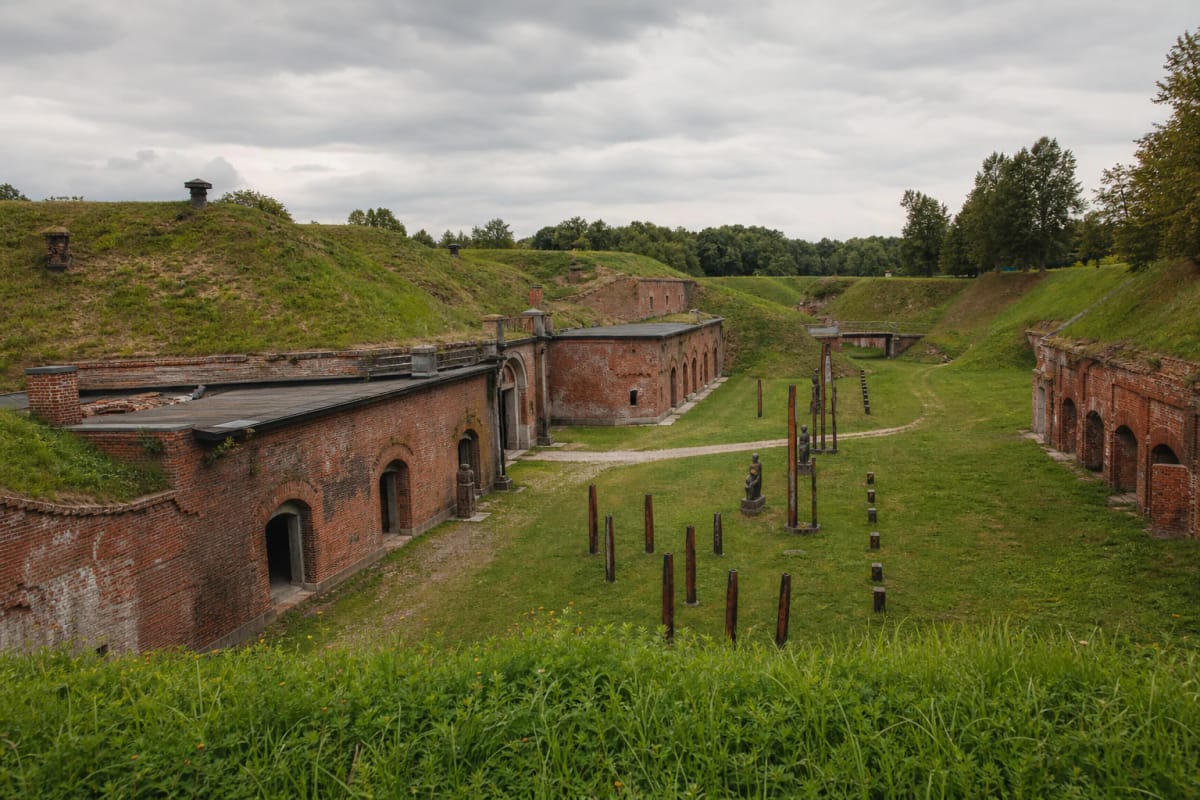
The fort stands in Žaliakalnis, opposite Kaunas Clinics, near the central fortifications of the third fortress sector. It has an asymmetric quadrangular structure: the right wing almost repeats the standard 1879 Russian fort design, while the left wing is simplified. The fort had barracks, a main traverse with postern, five ammunition stores, two rifle galleries, a drainage system, and four water wells; the faces and flanks were surrounded by a defensive ditch with a counterscarp wall, flanked by two caponiers and one half-caponier.
The Seventh Fort's distinctive feature is four gun casemates built under the fausse-braye traverse. The fort was never modernized, except for three concrete observation casemates placed on the artillery rampart at the beginning of the First World War, so VLE considers it the weakest fort of Kaunas Fortress. In 1915 it was taken by the German army without major resistance.
Central State Archive and the interwar period
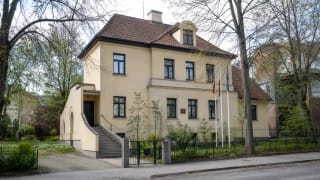
In 1924-1940 the Lithuanian Central State Archive operated in the Seventh Fort, and the adaptation project was prepared by architect Vladimiras Dubeneckis. Although the archive was a civil institution, the fort kept a closed military-site regime: entry was possible only with military permission.
After the USSR occupied Lithuania in 1940, the archive was moved to Pazaislis Monastery, and a Soviet army unit settled in the fort. Thus over several decades the fort changed its purpose from a military to an archival object.
Seventh Fort as a Holocaust memory site
The summer violence of 1941 is especially important in the Seventh Fort's history. According to VLE, on July 4, 1941, 463 people, most of them Jews, were shot in the fort territory; on July 6 another 2,514 Jews and other people were shot, and later Lithuanian poet Vytautas Montvila was also killed. In total, about 3,000 people were murdered. Later a branch of the prisoner-of-war camp Stalag 336 operated in the fort.
This place should be visited respectfully, understanding that its territory is connected with mass murder and the catastrophe of the Kaunas Jewish community. A guided tour, or at least reading about the fort's history in advance, is best; looking only at the ramparts cannot explain why this place matters so deeply to memory culture.
Museum activity and visiting the Seventh Fort
In 2009 the fort was privatized, and the public institution Military Heritage Centre became its manager, beginning repair and restoration work. On June 2, 2011, the fort opened to visitors and a memorial route was prepared to commemorate the victims of the July 1941 killings. Exhibitions representing different periods of the fort are being created in the barracks casemates.
Today the Seventh Fort is used for cultural, scientific, and educational activity; living-history events, open-gate days, and theatrical tours are organized here. Before visiting, check opening hours, whether registration is required, and which exhibitions are open. This is especially important for groups and schools.