- Place
- Kaunas City Municipality
- Region
- Kaunas
- Type
- literature museum, Maironis memorial apartment, and eighteenth-century late-Baroque palace
- Address
- Rotušės a. 13, Kaunas
- Coordinates
- 54.89675, 23.88423
Maironis Museum, Maironis House, Sirutis Palace, Siručiai Palace, Maironis Lithuanian Literature Museum
A literature museum on Town Hall Square
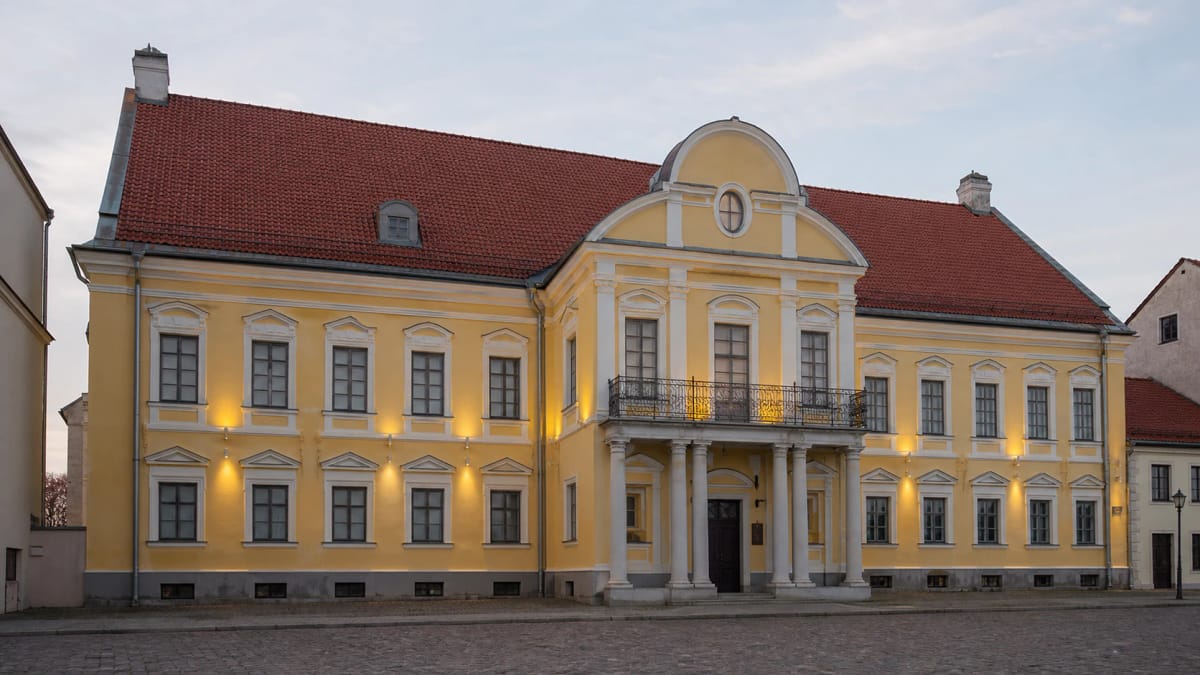
Maironis Lithuanian Literature Museum stands at Rotušės a. 13, in the centre of Kaunas Old Town. From outside, it is an elegant yellow late-Baroque palace with a red roof and columned balcony; inside, it is one of Lithuania's densest addresses of literary memory.
This place is not only a poet's memorial room. The official museum brings together Maironis' apartment, exhibitions on the history of Lithuanian literature, temporary exhibition halls, Gothic cellars, and a garden. A visit therefore works on two levels: as an encounter with Maironis and as a wider story about Lithuanian writers' archives, books, objects, and biographies.
Sirutis Palace and older cellars
The official museum description states that the palace was built in the mid-eighteenth century on the foundations and cellars of three sixteenth-century Gothic houses. VLE connects it with Simonas Sirutis, elder of the Kaunas district court, so the building is often called Sirutis or Siručiai Palace.
This layer matters because of scale: beneath the Maironis museum lies not only the poet's time but the memory of older urban Kaunas. The cellars remind visitors that representative facades on Town Hall Square often hide much earlier city structures.
The War of 1812 and the 1863-1864 uprising
The museum's historical narrative also links the building with more dramatic nineteenth-century episodes. After the War of 1812, a hospital operated in the palace; during the suppression of the 1863-1864 uprising, a field court-martial was based here.
The official museum stresses that the priest and uprising leader Antanas Mackevičius was probably imprisoned and sentenced in the cellars. The cellars are therefore not merely an architectural addition: they help read the building as a place where Kaunas city history, imperial coercion, and Lithuanian resistance met.
Maironis moved here in 1909
The poet and priest Jonas Mačiulis-Maironis bought the palace in 1909 after returning to Kaunas from fifteen years of work at the St Petersburg Theological Academy. The official memorial-apartment description states that in autumn he settled on the second floor, in eight rooms.
The apartment was not a random place to live but Maironis' space of work, receptions, and everyday life. Here he wrote early in the morning while looking onto Town Hall Square, lived with his sister Marcelė Mačiulytė, and balanced family concerns with cultural ties.
What Maironis created in these rooms
Memorial-apartment sources state that in his Kaunas home Maironis wrote poems, ballads, historical dramas, and literary and historical works. Works mentioned in connection with the house include the ballads Čičinskas and Jūratė ir Kastytis, and the historical dramas Kęstučio mirtis, Vytautas pas kryžiuočius, and Didysis Vytautas - karalius.
This detail changes the visit from merely biographical to literary. Rooms, furniture, writing desk, artworks, and the view of Town Hall Square allow visitors to imagine not an abstract national-revival poet, but a specific person working at home and receiving Lithuania's cultural figures.
From three rooms to a literature museum
The museum was founded in 1936, four years after Maironis' death, when three memorial rooms were opened to visitors. VLE gives June 28, 1936 as the date of the museum's establishment.
Bernardas Brazdžionis, who headed the museum in 1940-1944, began collecting archival material from other writers as well. In this way Maironis' house gradually became not only a memorial to one poet but a broader museum of Lithuanian literature. On March 1, 1989 the then LSSR Literature Museum was renamed the Maironis Lithuanian Literature Museum.
Tadas Daugirdas' decor and apartment restoration
The interiors of Maironis' apartment are especially important because of the decor created by artist Tadas Daugirdas. The official museum states that the full apartment was arranged in 1992, and that the authentic wall decor was first restored in 1998.
After later restoration, rooms reopened in 2016 with restored ornaments of the Great Drawing Room, Art Deco drawings in the study, and early Rococo decor in the Red Drawing Room. It is worth looking not only at exhibits here, but also at the walls, colours, ornaments, and movement logic of the rooms themselves.
What to see today
Today the main highlights are Maironis' memorial apartment, literature-history exhibitions, temporary exhibitions, the museum garden, and the old cellars. VLE states that the museum preserves more than 280,000 exhibits: manuscripts, photographs, letters, documents, books, periodicals, personal libraries, and writers' belongings.
The official prices page shows that visitors can choose different formats: all exhibitions, only Maironis' memorial apartment, the literature exhibition, temporary exhibitions, or the cellars and garden. That means the museum can be visited briefly, but it is best to allow at least a couple of hours.
Practical visiting
At the time of preparation, the official website listed opening hours for the main museum as Tuesday, Wednesday, and Friday 9:00-17:00; Thursday 9:00-19:00; and Saturday-Sunday 10:00-17:00. Last visitors are admitted 30 minutes before closing, but check current opening hours and ticket information on the museum page before going.
The location is very convenient on foot: from Town Hall Square you can connect Kaunas Castle, Santaka Park, Vilnius Street, and other Old Town sites. If architecture interests you as much as the exhibitions, step back into the square before entering and read the whole facade rhythm with its central balcony.