- Place
- Kaunas City Municipality
- Region
- Kaunas
- Type
- interwar technical-education palace and present Lithuanian Engineering College building
- Address
- Tvirtovės al. 35, Kaunas
- Coordinates
- 54.91358, 23.92897
Kaunas Higher Technical School, Kaunas Higher Technical School building, Kaunas Technical College, Lithuanian Engineering College, Kaunas Polytechnic
A technical-education palace in northern Kaunas
The Higher Technical School in Kaunas stands at Tvirtoves al. 35, in the northern part of the city where new educational, medical, and residential districts grew quickly in the interwar period. It is not a freely visited museum: the building is still used for higher engineering education, so plan it primarily as an architectural stop from Tvirtoves aleja.
The Cultural Heritage Register protects the object as the Kaunas Higher Technical School building. Its unique code is 33716, status is state protected, significance level is regional, and type is a single object. The register links its significance mainly with architectural value.
Beginnings in 1920
AUTC and the register agree that the Higher Technical School was established in Vilnius in 1920, but soon moved to Kaunas because of historical circumstances. The register names engineers Julijonas Gravrogkas, Kazimieras Vasiliauskas, Jonas Kiškinas, and others among the initiators.
The first years were temporary and cramped: in Kaunas the school first operated in primary-school premises on Vytauto prospektas, then in 1922 moved to a larger building on A. Mickevičiaus Street. As demand for technical education grew, even that became insufficient.
Why new premises were needed
AUTC emphasizes that the rising popularity of advanced technical education in the early 1930s forced planning for new premises suited to the school's needs. The new building had to hold students and represent the maturing of the state education system.
The need was very practical. AUTC notes that because the old building lacked space, lectures were held in two shifts. The Tvirtoves aleja palace was therefore an answer to a real teaching-infrastructure crisis, not only an architectural prestige project.
Stasys Kudokas's design
AUTC states that the new palace was designed in 1934 by Stasys Kudokas, and the register also names architect Stasys Kudokas as the building's author. The register adds that in 1934-1943 Kudokas himself taught at the Higher Technical School.
That detail matters: the building was designed not just by an outside architect, but by someone directly connected with the school's daily life. The palace was therefore made for the logic of teaching, corridors, halls, workshops, and institutional life rather than decorative representation alone.
Moving in during 1938
AUTC metadata gives 1936-1938, while the register gives 1937-1938 as the construction period. The AUTC narrative mentions a plasterers' strike in July 1938 and notes that the 1938 academic year began in the new building even though it was not yet fully finished.
That ending shows the reality of interwar construction: a modernizing state needed buildings quickly, but contracting, financing, and labour processes did not always follow an ideal schedule. Still, in 1938 the Tvirtoves aleja building became the real centre of the technical school.
Architecture: modernized historicism
AUTC describes the style as modernized historicism. That is precise: the facade is not radically functionalist, but it clearly uses a simplified and modernized institutional language.
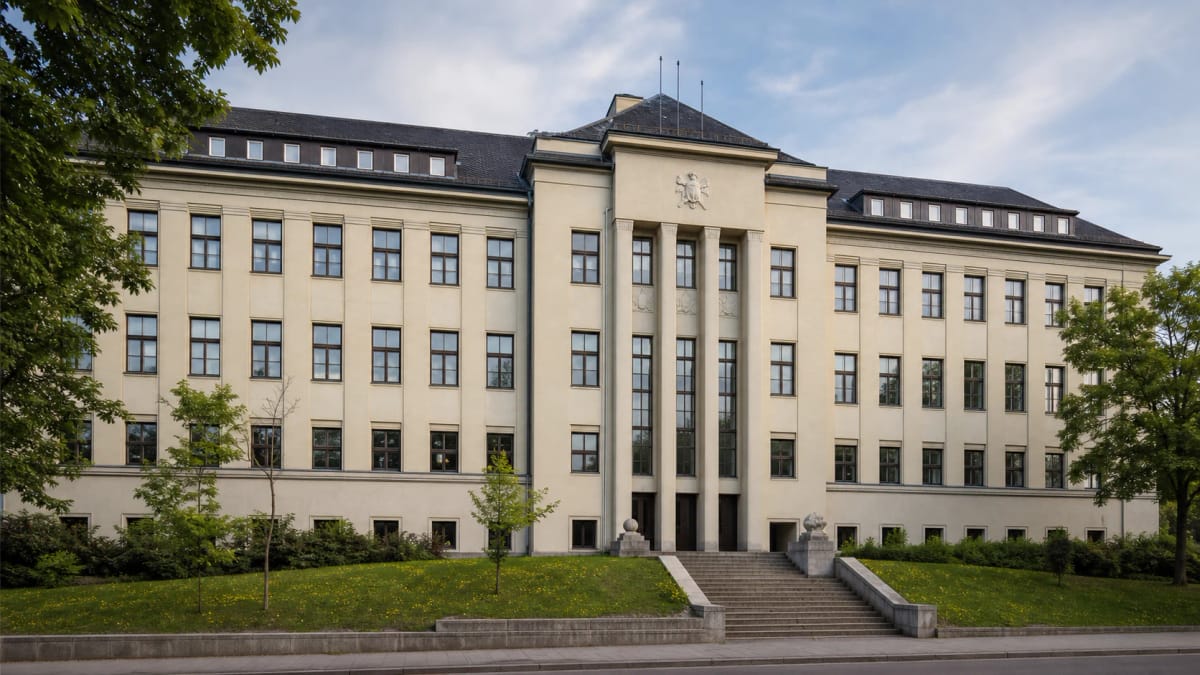
On the long symmetrical facade, the central axis is emphasized by the stairwell projection and entrance, strengthened by massive stairs. The register describes a semi-open E-plan, three-storey building with semi-basement, basement under the courtyard wing, attic, multi-pitched roof, rhythm of rectangular windows, central portal, and granite stairs on the main facade.
What to notice on the facade
Focus on the central projection, because it gathers the building's representation. The register mentions a recessed portal with rectangular pilasters and cornice, decorative bas-reliefs with craft symbols, and a relief cartouche with the Vytis emblem in the centre.
These details suit a technical school well: instead of abundant ornament, the facade uses labour, craft, and the state sign. In the AUTC text, the building on a small hill is called an architectural dominant in what was then a developing low-rise suburban-type district.
Interior and teaching function
Because the building functions as an educational institution, its interior should not be presented as a regular tourist exhibition. Still, the register's valuable features show that inside, important elements include one-sided corridor and hall layouts, terrazzo stairs, cast-iron radiators, wooden-window divisions, interior doors, hall details, and floor finishes.
The register also lists specific materials: monolithic terrazzo stairs and floors, grey and white ceramic tiles, herringbone wooden parquet, the hall stage platform, and the frame of the stage opening. This shows that the school was created as complex educational infrastructure, not only a street facade.
The unbuilt extension and later layers
After only a few years, the school again began to outgrow the building. AUTC states that in 1941 Stasys Kudokas prepared a stylistically matched extension project for additional workshops, laboratories, and classrooms.
That extension was not built, although coordination continued until 1943. During the Soviet period, the premises were expanded with educational architecture of a different character. Today it is worth distinguishing Kudokas's original palace block from later layers of the teaching complex.
From Kaunas Technical College to Lithuanian Engineering College
The official Lithuanian Engineering College page states that LIK, formerly Kaunas Technical College, was founded in 1920 and was the first institution in independent Lithuania to start training engineering specialists. Over more than a century it has trained nearly 40,000 graduates.
In 2024, Kaunas Technical College and Kaunas Forestry and Environmental Engineering College were merged to form Lithuanian Engineering College. Travellers and map users may therefore encounter several names: the historic Higher Technical School, Kaunas Technical College, and the present Lithuanian Engineering College.
Kaunas modernism context
The building should not be called a separate UNESCO site, but it clearly belongs to the same temporary-capital modernization field that UNESCO describes through Modernist Kaunas: Architecture of Optimism, 1919-1939. Here the story is not administrative representation but technical education and engineering-specialist training.
This building is a strong addition to a Kaunas modernism route because it shows that the interwar project was not only banks, the post office, or ministries. The state needed schools, laboratories, workshops, and specialists who could build the material foundations of modernization.
How to visit
The Higher Technical School is an active Lithuanian Engineering College building, so visitors should not expect free tourist access to interior spaces. The safest plan is an exterior view from Tvirtoves aleja and public approaches; ask the institution about any interior access, tours, or events.
A short stop takes 10-20 minutes. The best angle is from the street side, stepping back enough to include the long facade, central projection, stairs, and hillside. Architecturally, this site combines well with Žaliakalnis, the Kaunas Clinics area, and an interwar education-building route.