- Place
- Viduklė Eldership, Raseiniai District Municipality
- Region
- Samogitia
- Type
- state geomorphological reserve protecting remnants of moraine ridges
- Address
- Jūkainiai Forest, Jūkainiai village, Viduklė Eldership, Raseiniai District
- Coordinates
- 55.43800, 22.93200
- Visit duration
- 2-4 hours for a chosen route; longer if combining the reserve with the educational trail and other Raseiniai-region places
- Best time
- a dry day from late spring to autumn; wetlands and forest roads can be muddy after rain
Jūkainių geomorfologinis draustinis, Jūkainiai Forest protected area
Jūkainiai Reserve is a broad protected area, not just one trail
Jūkainiai Geomorphological Reserve lies in Raseiniai District Municipality, in Viduklė Eldership, roughly 6 km north-east of Viduklė and about 15 km north-west of Raseiniai. The official Saugoma.lt point is a representative coordinate, so it does not mark a gate, car park, or single legal entrance.
The map point helps locate the Jūkainiai Forest and reserve surroundings, but the final approach must be judged on site: a road may be a forest road, private access, or a route intended only for maintenance. Leave a vehicle only in a clearly lawful place.
The Jūkainiai Educational Trail within the reserve has its own page because its boardwalks, sculptures, and recreation infrastructure form a specific visitor experience. This page describes the wider protected area and does not treat the trail as synonymous with all 266 hectares.
Established in 1992 to protect moraine-ridge remnants
Saugoma.lt records the reserve's establishment in 1992 and an area of 266 hectares. Its purpose is to preserve remnants of washed moraine ridges characteristic of the Samogitian foothills. The important feature is therefore not simply green woodland, but the combination of glacial hills and the lower ground between them.
As you walk, notice how a road or trail rises and falls, and how forest edges give way to meadow or wetter ground. These changes in height and moisture are part of the reserve's geomorphological value, even when an individual hill has no name or viewpoint.
A geomorphological reserve is not a decorative park. Do not reshape the landform by driving off-road, digging, levelling, or making an improvised approach. A visitor route must adapt to the protected place rather than remodel it.
Jūkainiai Forest covers most of the reserve
The State Service for Protected Areas publication states that about 93 percent of the reserve is covered by Jūkainiai Forest. The remainder consists of farmland, isolated homesteads, a public road, and power-transmission lines. The setting therefore shifts from dense woodland to open clearings, and the reserve boundary is not a ring of one uniform landscape.
The same publication describes the highest hill in Raseiniai District, with an absolute elevation of 144.2 metres, and the Žūpė, a tributary flowing through the forest. These features help explain why the reserve protects a landform complex rather than one ornamental tree or a single wetland clearing.
Jūkainiai Forest is also a site of importance for habitat protection. The publication mentions broadleaf and mixed forests, herb-rich spruce forests, wet broadleaf woodland, and species-rich grassland. For visitors, this means leaving the forest floor, wet areas, and clearings as undisturbed as possible.
The educational trail is the clearest visitor gateway
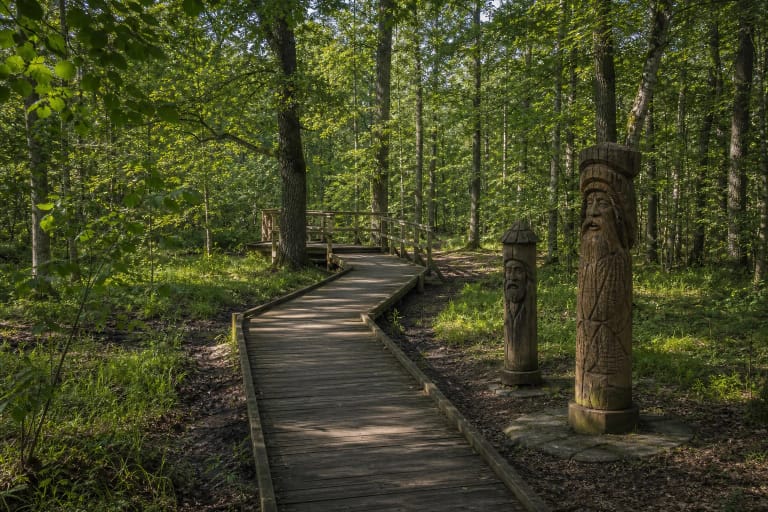
If you want more than a map point, choose the Jūkainiai Educational Trail for a defined walk. Its route includes wooden boardwalks across wet ground, forest and oak-grove fragments, folk-art sculptures, information boards, and viewpoints. These belong to a specific recreational infrastructure, not automatically to every part of the reserve.
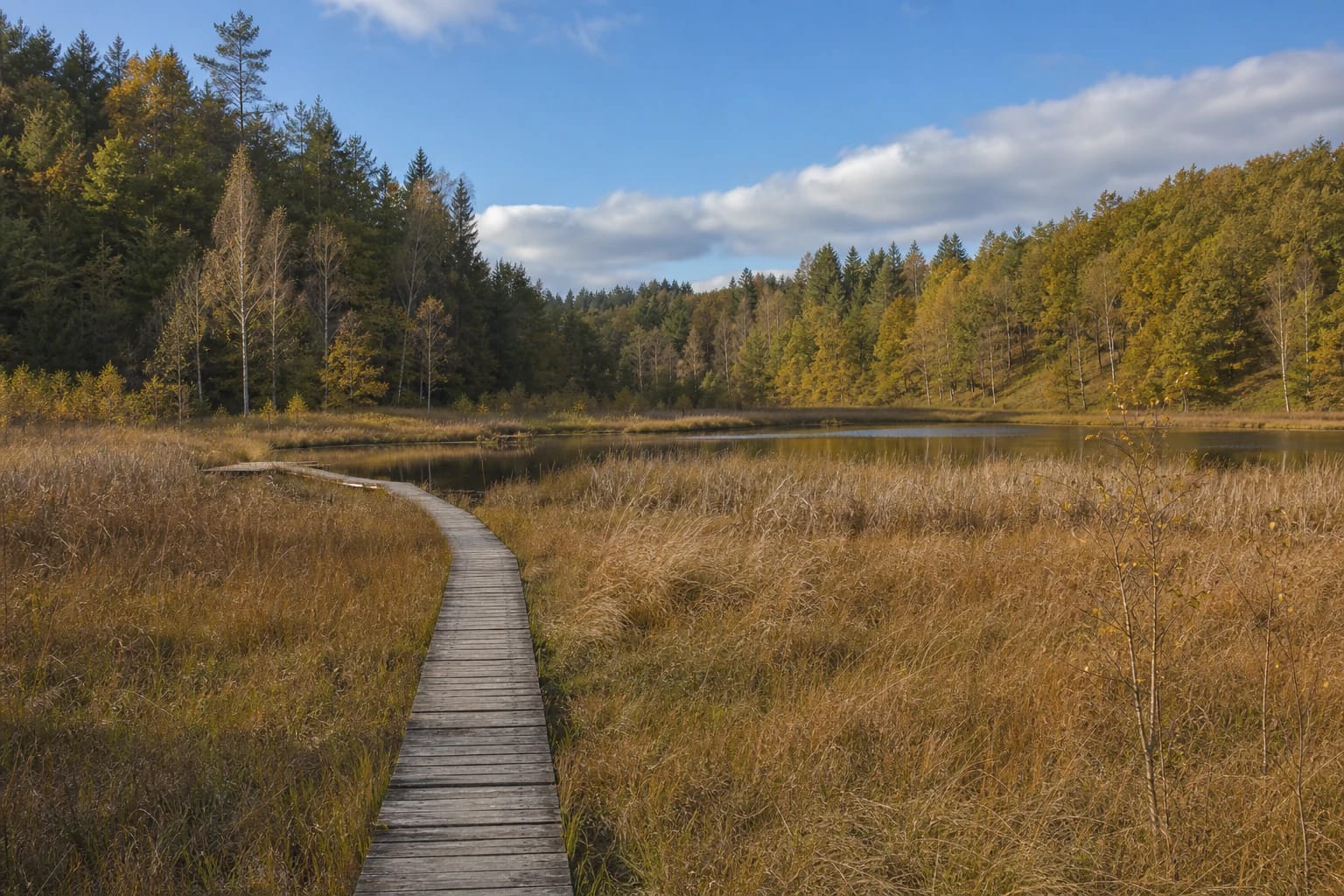
The Jūkainiai trail landscape includes broad stands of tall russet wetland grass, a winding boardwalk, a small water body, and dense mixed woodland. Towers, sculptures, and other trail structures occur only at particular points, so do not expect them throughout the reserve.
Trail conditions and access to individual structures can change with moisture, maintenance, or repairs. Check the separate trail information before travelling, and follow signs on site rather than crossing temporary barriers.
Plan a visit to a protected forest landscape
There is no single official visitor route around the whole reserve, so 2-4 hours is a practical allowance for a chosen trail, forest section, and stops. If the goal is the educational trail, plan around its loop rather than the area of the full reserve.
The official sources checked do not publish a separate reserve ticket, general admission desk, or one set of opening hours. That is not permission to drive onto every meadow or forest road: the protected-area regime, road signs, private land rights, and temporary local restrictions still apply.
Dry weather makes walking easier, but wetland ground and forest roads can be slippery and muddy after rain. Wear shoes with good grip, carry water, do not rely on one map marker, and allow extra time to return by the same route.
Protect the moraine relief, forest, and wet habitats
Do not cut new tracks through wetlands, drive off-road, widen ruts, or try to reach the nearest clearing shown on a map by car. Such actions damage soil, alter drainage, and harm the very landforms for which the area is protected.
Do not pick plants, collect rare species, light fires outside designated places, or leave litter. Keep dogs close in wet areas and prevent them from disturbing wildlife or other visitors.
The reserve's appeal lies in the quiet relationship between hills, forest, meadows, and wetland. Walking slowly along the educational trail or a lawful forest route reveals more than rushing to find one dramatic object that this landscape does not claim to have.