- Place
- Raseiniai District Municipality
- Region
- Samogitia
- Type
- educational trail with wooden sculptures in a geomorphological reserve
- Address
- Jūkainiai Forest, near Jūkainiai village, Raseiniai District
- Coordinates
- 55.42780, 22.92470
Jūkainiai educational-recreational trail, Jūkainiai natural-recreational trail
Jūkainiai Nature Trail: a sculpture avenue in the forest
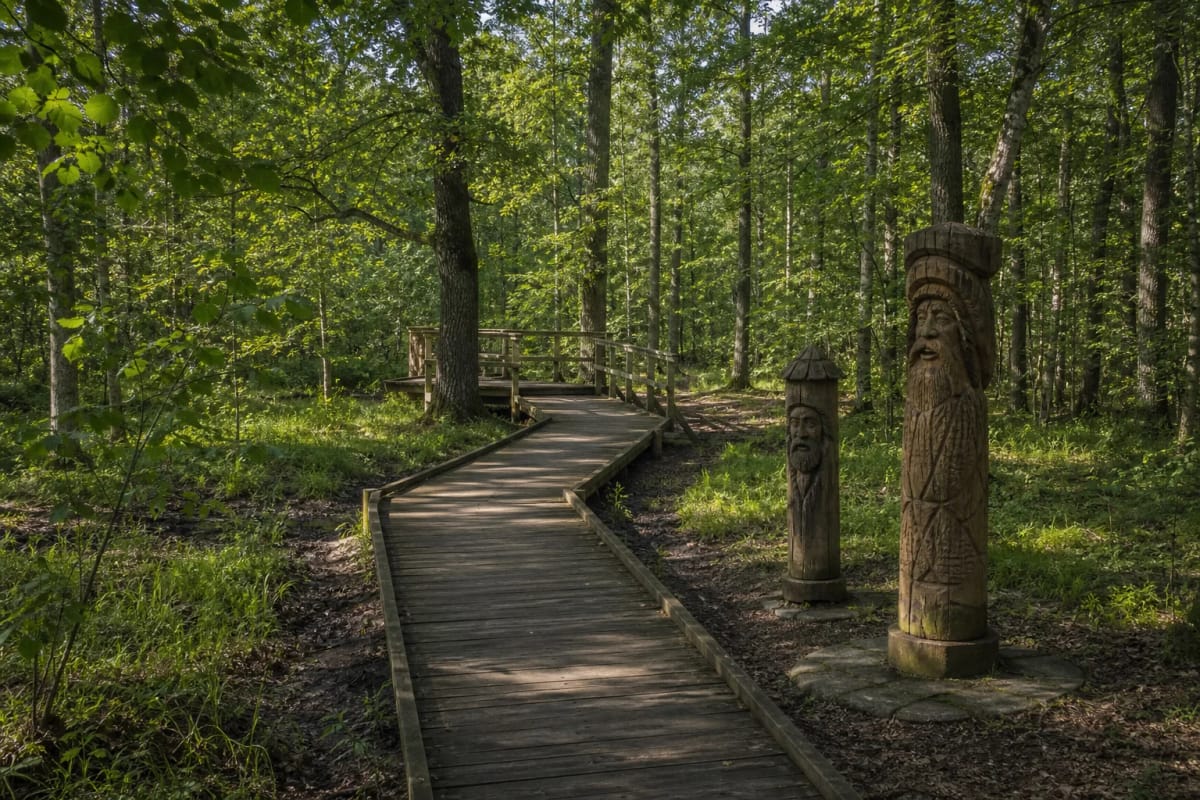
Jūkainiai Nature Trail is a circular forest route in Jūkainiai Forest, between Viduklė and Nemakščiai in Raseiniai District. It runs from remnants of old oakwood through a wetland and back to the start, with wooden boardwalks covering much of the route. Its distinctive feature is the line of wooden sculptures along the way.
It is a good place for a slow walk with children: the sculptures depict mythological and fairy-tale beings as well as forest animals, and a boardwalk crosses the wetland with a small viewing tower. The trail lies inside Jūkainiai Geomorphological Reserve, so staying on the marked route matters.
Loops and accessibility
The trail was installed in 2005 on the initiative of Raseiniai forestry. It is usually described as having a large loop of about 3.5 km and a small loop of about 1 km, with roughly 650 m adapted for people with reduced mobility. Different sources give trail length differently, so at individual junctions follow the signs on site.
Most of the trail is covered by wooden boardwalks, especially the first adapted section and the crossing over the wetland. Rest areas, shelters, and a viewing tower above the wetland are installed along the route, and from part of the trail a nearby pond can be seen.
Mythological and fairy-tale sculptures
Wooden sculptures stand along the route, depicting mythological and fairy-tale beings and forest animals: deities, witches, little devils, owls, and a moose wading in the wetland are among the motifs mentioned. Each sculpture has a board naming the work and its author.
The sculptures are by folk artists and local woodcarvers; specific author names are listed on site by the works themselves. The imagery is an artistic use of fairy-tale and mythological motifs, not a documented ethnographic reconstruction.
Wetland, oaks, and the Gojus legend
The trail crosses Jūkainiai Geomorphological Reserve, established in 1992 and covering about 266 ha, while Jūkainiai Forest itself was declared a forest park in 1991. The reserve protects the washed morainic ridge-island remains characteristic of the Samogitian foothills, so the relief is as important here as the plants. Fragments of old oaks also remain along the trail.
A local legend is attached to the place: it is said that between Raseiniai and Nemakščiai there once rustled a sacred grove of the old faith, and that a hill was called Gojus, a name associated with a sacred grove. This is local tradition rather than archaeologically confirmed fact, so it should be treated carefully; the Gojus name supports the story but does not prove it.
How to visit
The trail is open, free, and accessible year-round. A parking area and rest place are provided, and the entrance is marked by a wooden sculpture. The best season is spring to autumn, because winter boardwalks can be slippery.
The full large loop with sculptures, viewing tower, and wetland crossing usually takes 1-2 hours. A Raseiniai-area trip can combine Jūkainiai with Dubysa Valley, the Tytuvėnai monastery ensemble, or Lyduvėnai Bridge.