- Place
- Raseiniai District Municipality
- Region
- Samogitia
- Type
- private museum of technology and Nemakščiai history with a working reconstruction of an eight-wheeled vehicle
- Address
- Vyšnių g. 22, LT-60383 Nemakščiai, Raseiniai District
- Coordinates
- 55.42717, 22.77030
- Visit duration
- 60-90 minutes for a guided introduction to the vehicle and themed displays; technology enthusiasts may need up to 2 hours
- Best time
- at an agreed time in the warmer season, when the outdoor machinery can also be viewed; operation or rides on the eight-wheeler depend on the hosts and conditions
Aštuonračio muziejukas, Nemakščiai Muziejuks, Museum of the Eight-Wheeled Vehicle
The documented basis of Neveravičius's eight-wheeler
Pšemislovas Neveravičius was a local nobleman and self-taught engineer from the Nemakščiai area. A publication by the Lithuanian State Patent Bureau records that on 31 October 1907 he received an inventor's privilege from the Russian Empire confirming the patent for his eight-wheeled chassis. This firm documentary date should be distinguished from trials variously dated to 1905 or 1908 in later accounts.
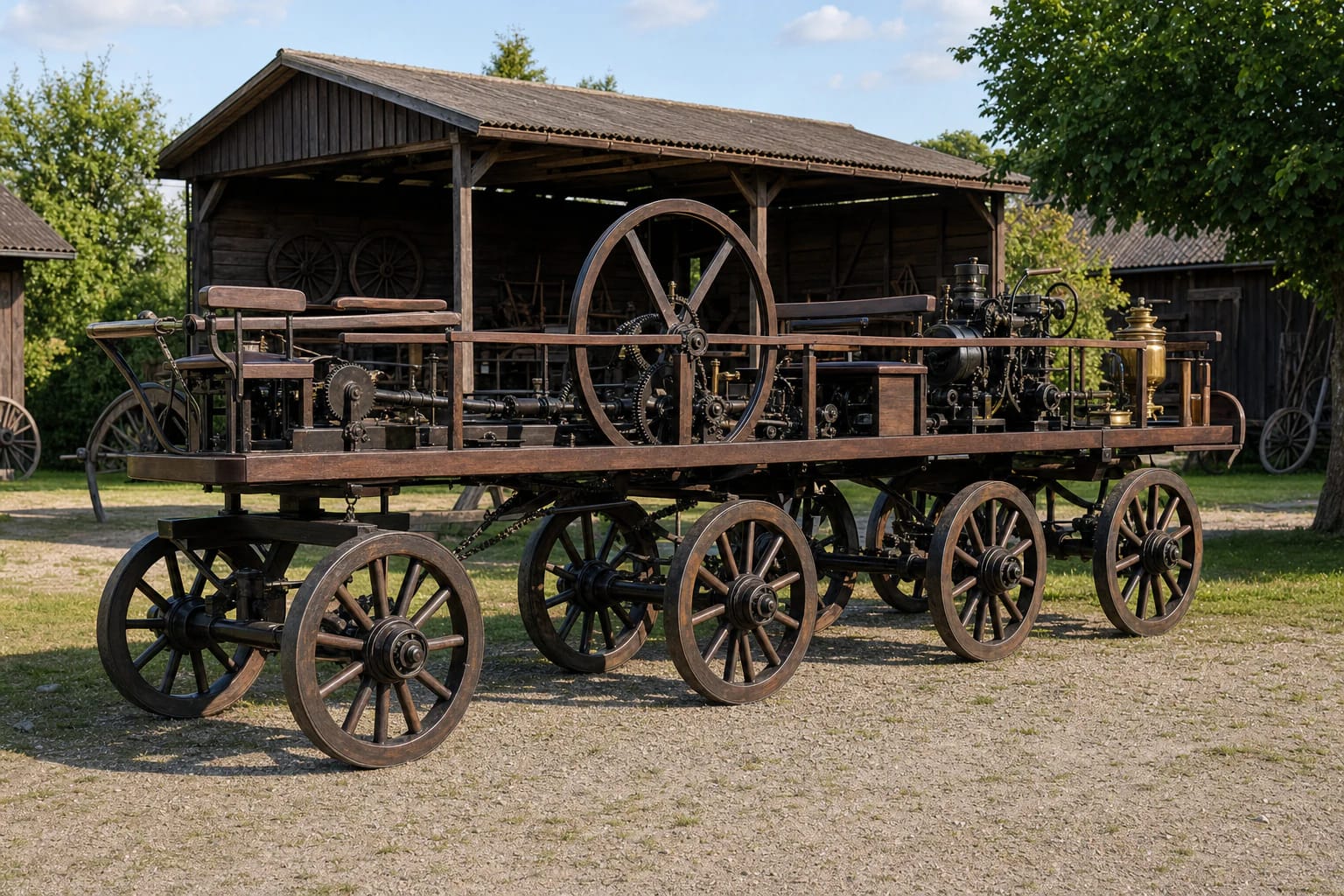
The chassis used four axles and eight wheels, intended to improve the mobility and manoeuvrability of a long carriage. An Eight-Wheeled Automobile Society established in Šiauliai in 1910 hoped to begin production. It never became a mass-produced vehicle, and the carriage displayed today is not the surviving 1907 original.
The museum presents Neveravičius's work as the world's first self-propelled eight-wheeled chassis. Whatever the breadth of that priority claim, the patent, four-axle arrangement, and early public demonstration are concrete facts of Lithuanian engineering history that make the Nemakščiai story significant.
How Leonas Tamulevičius revived a forgotten design
Leonas Tamulevičius says he encountered an illustration of the eight-wheeler in the magazine Mokslas ir technika in 1986. Curiosity became a long-term project: he gathered material about Neveravičius and his family, collected machinery and local objects at his parents' homestead, and built a reconstructed chassis from the patent drawings.
The Eight-Wheeled Vehicle Society was revived in Nemakščiai in 2007. Tamulevičius's machine is not merely a static surrogate. A long timber platform rests on four pairs of wheels, with drive mechanisms and controls visible on the deck and an engine later adapted for operation.
A useful question is therefore not only whether it moves, but which elements follow the drawings and which enable modern demonstration. The host's account distinguishes Neveravičius's principle, contemporary reconstruction choices, and the living spectacle created by the museum.
Nine thousand objects beyond the machinery shed
Figures released in 2025 describe roughly 9,000 objects arranged around about 25 larger and smaller subjects in twelve rooms. The collection had grown from the 5,000 cited in older reports, so the lower number is a trace of continuous expansion rather than necessarily an error.
Beyond the eight-wheeler are old cars and motorcycles, communications equipment, gramophones, radios, domestic objects, dairy-processing equipment, sewing material, carpentry tools, and other trades. Dedicated groups record the Nemakščiai volunteer fire brigade, forestry, and construction of the Samogitian Highway in 1934-1939.
The displays follow groups of objects, gifts from local people, and the founder's stories rather than one academic chronology. Their density is part of the museum's character. Mention a particular mechanism or period at the beginning so that a rich collection does not become merely a rapid survey.
Robertas Verba, Antanas Girčius, and people of Nemakščiai
A prominent newer strand concerns documentary film director Robertas Verba, who was born in Nemakščiai. His family donated work and personal material including a desk, chair, early cameras, watches, clothes, books from his library, awards, photographs, and films.
In 2024, Raseiniai District Municipality funded repairs to a farm building at neighbouring Vyšnių g. 20 and a dedicated room commemorating honorary citizen Antanas Girčius and his family. The project shows how the museum has expanded beyond one technology subject and one homestead building.
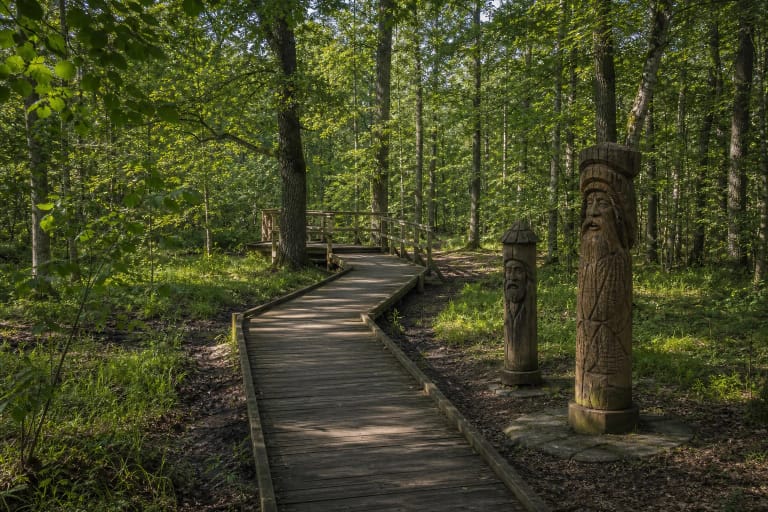
A life-size oak sculpture in the yard remembers musicologist Zita Kelmickaitė, a friend and frequent visitor. Such personal displays explain the paradox of the affectionate diminutive Muziejukas: the name remains modest while its range of stories has become very large.
Booking, price, and the real visit format
The museum operates in a private homestead and a hosted narrative is the most valuable part of the visit. On 27 July 2026, its official site listed Vyšnių g. 22, telephone +370 687 49215, and email astuonratis@gmail.com, but no fixed opening schedule. Agree the date, time, and group size in advance.
The official site also published no admission tariff on that date. Hours and prices on third-party pages may be old or apply to one organised group, so do not treat them as a guarantee. When booking, ask about the current price, payment method, tour language, and whether an eight-wheeler demonstration or ride is possible.
Displays occupy homestead buildings, the yard, and newer rooms, so surfaces, door widths, and thresholds vary. No complete accessibility route is published; discuss mobility, hearing, or other needs when reserving. Google Maps showed 4.8 out of 5 from 487 reviews on 27 July 2026; both figures change.