- Place
- Meteliai, Lazdijai District Municipality
- Region
- Dzūkija
- Type
- a state-protected botanical natural heritage object in Meteliai Regional Park
- Address
- Širvintas Forest beside Road 181 Simnas-Seirijai, Meteliai village, Seirijai Eldership, Lazdijai District
- Coordinates
- 54.28170, 23.75186
- Visit duration
- 20-35 minutes for both Širvintas oaks; longer when walking from the Meteliai visitor centre on the Bijotai-Širvintas forest trail
- Best time
- May to October for foliage and a drier woodland edge; the leafless season better reveals broken stems and crown structure
Drevėtasis Širvinto ąžuolas, Širvinto drevėtasis ąžuolas, Hollow Širvinto Oak
A dated inventory and an old sign tell the story in different numbers
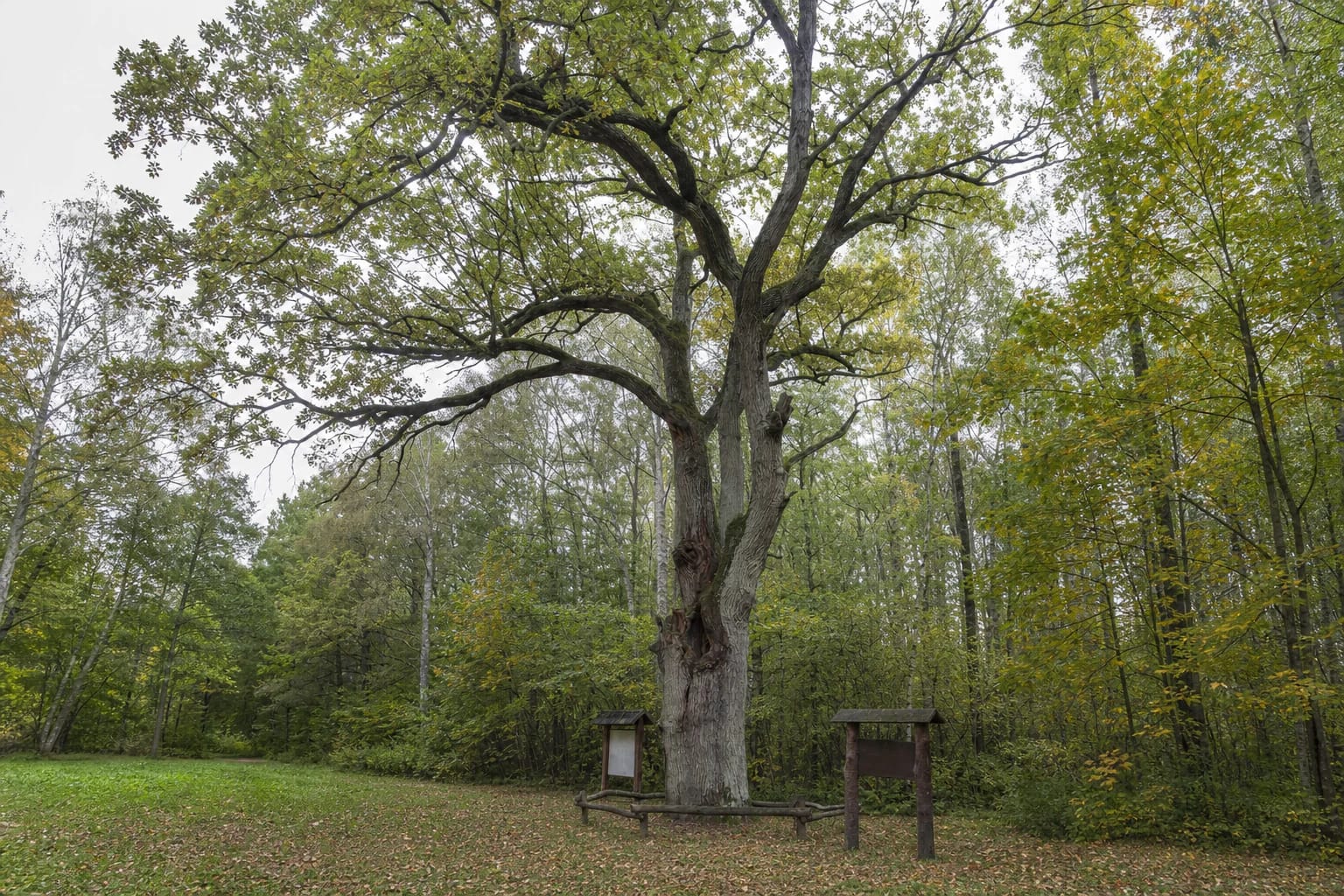
Hollow Širvintas Oak grows in a small deciduous-forest clearing furnished with a low rustic fence, an information board, and a name sign. Its silhouette is irregular: the thick trunk divides higher up, several old limbs end at break points, and the broad crown merges into the surrounding Širvintas woodland.
The State Forest Service inspected the oak for its veteran-tree inventory on 14 September 2017. It measured 24 m high, 4.6 m in trunk circumference, and 24 m across the crown; the first major branches began at about 8.5 m. Its official coordinates, 54°16'54.2" N and 23°45'06.6" E, almost exactly match the present Google pin.
An older sign photographed at the tree gives different figures: 29 m high, 4.4 m in circumference, and about 400 years old. The same height and girth recur in public descriptions. The difference need not be an error: measurements may have been taken in another year or by another method, and breakage can reduce height. This guide therefore leads with the dated 2017 inventory and labels the older numbers as a separate layer of evidence.
The hollow name describes a damaged trunk, but the tree remains alive
The 2017 inspection describes one stem as decayed and broken. It also notes that the limbs were considerably smaller than those of neighbouring Great Širvintas Oak and that many lower branches had already broken. Even so, the crown was assessed as sufficiently vigorous. A cavity and deadwood do not mean that the entire tree is dead.
A hollow tree carries its vital tissues closer to the trunk surface, so it may still leaf out and produce acorns after losing inner wood. That structure also makes it mechanically vulnerable. A visitor cannot reliably judge branch stability from the ground, so do not linger beneath the crown in strong wind or cross the low fence.
Lithuanian folklore sometimes associates hollow oaks with a devil hiding inside from Perkūnas, the thunder god. Public introductions to this tree repeat that general belief, but the checked sources contain no site-specific legend collected here and no evidence of a sanctuary. It belongs to the wider folklore of hollow trees, not to the oak's documented biography.
Great Širvintas Oak stands only fifty metres away, but they are separate objects
The State Forest Service inventory explicitly places Hollow Širvintas Oak about 50 m from Great Širvintas Oak. Both are state-protected botanical natural heritage objects, both stand within Meteliai Landscape Reserve, and both occupy the same part of Širvintas Forest. Their names, photographs, and dimensions are sometimes mixed online because they are so close together.
In 2017, the Great Oak measured 31 m high, 5.2 m around the trunk, and 20 m across the crown, while its trunk was judged completely healthy. The Hollow Oak was shorter and slimmer but carried a wider crown, and its broken stem created a different character. Visit both to compare two ageing histories rather than to choose a winner in a size contest.
Select the exact Hollow Oak listing in navigation if you want to begin there. Google names the card Širvinto drevėtasis ąžuolas, while VSTT and forestry records use Drevėtasis Širvinto ąžuolas. Both names identify the same hollow tree, not the Great Oak.
The oak is protected within the wider landscape of Meteliai's lakes and forests
VSTT lists Hollow Širvintas Oak among Lazdijai District's botanical natural heritage objects. Saugoma.lt and the Dzūkija-Suvalkija Protected Areas Directorate also identify it as a visitor site in Meteliai Regional Park. It is not merely an attractive tree marked by local initiative but an officially protected natural feature.
The tree stands in Meteliai Landscape Reserve, in Širvintas Forest between Lakes Dusia and Metelys. VLE places this eastern part of the park within the Bijotai-Širvintas forest massif and names both protected Širvintas oaks. The wider value extends beyond one trunk to mature woodland, deadwood, and habitat for insects and birds.
The directorate's 2024 activity report records maintenance around both the Hollow and Great oaks alongside other Meteliai park sites. That does not mean managing a veteran tree like an ornamental urban planting. Visitor space and safety are maintained while natural cavities, breakage, and the ecological role of deadwood require restraint.
The exact pin lies beside Road 181, but it does not mark a car park
The exact Google Maps listing Širvinto drevėtasis ąžuolas, place ID ChIJK82ihKzA4EYRnDZLm6_G_-A, marks 54.2817016, 23.7518632. On 15 July 2026 it showed an average rating of 4.8 out of 5 from 11 reviews. Ratings and review counts change, and the pin identifies the tree rather than guaranteed parking.
The oaks grow in Širvintas Forest beside national Road 181 Simnas-Seirijai, beyond Meteliai village. The 2017 inventory says that the Great Oak stands right beside the road, fenced and marked by an old sign; the Hollow Oak is roughly 50 m away. A clearing and information boards help with orientation, but the official sources checked do not confirm a dedicated modern car park immediately beside the Hollow Oak.
Park only where signs permit and where the vehicle will not obstruct traffic. Never drive over the forest floor or block an access track. For a longer walk, the Bijotai-Širvintas forest nature trail begins at the Meteliai Regional Park visitor centre, but check the current route map before setting out because descriptions from different years give different lengths and branch configurations.
No separate ticket or schedule is published, and daylight is the safest time
The official VSTT, Saugoma.lt, and directorate pages publish neither a separate fee nor set opening hours for Hollow Širvintas Oak, and the exact Google listing displayed no schedule on the verification date. This is an outdoor woodland site, not a promise of convenient access at every hour. Visit in daylight and check park notices and signs before travelling.
Allow about 20-35 minutes for both oaks. Summer makes crown vitality easiest to see, autumn sets the tree among colourful deciduous woodland, and winter or early spring reveals breakage most clearly. After rain, the woodland edge may be slippery; after dark, roots and uneven ground are difficult to see.
Do not cross the low fence, lean against the damaged trunk, enter cavities, or remove deadwood. Keep dogs under the control required by protected-area rules, carry litter out, and postpone the stop during storms. Photograph from the clearing's edge, leaving some surrounding forest in the frame to communicate the tree's scale.