- Place
- Meteliai, Lazdijai District Municipality
- Region
- Dzūkija
- Type
- a state-protected botanical natural heritage object in Meteliai Regional Park
- Address
- Širvintas Forest beside Road 181 Simnas-Seirijai, Meteliai, Seirijai eldership, Lazdijai District
- Coordinates
- 54.28278, 23.75043
- Visit duration
- 20-35 minutes for both Širvintas oaks; longer when combined with the Bijotai-Širvintas Forest nature trail
- Best time
- May to October for the crown and woodland colour, or the leafless season for the heavy branch structure; avoid storms and strong winds
Didysis Širvinto ąžuolas, Širvinto didysis ąžuolas
Thirty-one metres is the tree's height; 110 metres is the altitude of its site
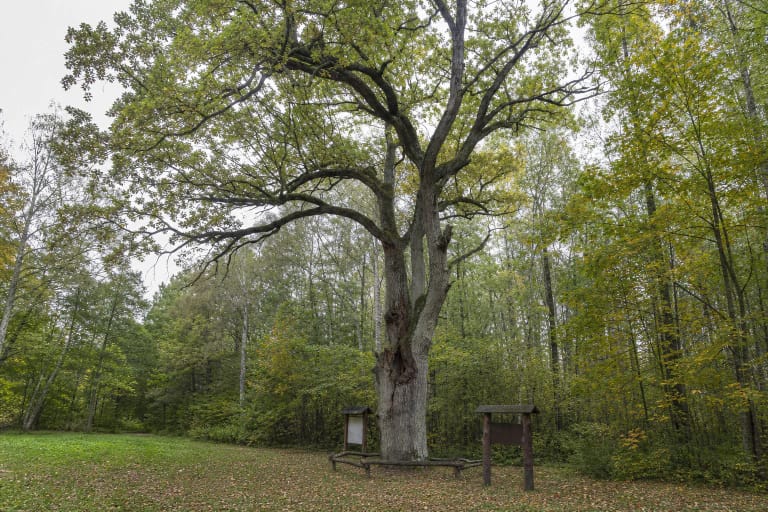
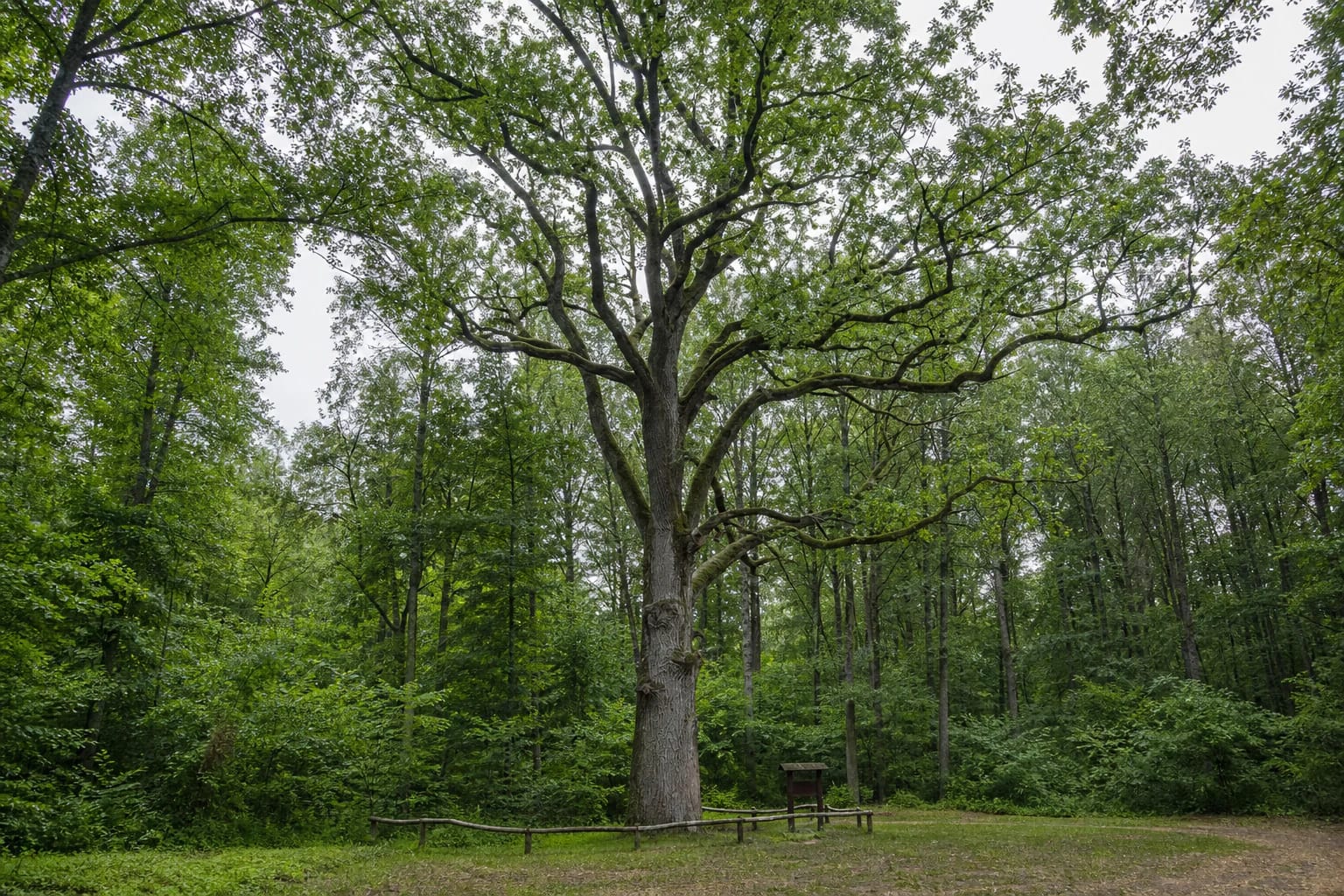
Great Širvintas Oak stands in a deciduous woodland clearing beside Road 181 Simnas-Seirijai. Its trunk rises almost undivided for a long distance, sends out its first major limbs at roughly 6 metres, and then spreads into a broad, open crown. A low timber fence and an old name board mark the tree; step back towards the edge of the clearing to understand its full height.
The State Forest Service inspected the oak on 14 September 2017. It measured 31 metres high, with a trunk circumference of 5.2 metres at the standard 1.3-metre measuring height and a crown width of 20 metres. The table also records an elevation of 110 metres above sea level. That number describes the site, not the tree, and must not be confused with the oak's 31-metre height.
The service's WGS 84 point, 54°16'58.2" N, 23°45'01.2" E, is very close to the modern Google place card. Because the figures are dated and the measuring height is stated, they are more useful than the rounded claims of a 31-metre height and 5-metre circumference repeated elsewhere online.
The trunk was healthy in 2017, while the open crown leaned towards the road
The inventory assessed the trunk as completely healthy. It described the crown as sparse but particularly attractive and healthy, with only a few dry lower branches. The crown had formed slightly towards the west, which is the road side, and this asymmetry helps identify Great Širvintas Oak from a lateral view.
Those words record one visual assessment in 2017. They do not promise that an old tree cannot later be affected by drought, storms, disease, or branch failure. A visitor cannot diagnose structural safety from one photograph, and the space beneath a veteran crown should never be treated as risk-free. Postpone the stop in strong winds.
The tall, substantially intact trunk is the clearest contrast with nearby Hollow Širvintas Oak. In 2017, Great Oak was 7 metres taller and 0.6 metre greater in circumference, yet its 20-metre crown was 4 metres narrower. The measurements do not rank one tree above the other; they reveal two different histories of ageing and crown development.
Both Širvintas oaks are protected, but they are two separate natural heritage objects
VSTT's Lazdijai District list records Great and Hollow Širvintas oaks as separate botanical natural heritage objects. VSTT's legal overview says both were among the new state-protected objects named by Environment Minister Order 652 of 20 December 2002. The directorate's current visitor list continues to name them separately.
The trees stand in the Meteliai Landscape Reserve of Meteliai Regional Park, in Širvintas Forest between lakes Metelys and Dusia. VLE identifies the Bijotai-Širvintas forest block in the park's wooded eastern sector and names both oaks as botanical natural heritage objects. Protection concerns the root zone and living setting as well as the visible wood of the trunk.
According to the State Forest Service, Hollow Oak is about 50 metres from Great Oak. Their proximity often leads to mixed photographs, measurements, and coordinates. Great Oak stands closer to the road described in the survey, is taller, and has a straighter trunk; Hollow Oak has a clearly decayed and broken trunk section and a wider crown.
A 2022 study identified the oak's H4_DE chloroplast DNA lineage
A 2022 study commissioned by Lithuania's Ministry of Environment and carried out by researchers from Vytautas Magnus University and the Lithuanian Research Centre for Agriculture and Forestry examined 347 veteran pedunculate oaks across the country. Chloroplast DNA microsatellite markers were used to identify evolutionary haplotype lineages and compare their geographic distribution.
The report's appendix lists Great Širvintas Oak at 54.28283, 23.75033 and assigns it the H4_DE haplotype. The study found the same haplotype in neighbouring Hollow Oak. It calls H4_DE the German haplotype, formed along a post-glacial migration branch of the Balkan haplogroup, and identifies it as one of Lithuania's common lineages.
A shared chloroplast haplotype does not establish that the two trees are the same age, direct descendants of one another, or genetically identical. It is a class of maternally inherited DNA marker used to study the much broader post-glacial migration of pedunculate oak. The finding adds a scientific layer to the place but does not replace monitoring of each individual tree's condition.
The exact Google pin marks the oak, not a guaranteed parking place
The exact Google Maps card Širvinto didysis ąžuolas, place ID ChIJE4ReDuPB4EYRL-lG4SltKXE, marks 54.2827849, 23.7504314. On 15 July 2026 it showed a 4.7 out of 5 average from 3 reviews. This clears the required threshold, but three ratings are a very small sample and one new vote could move the average sharply.
The 2017 inventory says the tree grows immediately beside Road 181 after Meteliai, is fenced, and carries an old board. Those are better orientation clues than the broad name Širvintas Forest. The map pin nevertheless marks the tree itself, not an entrance to a formal car park.
Leave a car only where signs permit and where it will not obstruct traffic or forestry access. Do not drive onto the forest floor, compact the root zone, or stop in the carriageway for photographs. If no safe space is visible, continue and find a legal stopping point.
No separate ticket or opening schedule is published, but a forest stop is not without limits
The VSTT, directorate, VLE, and forestry sources checked publish no separate ticket office, mandatory admission charge, or fixed opening hours for Great Širvintas Oak. The exact Google card also showed no hours on the verification date. It is an outdoor site, but visitors should still check Meteliai Regional Park notices, temporary forest-access conditions, and local signs before travelling.
Allow 20-35 minutes for both oaks. The leafy season reveals the shape of the healthy, open crown, autumn separates it by colour, and winter exposes the architecture of its heavy limbs. The clearing and exposed roots may be slippery after rain, while roadside hazards are harder to see after dark, so daylight is the safest choice.
Do not cross the low fence, lean against the trunk, carve bark, or take acorns or dead wood as souvenirs. Photograph from the edge of the clearing and keep some surrounding forest in the frame to show scale. Do not linger beneath old crowns during a storm or strong wind.