- Place
- Viekšniai, Mažeikiai District Municipality
- Region
- Samogitia
- Type
- Red-brick water mill and technical heritage site
- Address
- Tilto g. 3, Viekšniai, Mažeikiai District
- Coordinates
- 56.23200, 22.52100
Lesem Water Mill, Lesemo vandens malūnas
Viekšniai Water Mill by the Venta
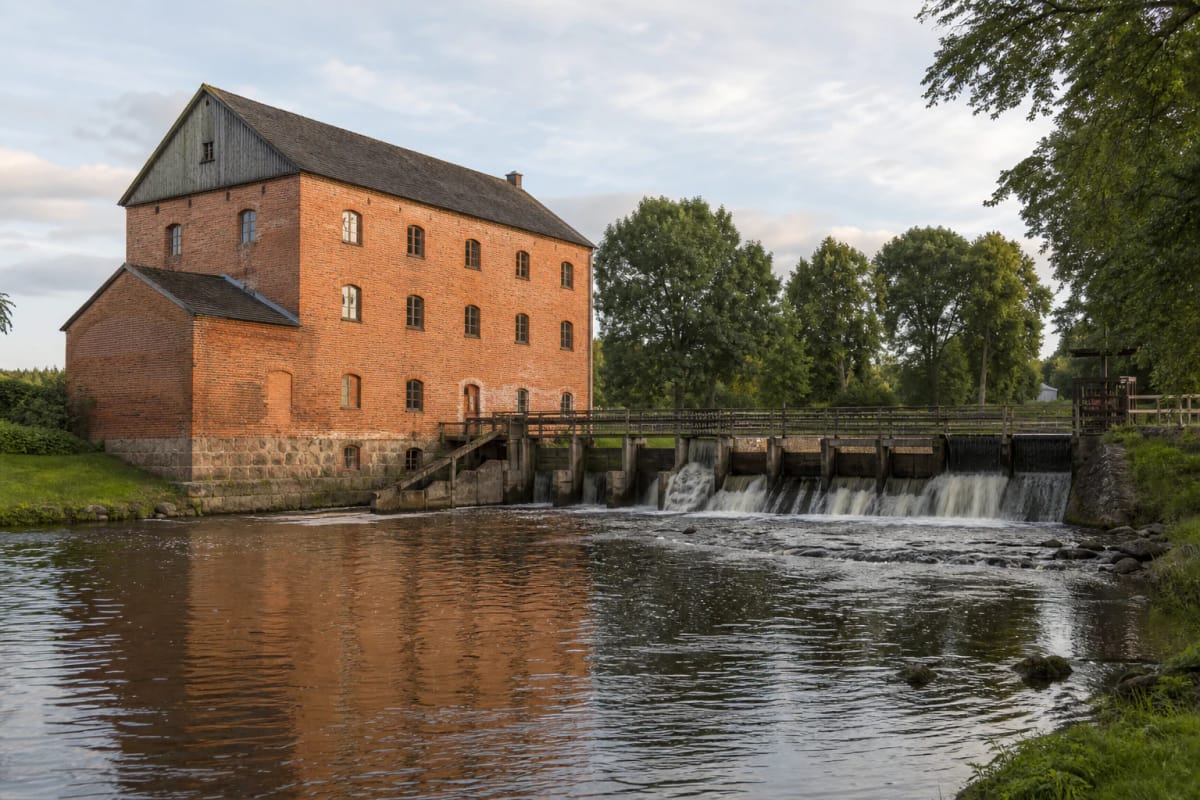
Viekšniai Water Mill stands on the Venta River in the town of Viekšniai, Mažeikiai District, within Venta Regional Park. It is a red-brick technical heritage object, a registered technical monument, and one of the best-preserved mills of its type in the region.
It is important not to confuse it with Viekšniai Pharmacy Museum, a separate site in the same town. The water mill is by the river on Tilto Street, while the pharmacy museum is elsewhere in the town.
Construction and technical history
The mill was built in 1897 by Pranciškus Lengvenis. A dam across the Venta powered the mill turbine. Later the mill passed to merchant Lesen, also written Lesem, so local people often call it Lesem's mill.
The mill was repeatedly improved: in 1917 local craftsman V. Juodeikis made a turbine; in 1920 rollers for milling flour were installed; in 1925 a wool-carding and spinning section appeared. Authentic equipment for milling, wool processing, and water power still survives inside.
The mill that supplied electricity
The most interesting feature of Viekšniai Water Mill is that it did more than grind grain: it supplied the town with electricity. Around 1928-1930 a generator was installed in the mill and lit Viekšniai, a rare example of early rural electrification.
The exact years should be treated as approximate because sources give them slightly differently, but the fact that the mill electrified the town is well attested. This combination of functions - milling, wool processing, and electricity generation - makes the mill especially valuable.
Restoration and future
The mill was privatised in 1999, and later a small hydroelectric plant and fish pass were installed by the dam. The building has remained almost unchanged, with authentic equipment whose operation is still remembered by former workers.
In recent years plans have been announced to restore the mill, including a project of about 1.47 million EUR. The future plan is to adapt it for education, exhibitions, conferences, a cafe-bakery, and an observation terrace. For now it should be understood as a heritage building under preparation, not yet a regular museum or cafe.
How to visit Viekšniai Water Mill
The mill is easy to view together with Viekšniai town, the Pharmacy Museum, and Venta Regional Park routes; it is included in local mill-route itineraries. For the exterior, dam, and riverside, 20-40 minutes is usually enough.
Because the mill is not yet adapted for regular visiting, interior access is usually possible only during events or guided tours. No regular opening hours or ticket prices were found in official sources, so check current information through Mažeikiai tourism or the municipality before travelling.