- Place
- Vilnius City Municipality
- Region
- Vilnius
- Type
- active eclectic synagogue and Jewish sacred-heritage site
- Address
- Pylimo g. 39, Vilnius
- Coordinates
- 54.67610, 25.28140
Taharot Hakodeš Synagogue, Pylimo Street Synagogue, Vilniaus choralinė sinagoga
Vilnius Choral Synagogue
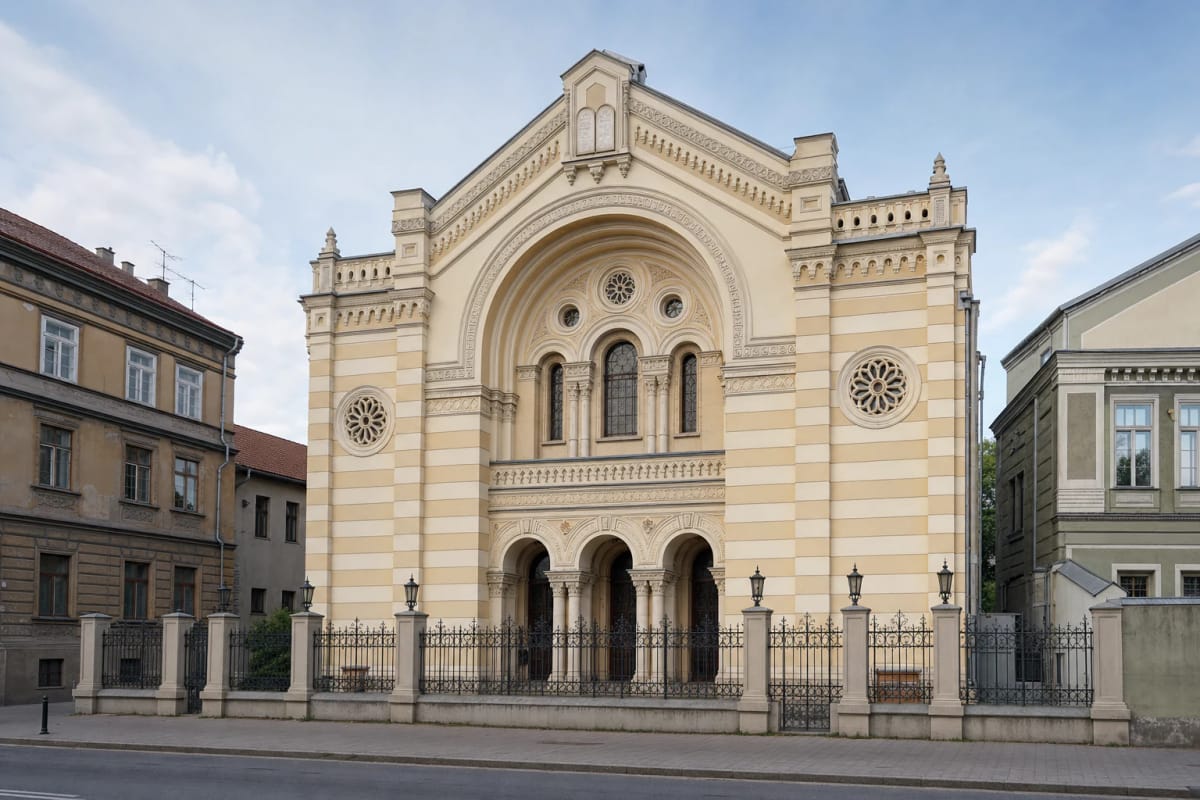
Vilnius Choral Synagogue stands on Pylimo Street at the edge of the old town. It is an exceptional survivor: of the more than one hundred synagogues and Jewish prayer houses that existed in prewar Vilnius, it is the only one that both survived and continues to function. Most of the others were destroyed during the Holocaust and the Soviet period.
The synagogue is a centre of religious life for the Lithuanian Jewish, or Litvak, community. It should therefore not be treated as a museum alone. It is a living place of prayer and a witness to the deep Jewish history of Vilnius, the city Jews called the Jerusalem of Lithuania.
Construction and architecture
The synagogue was built in 1903. It was designed by architect Danielius Rozenhauzas, while construction was supervised by Aleksiejus Polozovas. The building is made of yellow brick, eclectic in form, with modernized Neo-Romanesque elements and eastern, Moorish-style decorative motifs.
Inside, the space is three-aisled and covered with a barrel vault. In the apse, where a presbytery would stand in a church, is the richly decorated Torah ark, the Aron Kodesh; in the centre is the bimah with a metal enclosure. The second floor contains the women's gallery and a choir area.
What makes it a choral synagogue
The word choral means that services here followed a more modern liturgical practice and were accompanied by choir singing, a feature associated with reform-minded synagogues around the turn of the nineteenth and twentieth centuries. The original congregation was called Taharot Hakodeš.
Because of this modern form of worship and its representative architecture, the synagogue became one of the city's most important Jewish sanctuaries. Today it continues that tradition as an active community synagogue.
The only surviving active synagogue
Before the Second World War, Vilnius had more than one hundred synagogues and prayer houses, but the Holocaust and the following decades destroyed almost all of them. The Choral Synagogue is the only one from that prewar network that still operates.
Accounts of how the synagogue survived the Soviet period differ. Some sources say it remained the only functioning synagogue; others state that the building was used for other purposes and was later revived. These details should be handled carefully. The essential point is that the building survived and returned to the community.
How to visit
The synagogue is an active place of worship, not a standard tourist attraction. Visits are often possible only with a guide or by prior arrangement, and tourist visits during Shabbat, Jewish holidays, or services are not appropriate.
Before going, check the current visiting rules, tour times, and any contribution on the official Lithuanian Jewish community page. Inside, follow local rules and dress respectfully.