- Place
- Dovilai, Klaipėda District Municipality
- Region
- Klaipėda District
- Type
- a memorial grove of 100 oaks planted in 2017, with a 35-tonne boulder and a neighbouring sculpture hill
- Address
- Parko St 6, Dovilai, Klaipėda District
- Coordinates
- 55.68052, 21.36475
- Visit duration
- 20-40 minutes for the grove and memorial stone; 45-90 minutes together with the neighbouring sculpture hill
- Best time
- daylight from late spring to early autumn, or during a Statehood Day event announced in advance
Lietuvos šimtmečio ąžuolynas, Lithuanian Centennial Oak Grove, Dovilai Statehood Centennial Oak Grove
A grove of 100 planted oaks, not an old natural forest
Klaipėda District Municipality's 2017 activity report records an oak-planting action in Dovilai and gives an exact result: 100 saplings were planted in Dovilai park. The council material prepared for the stone plaque in 2018 defines the purpose more precisely, stating that the grove was planted to commemorate the centenary of the restoration of Lithuania's statehood. The number 100 is therefore both the documented planting count and the anniversary's central symbol.
That distinction matters when setting expectations. Oaks planted in 2017 are still forming a future stand, so visitors should not expect massive trunks, a closed canopy, or the shade of an ancient wood. The Universal Lithuanian Encyclopedia notes that oaks grow slowly and may live for 500 years or longer. Dovilai's concept is a promise to the future: a state anniversary marked by trees that must grow into their role.
The checked records contain no current inventory of all 100 trees or complete survival survey. The historic planting total should therefore not be turned into a guarantee that exactly 100 oaks of identical condition stand here in 2026. There is no need to walk across wet grass and into the root zones to count them; the planting pattern is best read from the memorial stone and existing paths.
A 35-tonne boulder and a precisely designed black plaque
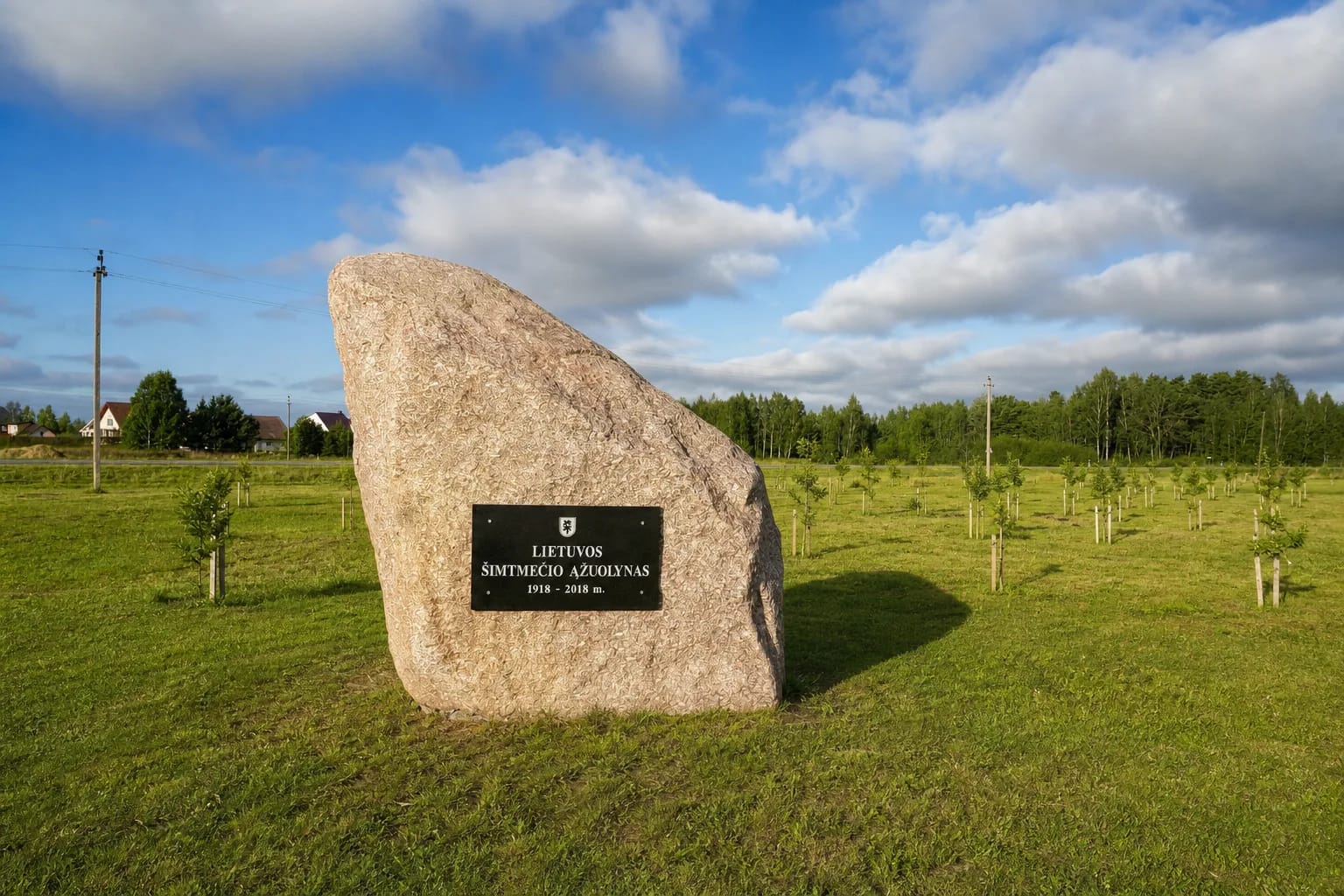
The grove's strongest landmark is a huge pale fieldstone. The current official district place record says that it weighs about 35 tonnes and was brought from the Šnaukštai gravel quarries in 2018. Standing in an open meadow before rows of young oaks, it works both as a memorial and as an unmistakable meeting point.
The council's 2018 material confirms details that may be hard to read from a distance. It specifies a 60 by 110 cm black-stone plaque, the Dovilai coat of arms at the top, and the inscription 'Lietuvos šimtmečio ąžuolynas 1918-2018 m.' The same document explicitly connects the boulder with the grove planted in 2017, ruling out the idea that it is merely a generic anniversary stone later placed in an unrelated park.
Photograph the plaque from the front rather than climbing onto the boulder. Its surface can become slippery when wet or icy, and it was not designed as a viewpoint. The dates on the stone, framed by the developing grove behind it, convey the idea far better than a view from the top.
Reading a statehood memorial in a town of Lithuania Minor
The oak is widely associated in Lithuania with strength, longevity, and memory, but Dovilai's grove does not need an invented story about an ancient sanctuary. The checked local records describe a specific community action in 2017 and the centenary of Lithuania's modern restored state. This is documented civic memory, not an archaeological or mythological site.
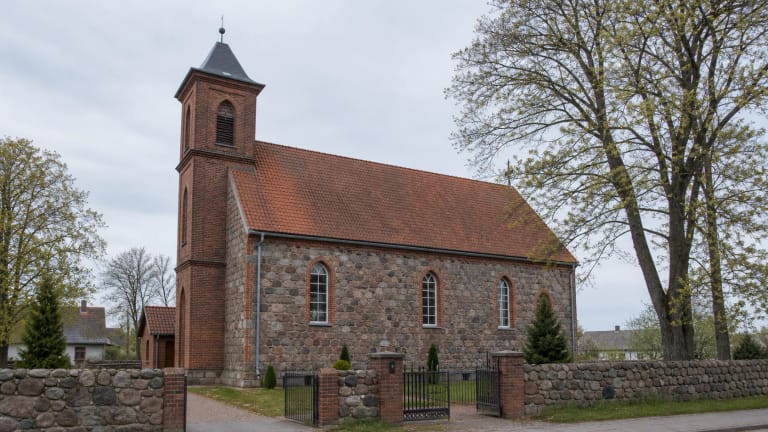
Its regional setting nevertheless adds meaning. Dovilai is a town of Lithuania Minor with an Evangelical Lutheran church and a distinct local heritage, while the grove's plaque displays the Dovilai coat of arms. The nationwide story of 1918 is therefore set within the landscape and identity of a particular community rather than in an anonymous park.
The memorial changes as the oaks grow. Stakes and small saplings dominated its first years; crowns and rows become more legible over time. Returning after several years can be more rewarding than a single visit because this is a monument whose defining material grows rather than merely ages.
The neighbouring Wheel of the Year sculpture hill extends the visit
The Wheel of the Year sculpture hill opened in the same Parko Street area on 6 July 2025. Its composition has 12 metal-and-stone sculptures dedicated to the months, with four taller works marking the two solstices and two equinoxes. Some elements respond to wind or human touch, so the hill is a distinct experience rather than decorative scenery for the boulder.
The grove and sculpture hill are related but not interchangeable. The first consists of the 100 centennial oaks and memorial boulder; the second explores the annual cycle, natural phenomena, and seasonal work. Seen in sequence, the fixed dates 1918-2018 lead into a landscape concerned with recurring natural time.
The earlier Dovilano Žvaigždė emblem is also associated with this area. Do not assume that every stone or metal element belongs to the centennial grove: read the labels first and leave movable artwork components as intended. Allow at least 45 minutes if you want to understand the combined ensemble rather than photograph only the main stone.
On Statehood Day, the meadow becomes a community stage
The grove is more than a static memorial. In 2025, Klaipėda District Municipality announced a Statehood Day programme here with history, traditional games, music, the opening of the sculpture hill, and a communal singing of the national anthem. In 2026, Klaipėda District Ethnic Culture Centre again held a free Statehood Day festival at Parko St 6. The repeated use confirms an emerging role as a setting for Dovilai's civic gatherings.
An event day and an ordinary visit produce very different experiences. The festival offers a live programme, but a stage, service vehicles, and crowds may occupy part of the meadow, while parking becomes harder. Outside events, the boulder and planting plan are easier to examine, although there is no permanent exhibition attendant or guide on site.
Dates, admission, and programmes can change. The event on 6 July 2026 was advertised as free, but that does not guarantee the terms of every future activity. Check the Ethnic Culture Centre's current calendar before making a special journey and follow any temporary rules for access, traffic, photography, or filming.
Opening hours, admission, surfaces, and arrival
The centennial grove is an open outdoor space without a ticket office, and the checked official sources do not publish fixed opening hours or general admission. A brief visit is normally free, but daylight is the safest time. An event, mowing, tree care, storm damage, or other work can alter access, so signs on site always take priority over older online descriptions.
The official visitor and event address is Parko St 6. The coordinate 55.680517, 21.364749 marks the attraction itself, not the centre of a confirmed visitor car park. Park only where current signs permit, never block Parko Street, residents' entrances, or event and emergency access; during a large celebration, walking from central Dovilai may be the simplest option.
The principal view is across open grass, and ground around the young trees can be soft, natural, or wet. No independent accessibility audit for the whole visit was found. Wheelchair users should ask event organisers about current surfaces and temporary facilities before a festival. After rain, avoid crossing waterlogged root zones: this protects both visitors and oaks that are still maturing.