- Place
- Dovilai, Klaipėda District Municipality
- Region
- Klaipėda District
- Type
- hillfort and archaeological site
- Address
- Piliakalnio Forest, Dovilai Eldership, Klaipėda District
- Coordinates
- 55.66403, 21.33945
Dovilai, Gedminai Hillfort, Gedminai Castle, Muškalnis, Pelalė (Pilalė) Hill, Pelutė Hill, Dusmenai Hillfort
Dovilai Hillfort - Gedminai Castle by the Minija
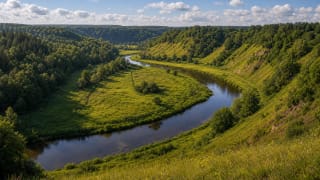
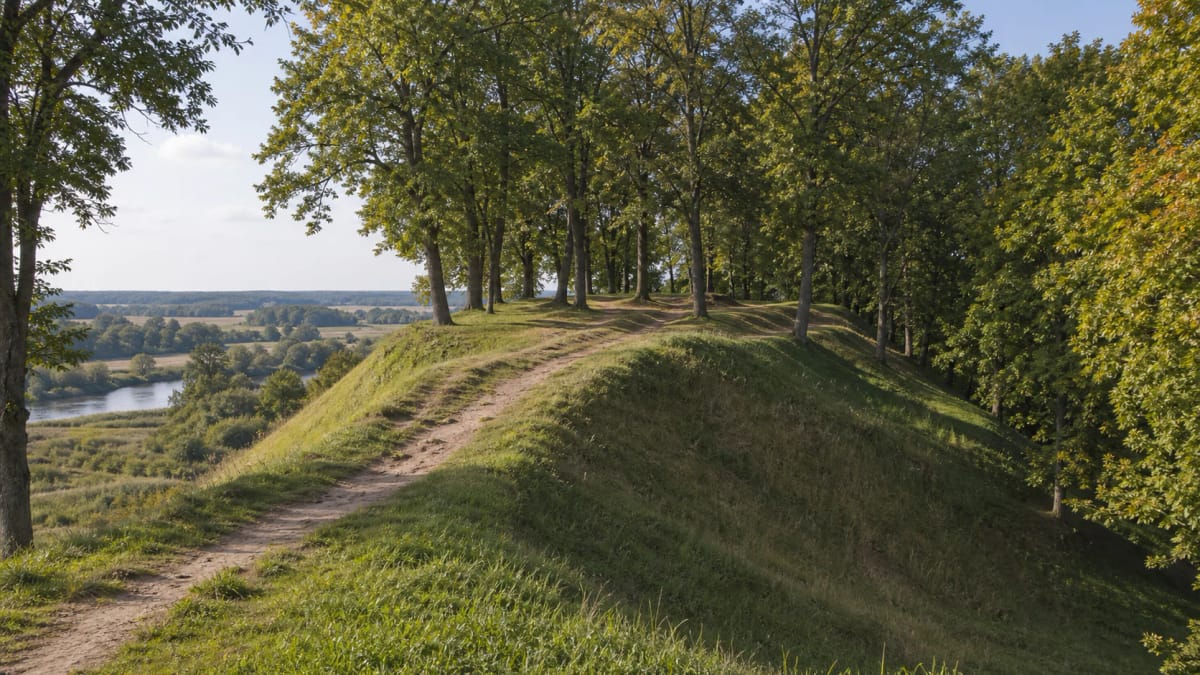
Dovilai Hillfort stands on the right bank of the Minija, in Piliakalnis Forest north-west of the town of Dovilai. It was built on a spur of the highland, so its relief is directly tied to the river valley, and the site is reached from the road by following signs set out from the town.
In the Cultural Heritage Register the object is listed as Dovilai, Gedminai Hillfort, also called Gedminai Castle, Muškalnis, and Pelalė and Pelutė Hill (unique code 5173). It is a state-protected archaeological monument of national significance, dated to the first millennium to the middle of the second millennium.
Platform, ramparts, and steep slopes
The hillfort platform on the spur is long and narrow - about 110 x 20-25 m, with ramparts 0.5-2.5 m high at its ends. The slopes are steep, about 9 m high, so the defensive logic is clear on site: the highland is surrounded on three sides by lower ground, while the ramparts reinforce the platform's most vulnerable ends.
These dimensions help visitors do more than simply climb the hill: they make the hillfort's structure readable. The elongated platform is typical of the spur hillforts of western Lithuania, where the natural edges of river valleys were adapted for defence.
An abundance of names and the name Gedminai Castle
The hillfort carries an unusual number of names: Gedminai Castle, Muškalnis, Pelalė (or Pilalė) Hill, and Pelutė Hill. The Universal Lithuanian Encyclopedia also records it as Dusmenai Hillfort. This variety shows that the place was long a prominent local landmark, spoken about across several generations of villagers.
The names are not historical proof of specific dukes or castles - they are community memory attached to the landscape. Because of this, the hillfort is valuable not only archaeologically but also as a cluster of place names and stories.
Legends of treasure hidden in the hill
Nearly twenty stories and legends are linked with Dovilai Hillfort. One of the best known, recorded before the Second World War, tells of a hole in the hill where shepherds hoped to find treasure. Lowered into the cave, a shepherd boy found a gate, and behind it an old man who fed him and showed him halls gleaming with gold, then let him out with orders to tell no one what he had seen.
When the boy returned after three days and, unable to resist questioning, let the secret slip, he immediately lost the power of speech. Such stories should be presented as legends: they do not prove historical events, but they show how the community explained the mysterious relief and the ancient past. Here it is important to separate archaeological fact from folklore.
Traces of the Second World War and visiting
In late 1944 the hillfort was incorporated into the Klaipėda defence system: a trench was dug along the eastern edge of the platform, concrete machine-gun positions - so-called Koch bunkers - were built into the ramparts, and an anti-tank ditch with a bank leans against the slopes. Dovilai Hillfort therefore shows not only an ancient layer but also a twentieth-century war layer.
It is a freely accessible outdoor heritage site with no ticket. A visit usually takes 30-45 minutes; on the forest paths it is important to protect the slopes and turf. The hillfort pairs well with Dovilai Ethnic Culture Centre, the Evangelical Lutheran church, and Minija valley routes - so the archaeological, sacral, and living-culture layers open up within a small area.