- Place
- Degaičiai, Telšiai District Municipality
- Region
- Samogitia
- Type
- state-protected botanical natural-heritage site and public dendrological park containing fragments of a former manor estate
- Address
- Parko g. 24, Degaičiai, Telšiai District
- Coordinates
- 55.99636, 22.29347
- Visit duration
- 1-1.5 hours for the ponds, avenues, plant collection, and park landmarks; up to 2 hours for slower plant study or a family rest
- Best time
- late May and June for the tulip tree and flower beds, or a dry autumn morning for foliage colour
Degaičiai Park, Degaičiai Manor Park, Degaičiai Manor Park of Dendrological Value
A state-protected park embedded in the village of Degaičiai
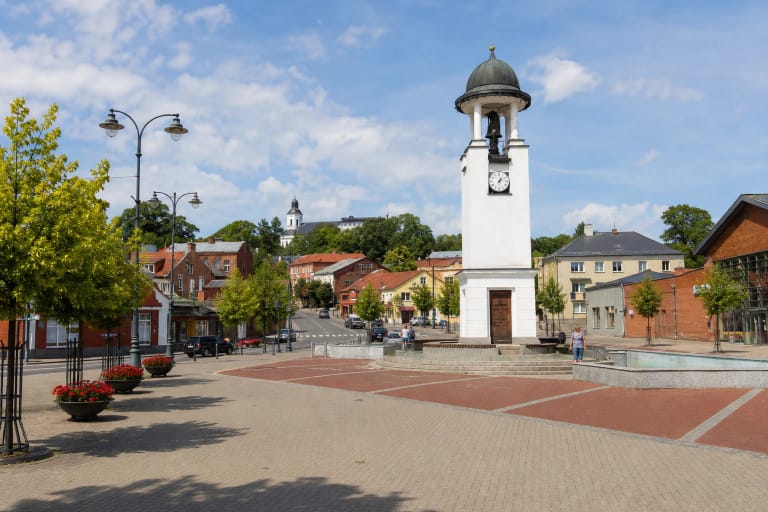
Degaičiai Manor Estate Park is more than a green backdrop to a lost manor house. Lithuania's State Service for Protected Areas lists it among the botanical natural-heritage sites of Telšiai District, and a 2017 environment-ministerial order granted state protection as a park of dendrological value. The irregular protected territory is enclosed by village streets and buildings; its value lies in the tree and shrub collection, the planting composition, and the pond system.
The map point at 55.996364, 22.293470 comes from the official Telšiai District list of visitor attractions. It is a representative park-side location, not a single gate, a confirmed parking bay, or the geometric centre of the protected area. That list uses Parko g. 24, while newer public listings use Degaičių g. 9. Both lead to the same central part of the park rather than to two separate attractions.
The park is a public village space, but protected status places responsibilities on visitors. Do not damage labelled plants, enter closed maintenance areas, let pets into flower beds, or ignore temporary instructions beside the ponds.
The late-19th-century park survived more clearly than the manor estate
The old section, covering about 6 ha, was formed in the late 19th century on mixed-planning principles. Straighter avenues meet looser curving paths and irregular groups of trees. No reliable record of the original designer survives, so the landscape should not be attributed to a famous architect without evidence.
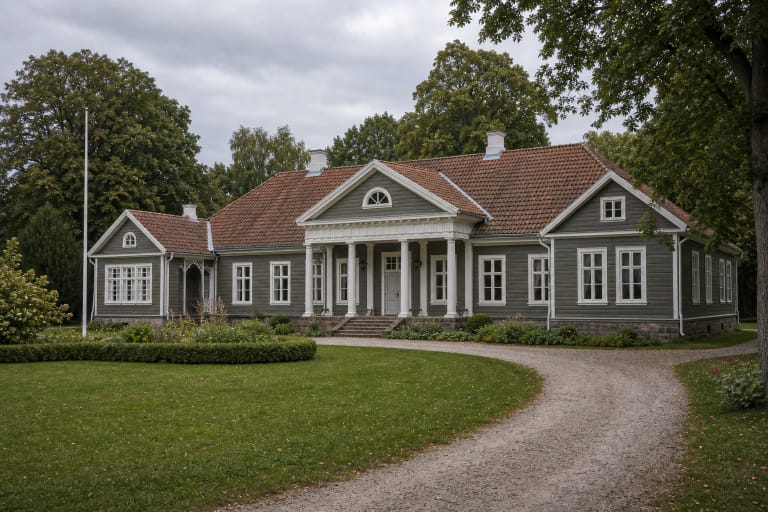
Around 1913 the manor was purchased by the farmer brothers Liaugaudai. Sources say they concentrated on the working estate while retaining rare trees and shrubs in the park. VLE confirms that a manor existed at Degaičiai until 1940, while Telšiai District Municipality lists the former manor-estate fragments under Register of Cultural Property code 732.
The word fragments matters. Degaičiai is not a complete ensemble of palace, service wings, farm buildings, and visitable interiors. The reason to come is the park and its living collection; the old planted core and traces of the estate plan are the clearest ways to read the manor-period layer.
Adolfas Kišonas rebuilt the landscape as a long-term dendrological work
The decisive revival began in 1972, when Mykolas Ežerskis, director of the Anulėnai poultry farm, invited artist and dendrologist Adolfas Kišonas to restore the neglected park. Kišonas prepared an improvement plan, removed low-value growth, shaped paths, excavated ponds, and planted both native species and ornamental plants brought from elsewhere.
This was not a one-off clean-up. Kišonas worked with Lithuanian botanical gardens and nurseries, propagated plants at his own property, grafted ornamental forms, and raised some specimens for roughly ten years before moving them into the park. The present collection is therefore the outcome of one creator's sustained selection as well as the survival of an old landscape.
Karolina Praniauskaitė Public Library's profile of Kišonas gives 6 ha for the old section and 18.2 ha for the enlarged park. A 2025 municipal budget document, by contrast, describes the area maintained by the eldership as more than 10 ha. These figures should not be added together or treated as a single exact measure of today's protected boundary, because the documents describe the park at different historical and administrative scales.
About 300 tree and shrub taxa arranged around six ponds
Native oaks and spruces form much of the park's structural woodland, but introduced conifers and ornamental broadleaf forms reveal its dendrological character. Documented specimens include blue and Serbian spruces, European silver and Siberian firs, blue Douglas fir, Swiss stone pine, European larch, purple-leaved beeches, columnar oaks, and yellow-flowered tulip trees.
The Lithuanian Dendrologists' Society counts about 300 species and cultivars of trees and shrubs here. The words and cultivars are important: differences in leaf colour, crown form, or grafting may represent selections within one botanical species. Look beyond named rarities to see how purple foliage, narrow conifer crowns, and mature native trees have been composed together.
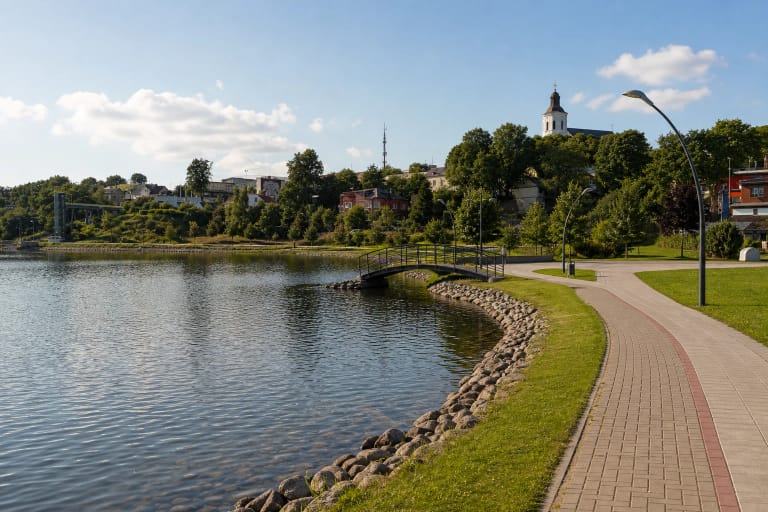
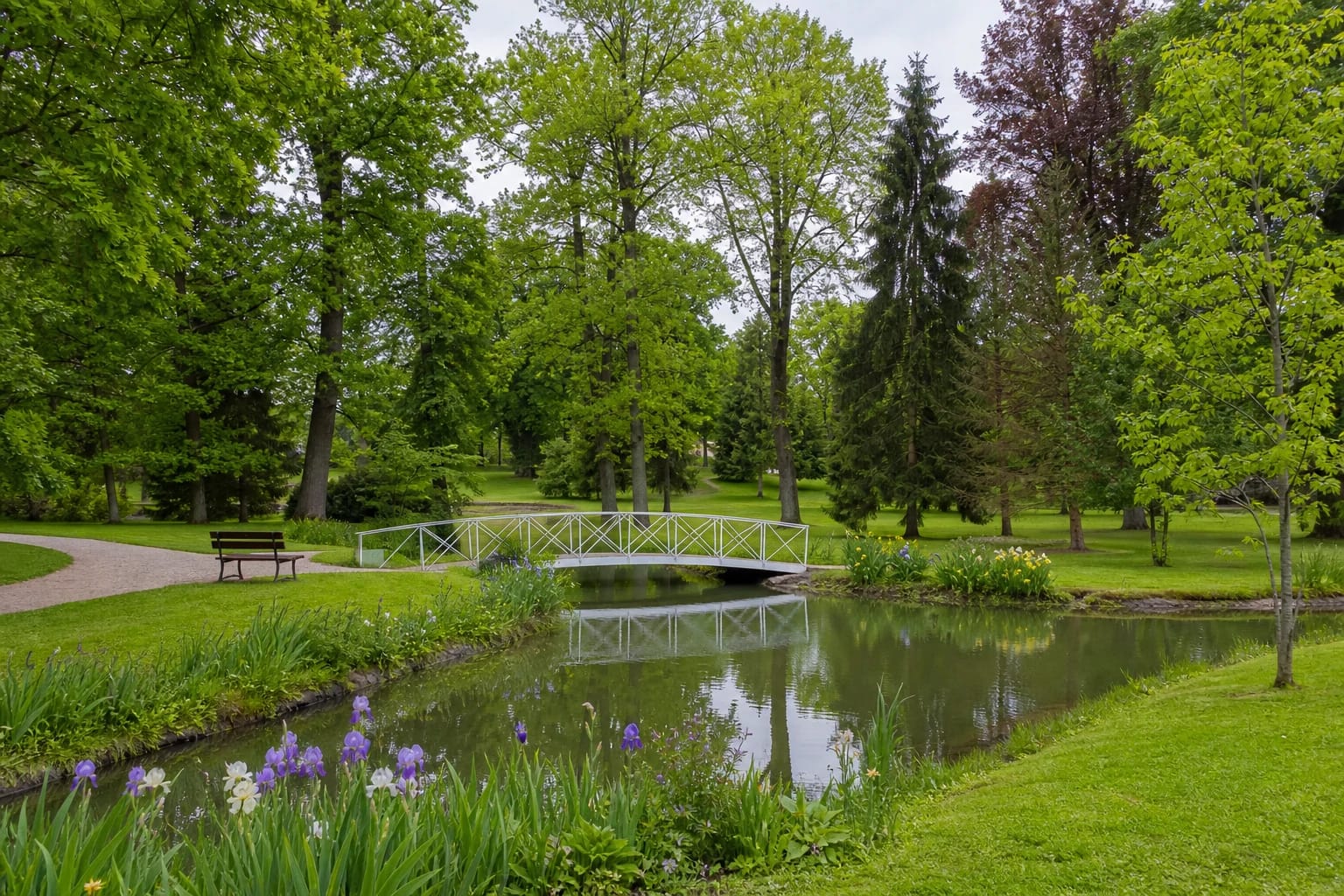
Six ponds of different sizes turn the planting into a walking sequence, while low metal bridges and flower beds create the park's most recognisable views. The water bodies require continuing care. Municipal documents report that two ponds were cleared in 2024 and that work on the remaining four was planned, so aquatic growth, maintenance activity, and temporary route changes can vary by season.
Paths, the Samogitian Unity Stone, and two different giant bicycles
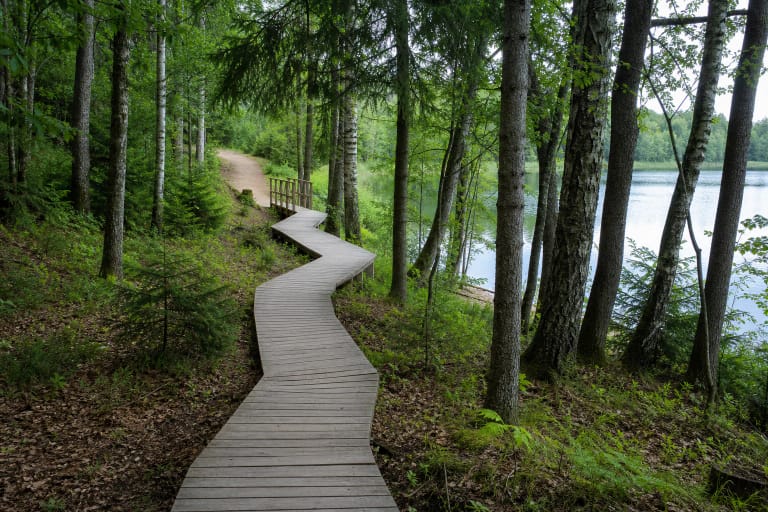
The park rewards a circuit rather than the shortest crossing. Follow straight avenues and curving paths around the ponds, looking for plant labels, the Samogitian Unity Stone, low bridges, flower beds, and artistic details added by the community and local makers. The condition and location of labels, sculptures, and paths can change, so an older plan cannot guarantee that every marked element remains in place.
The easiest contemporary landmark to recognise is a two-seat, 1,800 kg metal bicycle installed in 2021 and made by Albinas Rimkus with the local community. It is heavier than the earlier rideable bicycle that first made Degaičiai famous, but it is not the same model that received a Guinness record. Online articles and photographs often conflate the two machines and their weights.
Treat the current bicycle as an outdoor exhibit and photographic landmark. Do not climb on it or try to move it unless an organised event, an authorised supervisor, and explicit safety instructions make participation possible.
Planning a visit to Degaičiai Park
The park is an unfenced public outdoor space. No separate admission ticket, ticket office, or shared published opening schedule was found in reliable sources, so an ordinary walk is free. Events, tree care, and pond works may temporarily alter routes; if travelling for a specific festival or feature, check the latest notice from the eldership or Telšiai District Municipality.
Allow 1-1.5 hours for the principal circuit, or up to 2 hours when reading labels and pausing by the water. Official visitor information marks the park as adapted for disabled visitors, but this does not mean every secondary path, lawn, or pond edge is uniformly step-free, firm, and level. Assess the most suitable route on arrival.
A 2025 municipal planning document described the roughly 400 sq m parking area's surface as poor and proposed repairs, but that is not confirmation of its condition in 2026. Park only where current signs permit, do not obstruct residential entrances, and supervise children closely beside open water. Degaičiai combines naturally with Telšiai Old Town and the Lake Mastis waterfront.