- Place
- Daugai eldership, Alytus District Municipality
- Region
- Alytus District
- Type
- Romantic Gothic Revival masonry church with a separate wooden bell tower
- Address
- Maironio g. 6, Daugai
- Coordinates
- 54.35993, 24.34422
- Visit duration
- 30-60 minutes; longer if the church is open and you want time for the art
- Best time
- daylight, when the fieldstone and churchyard buildings are clearest; check Mass times before travelling
Daugai Roman Catholic Church of Divine Providence
A towerless church in the centre of Daugai
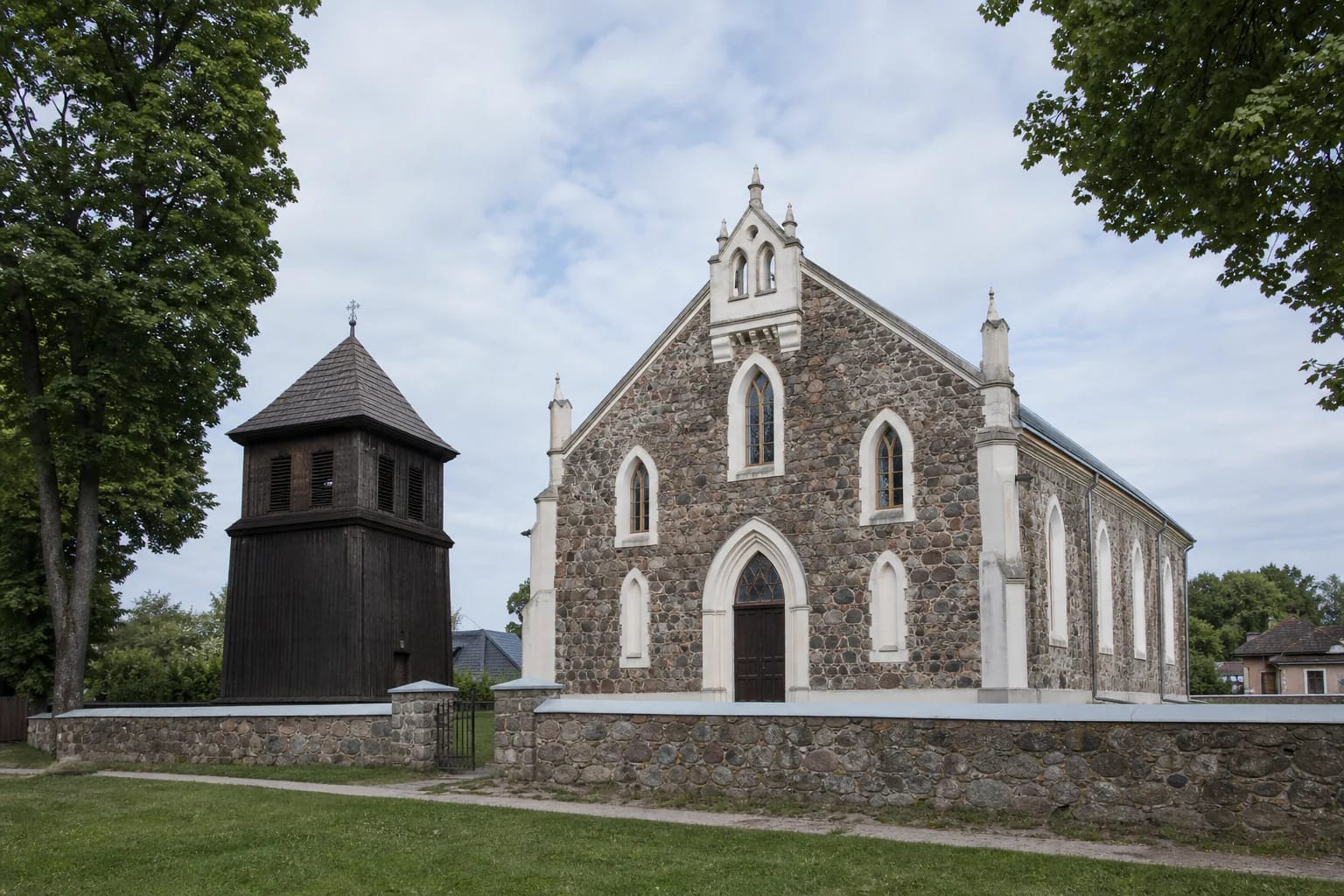
Daugai Church of Divine Providence stands on Maironio Street, and its exterior is immediately marked by unrendered fieldstone walls and pale plaster details. The main building has no tall facade towers: a small central element gives the gable some height, while a separate bell tower stands on the churchyard side.
This is a working Catholic parish church, so exterior viewing can be calm while interior entry follows parish practice. If you hope to go inside, choose a time before or after worship and follow the church's rules.
1862 fieldstone masonry and unbuilt towers
The present masonry church was built in 1858-1862, with Tomas Tišeckis named as its architect. Romantic Gothic Revival and Classicist traits meet local material here: split fieldstone remains visible in the walls, while the frames around windows and openings establish a pale, measured rhythm.
Towers were planned for the sanctuary but were never built, leaving an unusually restrained silhouette. Walk around the facade to notice pointed openings, white plaster inserts, and proportions that suggest Gothic Revival even without a twin-towered front.
The separate wooden bell tower from 1889
A separate two-storey wooden bell tower stands in the Daugai churchyard and dates from 1889. Its pyramidal roof makes it visually distinct from the fieldstone church, and the pairing helps explain how the ensemble served the liturgical life of the parish.
Leave a clear gap between the two buildings when taking photographs and do not describe the bell tower as a church tower. This independent structure is an important detail of the Daugai skyline, with a wooden texture that contrasts with the strict masonry of the main volume.
Altars, paintings, and the organ story
The interior is associated with an 18th-century painting of Divine Providence attributed to Pranciškus Smuglevičius, an 18th-century Crucifixion group, and 18th-century confessionals. An early 19th-century reliquary of Saint Victor adds another layer, although the works can only be viewed when the church is properly open.
The church organ dates to about 1770 and was rebuilt in 1931 by Wacław Biernacki. Antanas Kmieliauskas painted the vaults in 1958. Materials from the Cultural Heritage Department's 2026 Restoration Council considered conservation of the side altars, so interior access and condition may change.
Daugai's historical layers and a practical visit
The present church has a complex line of predecessors: an earlier wooden sanctuary burned in 1655, was rebuilt by 1674, and after later fires and relocations Daugai received a new masonry church. Parish priest Vladas Mironas was part of Daugai's community from 1914 to 1926, linking the site with a wider strand of 20th-century Lithuanian history.
The address is Maironio g. 6, Daugai. Around 30 minutes is usually enough for the exterior and bell tower, while up to an hour is sensible if the church is open. Check Mass times, door access, photography rules, and any restoration work before travelling, because a public map card is not a visiting timetable.