- Place
- Vilnius City Municipality
- Region
- Vilnius
- Type
- late Gothic monastery church with defensive features
- Address
- Maironio g. 10, Vilnius
- Coordinates
- 54.68310, 25.29390
Bernardine Church, Church of St Francis and St Bernardino
Bernardine Church and Lithuania's best-known Gothic ensemble
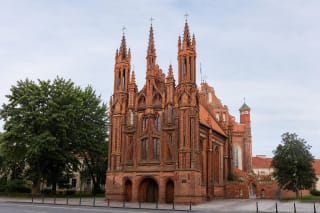
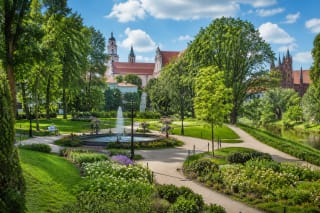
The Bernardine Church stands on the edge of Vilnius Old Town, by the Vilnelė and Sereikiškės Park, just behind the smaller St Anne's Church. Do not confuse the two: St Anne's is small, single-aisled, and famous for its openwork brick facade, while the Bernardine Church is a much larger three-aisled hall church immediately behind it. VLE calls the whole ensemble the most famous Gothic monument in Lithuania.
The church belongs to the Observant Franciscans, the Bernardines, whom Grand Duke Casimir Jagiellon invited to Vilnius around 1469. The first wooden church was dedicated to St Bernardine of Siena, while the present, already third, masonry church was consecrated under the title of St Francis of Assisi.
When it was built and who created it
The present church was built in the early sixteenth century, around 1506-1516. Exact dates differ somewhat among sources, so they should be treated as approximate. Mykolas Enkingeris is named in the literature as the architect of the Gothic building. Over the centuries the church was damaged by wars and fires, rebuilt, and supplemented with Renaissance and Baroque details.
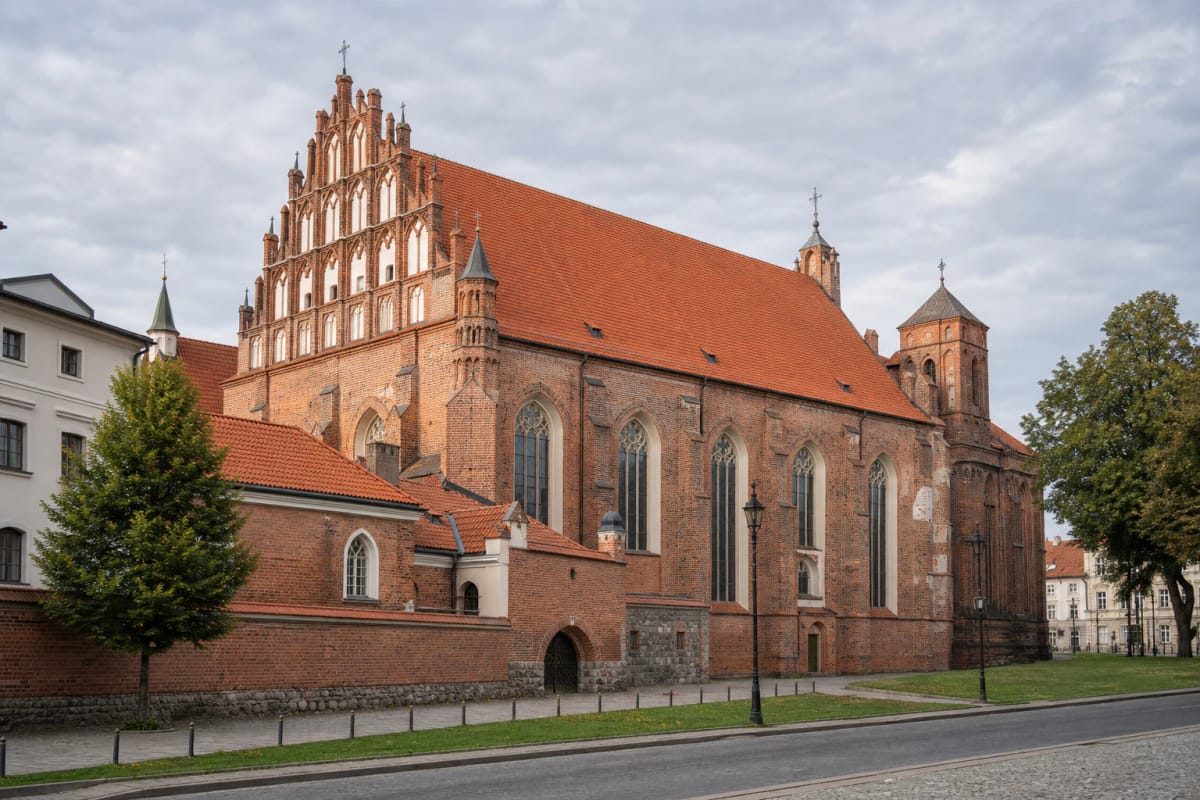
The clearest Renaissance accent is the wavy gable of the main facade, with the Crucifixion fresco painted in 1846 by artist Kanutas Ruseckas. The side-aisle vaults - net, star, and crystal vaults - are regarded as one of the most mature examples of Lithuanian Gothic.
A church that also served defence
The Bernardine Church is unusual because it was built not only as a sacred building but also as part of city defence, near the Lower Castle and on the line of the city defensive wall. Above the naves, in the attic, a defensive gallery with firing openings survives, and the facade turrets once gave access to this level. It is a rare case in Lithuania where a church combines prayer and fortress functions, unlike its more decorative neighbour St Anne's.
The church also preserves important artworks. It has a wooden cross dated to the fifteenth century and described by heritage sources as one of the oldest sculptures of this kind in Lithuania, a claim best understood as a source-based heritage statement. Inside, sixteenth-century Gothic al secco frescoes have been uncovered, a unique Lithuanian example on this scale, and around ten late Baroque wooden altars from the seventeenth and eighteenth centuries survive in natural wood colour.
From warehouse to returning Franciscans
The mid-twentieth century was dramatic for the church. In 1949 the Soviet authorities closed it, moved the parish to St Anne's Church, and handed the premises to the Art Institute, which used them as a warehouse. Restoration began in 1982.
In 1994 the church was returned to believers and the Franciscans came back. Today it is the active Vilnius St Francis of Assisi, or Bernardine, Parish, served by the friars; the monastery also houses the administration of the Lithuanian Franciscan province.
How to visit the Bernardine Church
The best approach is to visit the church together with St Anne's Church, the bell tower, and the surrounding old-town quarter by the Vilnelė. Allow about 1-1.5 hours for the whole ensemble. For the Bernardine Church itself, 30-45 minutes is usually enough: enter, look at the vaults, frescoes, and wooden altars.
It is an active parish church, so entry is usually free and visiting is best coordinated with service times. Check the official parish page for the current visiting and service schedule, because it can change.