- Place
- Viekšniai Eldership, Mažeikiai District Municipality
- Region
- Samogitia
- Type
- state-protected geological and archaeological monument and boulder
- Address
- Žibikai Forest, near Žibikai village, Viekšniai Eldership, Mažeikiai District
- Coordinates
- 56.23100, 22.47500
- Visit duration
- 30-60 minutes
- Best time
- in daylight, when the forest road is dry and the approach is safer
Žibikai Stone, Black Stone, Love Stone, Viekšniai Stone, Great Stone
A boulder in Žibikai Forest
The Black (Love) Stone stands in the Žibikai pine forest in Viekšniai Eldership, Mažeikiai District, near the Viekšniai-Pievėnai and Viekšniai-Tirkšliai road junction. Saugoma.lt places it about 0.22 km northeast of the junction and roughly 0.2 km northeast of the Žibikai village cemetery.
The map point marks the boulder itself, not the whole forest or the nearest village. Choose a dry day if possible and allow for a final approach by forest road or on foot.
A broad, unusually large stone
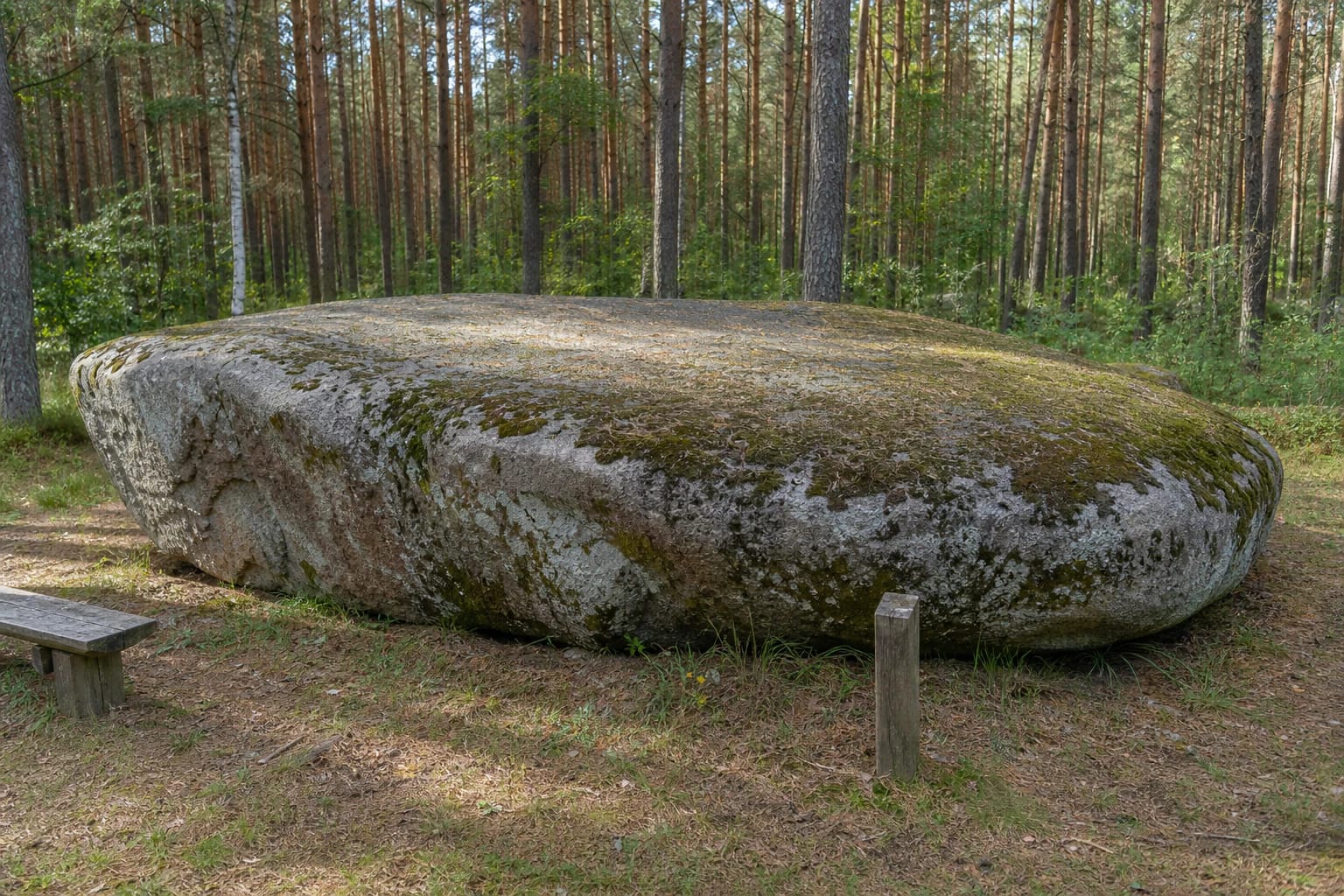
The boulder has a flat, irregularly oval surface. Saugoma.lt gives its length as 5.59 m, width as 3.76 m, height as 1.89 m, and circumference as 15.25 m. Two step-like ledges about 80-90 cm high are visible on its southern side, making its scale easier to grasp than the simple label “large stone.”
VLE describes it as reddish granite. Its listed minerals are plagioclase, garnet, microcline, quartz, and biotite, so visitors may look for differences in grain and colour without removing any fragments.
A glacial natural monument
VLE says the boulder is thought to have been carried to its present location by a glacier from Sweden or northern Finland about 70,000 years ago. Its geological story can be read in one stone: its origin is tied to glacial movement, while the surrounding forest belongs to today's Samogitian landscape.
The Black Stone has been state-protected since 1964 and is both a natural and archaeological monument. Protected-area sources place it in the setting of Venta Regional Park, so responsible visiting means respecting the wider protected landscape as well as the boulder.
Why Black Stone and Love Stone?
The name Black Stone is linked to a dark surface crust that VLE explains through manganese compounds. Other names - Žibikai Stone, Viekšniai Stone, and Great Stone - refer to its location, the nearest town, or its size.
VLE connects the name Love Stone with a local account of a tragedy from the early twentieth century. This is a layer of cultural memory and legend, so it is best told as a traditional explanation of the name rather than as a verified account of every detail.
Visiting and protecting the stone
Take time to approach the boulder: the pine-forest setting, needle-covered ground, and the stone's scale are the main experience. The checked official sources do not list a regular ticket, visitor centre, or opening hours, so this is not a site to plan like a museum visit.
Do not climb if it could damage the surface or create a hazard, and never scratch, dirty, paint, chalk, or break the stone. Follow signs on site, take rubbish with you, and protect the forest floor so the boulder remains both a natural and a cultural-heritage place.