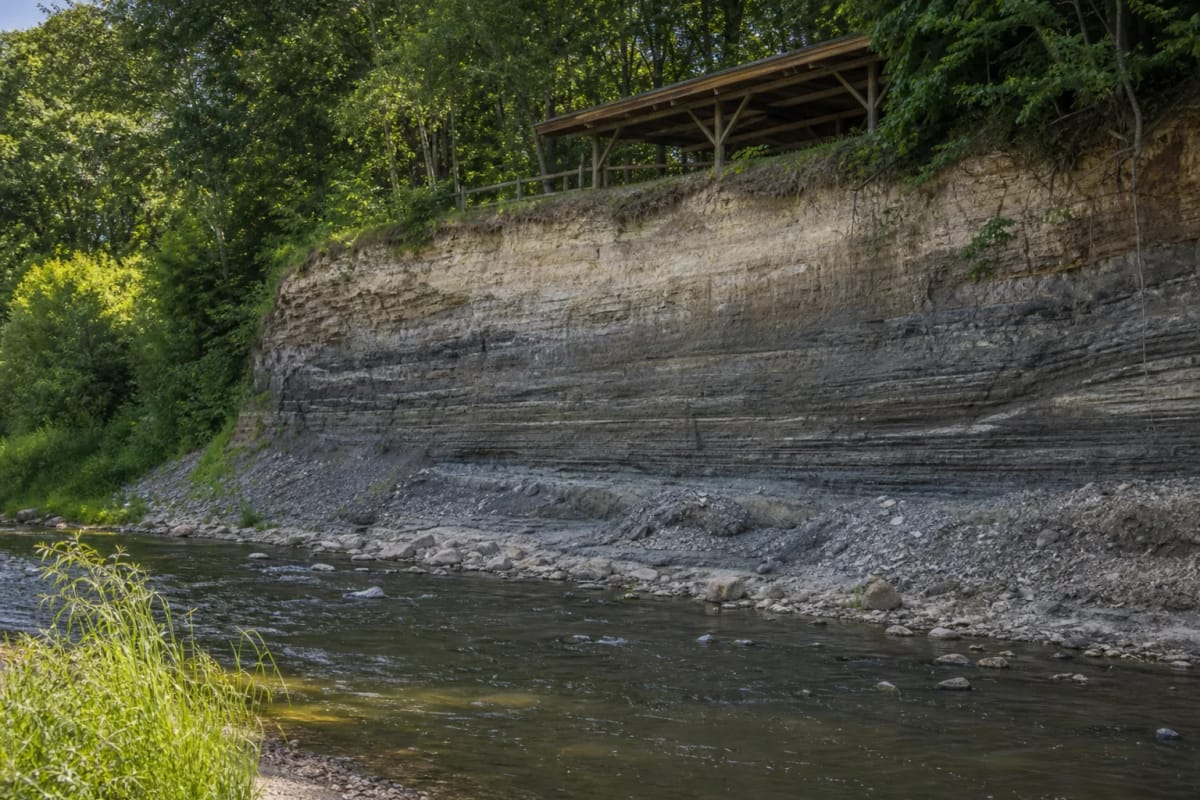
- Place
- Akmenė District Municipality
- Region
- Samogitia
- Type
- Jurassic geological outcrop and natural monument
- Address
- Papilė, right bank of the Venta, Akmenė District
- Coordinates
- 56.14800, 22.80700
Papilės atodanga, Papilė Jurassic outcrop, Papilė geological outcrop
Papilė Outcrop: a look into the Jurassic
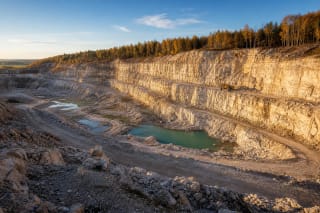
Papilė Outcrop opens on the right bank of the Venta River near the town of Papilė in Akmenė District. It is one of Lithuania's most important geological heritage objects: protected since 1964 and declared a natural monument in 2000. The outcrop is notable because rocks visible here at the surface lie tens or hundreds of metres deep elsewhere in Europe.
VLE states that the outcrop exposes middle and late Jurassic rocks 164-155 million years old: blackish and brown clays, silt, sand, and sandstone. The outcrop is about 20 m high and 130 m long, with steep 40-60-degree slopes.
A treasury of fossils
Papilė Outcrop is famous for fossils. The clay layers contain many ammonites, shells and fragments of bivalves and other molluscs, and belemnites are also found. According to saugoma.lt, about 300 remains and fragments of Jurassic animals have been described here.
These finds tell the story of an ancient sea that covered the area of present-day Lithuania hundreds of millions of years ago. Because of this scientific value, the outcrop is considered one of the most important sites around Papilė and in the country: an open-air page of Earth history.
Protection and setting
To preserve the fragile outcrop, it was adapted for visitors in 2006: a shelter with a wooden-shingle roof protects it from precipitation, and the slopes above the exposure were reinforced with a special mesh. Visitors can therefore see the layers without damaging the monument itself.
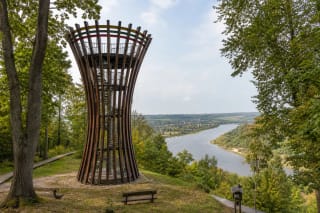
The outcrop belongs to Venta Regional Park and the Venta Landscape Reserve, making it part of a wider protected river-valley area. The Venta, its valley, and Jurakalnis on the opposite bank form one coherent geology and nature route.
How to visit
The outcrop can be visited freely and without charge; a path along the Venta leads to it. The best time is dry, warm weather, because clay slopes become slippery after rain. Wear practical footwear and use care. A visit usually takes 30-45 minutes.
It is easy to combine the outcrop with Papilė town, where historian Simonas Daukantas is buried and a museum is dedicated to him, as well as with the Jurakalnis Trail across the Venta. Do not break the rock or collect fossils: this is a protected natural monument.