- Place
- Alytus, Alytus City Municipality
- Region
- Dzūkija
- Type
- city park founded between the Dainava and Putinai districts in 1982, with a metal-sculpture ensemble begun in 1984-1985, two later works by international artists, and active recreation areas
- Address
- Entrance from Vilties Street, Alytus
- Coordinates
- 54.40337, 24.03115
- Visit duration
- 60-90 minutes for the ten sculptures and ponds; 2-3 hours with a playground, sports area, or picnic
- Best time
- April-October for a longer walk and outdoor activities; the colors read best in daylight, and temporary diversions should be checked while 2026 works continue
Jaunimo parkas, Alytaus Jaunimo parkas, Youth Park sculpture ensemble
The map point leads into the sculpture zone, but a 36 ha park has more than one approach
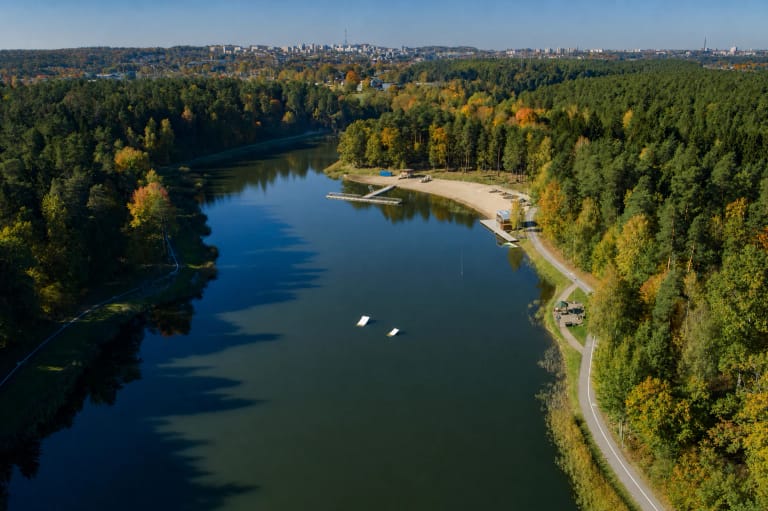
Youth Park covers roughly 36 ha between the Dainava and Putinai residential districts, so one coordinate cannot represent a single official gate. The point on this page, 54.403366, 24.031151, comes from Alytus TIC's official sculpture map and is a useful representative location near the artworks, not a precise parking bay or geometric center. TIC uses Vilties Street for the ensemble, the municipality's park page names Žuvinto Street, and project material also refers to Parko Street. These are different edges of one large park, not separate attractions.
On July 19, 2026, the EU investment record still marked the 2024-2026 regeneration as in progress, with completion scheduled for December 31, 2026. Its scope includes paths, a small bridge, street furniture, lighting, accessibility, parking infrastructure, and new leisure spaces. Until each phase is accepted, planned features in the project description should not be mistaken for facilities already open.
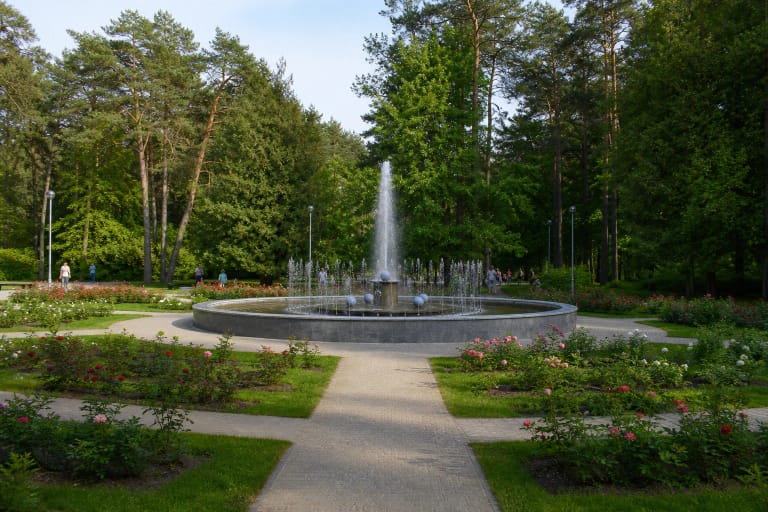
Excavation of a 2,032 square metre pond began in January 2026. A section of lighting, part of a path, one bench, and part of the dog-area fence were temporarily removed within the work zone; the municipality said these would be restored, with a fountain, approaches, lawn, and planting to follow. No park-wide closure has been announced, but local fencing and diversions remain a realistic part of a 2026 visit.
The park founded in 1982 and the 1984-1985 sculpture program are distinct phases of its history
Youth Park was created in 1982 around undulating terrain, spring-fed channels, and surviving groups of pines. An early municipal green-space plan gives an area of 36.6 ha and identifies chief architect V. Jodelė with architects A. Gercienė and S. Vaičaitytė. Open lawns, tree masses, and wet depressions were composed as a large district park, not simply a square for sculpture.
In 1984, young sculptors led by Naglis Nasvytis and Alytus chief artist Albertas Stankevičius began a vividly colored metal-art program commemorating Teodoras Kazimieras Valaitis. A peer-reviewed Vilnius Academy of Arts study describes the result as Lithuania's first permanent outdoor display of its kind in metal. The original eight were not remote monuments on plinths but decorative forms close to human scale and, in the design language of the time, deliberately functional.
The municipality dates creation of the ensemble to 1984, while captions for several works in the academic study give 1985. The honest description is therefore an ensemble formed in 1984-1985, rather than forcing one year onto all eight objects. The park was declared an art monument of local significance in 1993 because of these sculptures.
The original eight make a colorful trail from a cage to an image of early flight
Kęstutis Musteikis's Narvelis gegutei, or Cage for a Cuckoo, resembles a domed cage assembled from metal ribs. Benjaminas Narbutas's Vandens malūnas, Water Mill, uses an abstract arrangement of angular and forked elements for a mill image inspired by the landscape. Vytautas Narutis's tall Vartai, Gates, ends in stylized horse heads that reinterpret traditional Lithuanian rooftop finials. Klaudijus Stepanovas turns a goat into a sharp black-and-red silhouette in Ožys.
Antanas Balkė's Karališkasis voras, Royal Spider, is a large blue tubular structure whose spread legs are easy to recognize across the lawn. In Virginija Babušytė-Venckūnienė's Vaivorykštė, Rainbow, two figures seem to hold a beam of light; the artist emphasized blue, red, and yellow and chose a scale close to children. Vidmantas Gylikis's Povas, Peacock, opens a semicircular tail punctuated by rhythmic round forms. Naglis Nasvytis's Aeronautikos istorija, A History of Aeronautics, combines a blue arch, red wing-like arms, and an upper emblem to suggest early dreams of human flight.
Their brightness is not only a survival from the original program. The academic study notes that the sculptures were maintained and repainted in colors selected by their artists. What visitors see is therefore the product of long-term care, not untouched paint from 1984. Several pieces stand in lawns or among trees rather than directly beside the principal path, making the complete set a genuine visual hunt.
Two international additions complete the ten, while Žiedas is a separate precursor
Danish sculptor Tim Juel Jacobsen gave Klausimas, Question, to the park in 1997. In the interpretation published by the municipality, a person follows a path, reaches a dead end, and discovers an opening through the wall into new space. German sculptor Michael Odenwaeller's Žingsnis, Step, was unveiled in 1998. These two works plus the original eight form the ten sculptures on the municipality's current park list.
Teodoras Kazimieras Valaitis's Žiedas, Ring, also known locally as Kosmosas, is not one of those ten. VLE records a 1972 design by Valaitis that sculptor G. Kavaliauskas realized in 1981; the work stands beside the sports center on Naujoji Street, west of the principal Youth Park ensemble. It matters as a physical and intellectual precursor and as context for the later program honoring Valaitis.
The records also contain naming inconsistencies. The municipality and TIC currently call Musteikis's work Narvelis gegutei, Cage for a Cuckoo, whereas a caption in the academic article calls the same object Narvelis lakštingalai, Cage for a Nightingale. The city page prints the Royal Spider artist's surname as Blakė, but the academic study and artist records support Antanas Balkė. These are editorial differences, not extra sculptures or different creators.
Today's play, sport, quiet-rest, and dog facilities occupy separate zones
The municipality's park inventory names children's play, skate, parkour, pump track, basketball, beach volleyball, and table-tennis areas, together with fixed and adjustable-weight outdoor gyms. It also lists a dog zone, Love Labyrinth, and an area for older visitors. Padaužų aikštelė, a climbing and obstacle area aimed at ages 10-16, was added in 2025; in 2026 the municipality described the beach-volleyball courts as freely available without advance booking.
These activities are dispersed across a large site, so the sculpture circuit and sports equipment do not form one compact plaza. If one activity is your main purpose, inspect its surface, equipment, and possible work fencing on arrival. The official park page does not establish shared opening hours for every installation or confirm permanent equipment hire, a drinking-water point, or a public-toilet schedule.
Some metal works were historically designed with playful interaction in mind, and the creator of Rainbow explicitly spoke about children moving beneath its form. That does not make four-decade-old sculptures certified climbing equipment today. Use the dedicated playgrounds for active play, follow current signs, and do not climb a sculpture unless on-site guidance clearly permits it.
For a first visit, connect the sculptures and ponds before choosing one activity zone
Begin near the representative point on the Vilties Street side and make an unhurried circuit in search of the eight original and two later sculptures. Aeronautikos istorija, Karališkasis voras, and Vartai work well as landmarks because of their scale, while the lower Povas and Vaivorykštė can recede into the terrain and planting. Continue towards the established ponds after the sculpture circuit, but never cross construction barriers around the new water body.
The main network includes broad asphalt sections, yet the landscape undulates, some sculptures stand on grass, and the 2026 works can alter an otherwise familiar route. Improving accessibility is an explicit objective of the ongoing project, but an unfinished project is not proof that every sculpture is already step-free. Wheelchair and pushchair users should favor the principal hard-surfaced paths and be prepared to turn back at a temporary barrier.
The official sources publish no common admission charge, ticket office, or gate-controlled park hours, so the public space itself is free to enter; this does not promise that every sports area or event is available at every hour. Daylight is best for identifying the works and navigating safely. Allow 60-90 minutes for the sculptures alone, or 2-3 hours if adding play, sport, or a picnic.