- Place
- Vilnius City Municipality
- Region
- Vilnius
- Type
- early Baroque Jesuit church in Vilnius Old Town
- Address
- Didžioji g. 34, Vilnius
- Coordinates
- 54.67760, 25.28880
St Casimir's Church in Vilnius, Vilnius Jesuit Church
The first Baroque church of the Grand Duchy near Town Hall
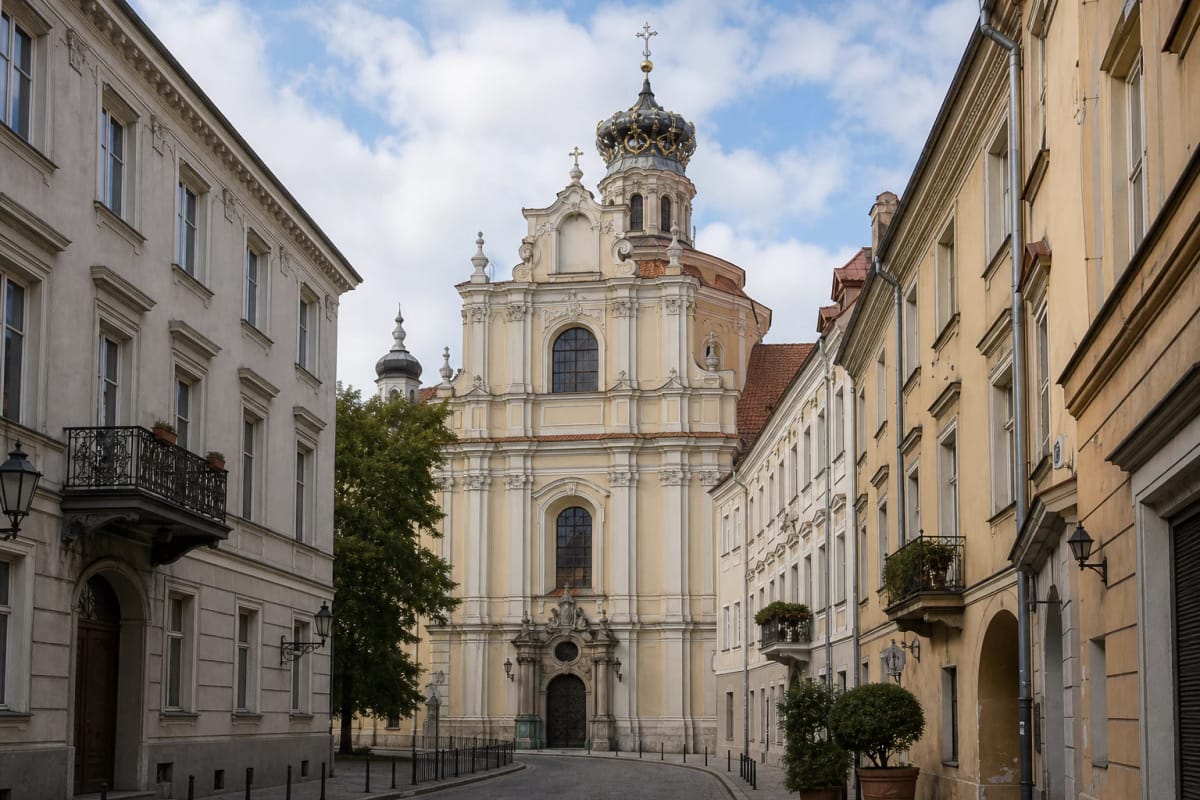
Vilnius St Casimir's Church stands on Didžioji Street, facing toward Town Hall Square. It is considered one of the first Baroque churches in the Grand Duchy of Lithuania, so it is not only a sacred site but also a foundational marker on the old town's representative axis.
The church has a Latin-cross plan and is a three-aisled basilica. The side aisles are divided into six chapels that are not connected by passages. The facade is articulated with pilasters, semicircular arched windows and niches, four-tier towers on the sides, and an early Baroque gable with mannered volutes.
The dome with the Grand Duke's crown
The church's most recognizable feature is the high dome, about 40 m tall, rising at the crossing of the nave and transept. It is crowned by a helmet shaped like the crown of a Grand Duke of Lithuania and topped with an iron cross, an unusual symbol of statehood and sanctity in the Vilnius roofline.
The original eighteenth-century crown helmet did not survive. The present one was forged in 1942 to a design by architect Jonas Mulokas. Inside, the dome is decorated with Rococo reliefs, while the main and transept artificial-marble altars are dynamic late Baroque compositions.
Jesuits and the cult of St Casimir
The church was begun in 1604 on the initiative of the Jesuit order. It is thought that Jesuit provincial Petras Bokša designed it and J. Frankevičius built it; construction was completed around 1618. Its creation was directly connected with St Casimir's canonization: Casimir, Grand Duke of Lithuania, 1458-1484, was declared a saint in 1602, solemnly honoured in Vilnius for the first time in 1604, and proclaimed patron of Lithuania in 1636.
In Vilnius, St Casimir is not only a dedication. His remains rest in St Casimir's Chapel in Vilnius Cathedral, and the March 4 indulgence feast gave rise to Kaziukas Fair. The Jesuits promoted St Casimir's cult as part of the Counter-Reformation, so this church links the cathedral, the idea of a state patron, and the sacred map of the city.
A complicated history of use
After the fire of 1749, the church was reconstructed by architect T. Žebrauskas. After the Jesuit order was suppressed in 1773, it was a parish church for a time; in 1812 the French army used it as a grain warehouse and destroyed the altars. In 1840 it was given to the Orthodox, and in 1864-1868 it was rebuilt as St Nicholas Cathedral, gaining Neo-Baroque features: lowered towers, and onion-shaped helmets on the dome and towers.
In the twentieth century the church changed owners several times. In 1915 it became a German Lutheran prayer house; in 1917 it was returned to Catholics; in 1942 the crown on the dome was restored (architect Jonas Mulokas); in 1949 it was closed; and in 1966 the Soviet authorities installed the Museum of Atheism here. It was returned to believers in 1988, transferred to the Jesuits in 1990, reconsecrated on March 3, 1991, and in 1991 a crypt from the first half of the seventeenth century was found under the high altar.
How to visit St Casimir's Church
Today it is an active, small non-parish Jesuit church belonging to St Teresa's Parish. Visiting, service, and concert arrangements change, so check the official church page before going. For the exterior alone, 20-30 minutes is enough; add more time for the interior.
From Didžioji Street the church is seen in fragments because the old-town fabric is dense, so it is worth walking around and viewing the facade from several points. Inside, behave as in an active church: speak quietly and avoid disruptive photography.