- Place
- Vilnius City Municipality
- Region
- Vilnius
- Type
- Holocaust memory sites in the former ghetto quarter
- Address
- Rūdninkų g. 18 (buvusieji Didžiojo geto vartai), Vilniaus senamiestis
- Coordinates
- 54.67570, 25.28430
Vilnius Ghetto, Vilna Ghetto, Large and Small Ghettos
What you see in the old-town streets
The Vilnius Ghetto Memorial is not one large monument. It is a group of memory markers scattered through narrow old-town streets - Rūdninkų, Žemaitijos, Mėsinių, Ašmenos, Stiklių, Gaono, and Žydų - where the Nazi-created Jewish ghetto operated in 1941-1943. The street network itself is the central memorial: as you walk, you read the former ghetto boundaries.
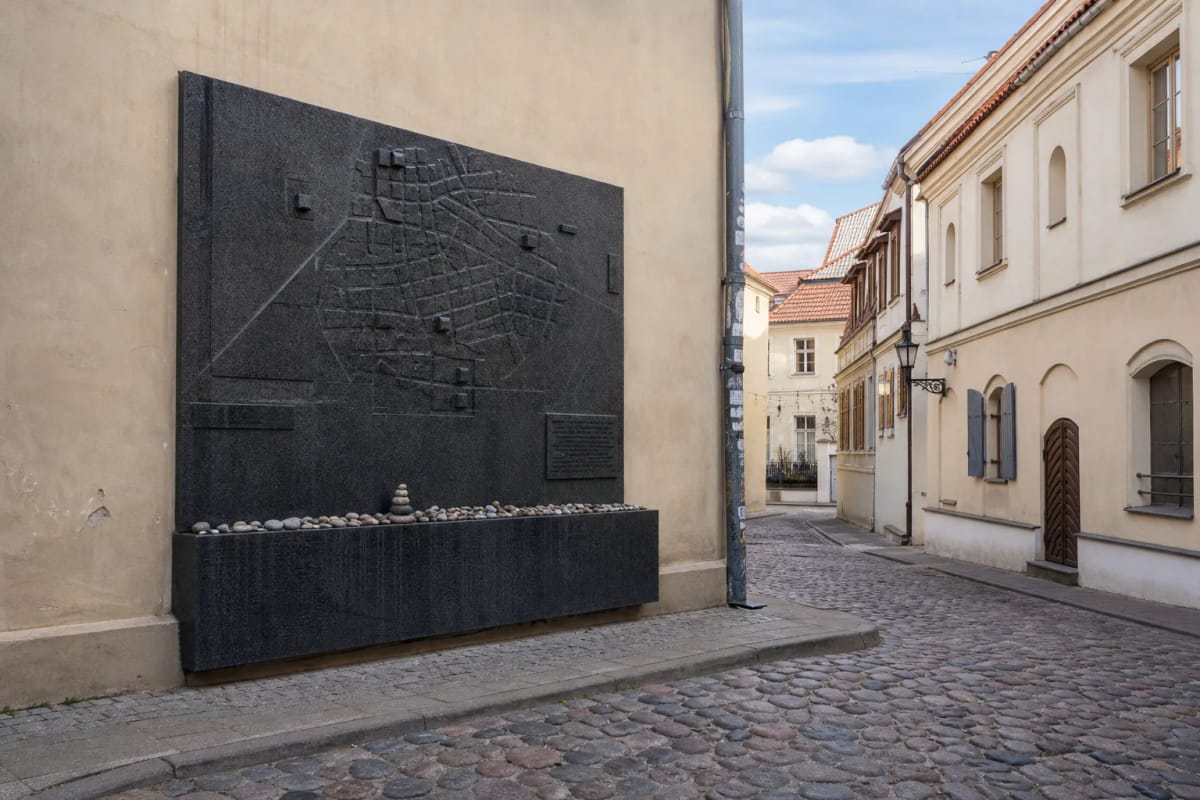
The main marker is the pair of granite plaques at the former Large Ghetto gate at Rūdninkų g. 18, at the corner of Visų Šventųjų Street. The upper plaque shows the plan of the Large and Small Ghettos with important buildings; the lower plaque gives the text in Lithuanian and Yiddish. Another clear focus is the monument to the ghetto victims on Mėsinių Street, near the Jewish Culture and Information Centre.
Visit slowly and quietly. These are open-air memorial places: they are free and accessible at any time, but they make the most sense on foot, moving from plaque to plaque and imagining that these streets were once divided by a ghetto fence and gates.
Large Ghetto and Small Ghetto
VLE states that the ghetto was established on September 6, 1941, in the part of the old town where a large Jewish community had long lived. It was divided into two sections, the Large Ghetto and the Small Ghetto, separated by Vokiečių Street. More than 40,000 people were forced into the two ghettos.
The Small Ghetto covered the historic Jewish quarter around the Great Synagogue, including Stiklių, Gaono, Antakalnio, and Žydų streets. It existed only briefly: in October 1941 it was liquidated, and its prisoners, mostly older people, children, and those considered unfit for work, were shot at Paneriai. The Large Ghetto covered Rūdninkų, Mėsinių, Ašmenos, Žemaitijos, Dysnos, Lydos, and nearby streets and operated until September 23, 1943.
This distinction matters on site. In the Small Ghetto streets, memory reaches back to only a few months in autumn 1941; in the Large Ghetto quarter, the story spans two years, from creation to final destruction. The dates on the plaques point to these different boundaries.
Gate plaque and victims' monument
The most important memorial point is the former Large Ghetto gate at Rūdninkų g. 18. According to the plaque text, the gate stood here in 1941-1943, and more than 30,000 Jews were driven through it to their deaths. The upper plaque with the ghetto plan helps orient visitors immediately, showing which surrounding streets belonged to the Large Ghetto and which to the Small Ghetto.
On Mėsinių Street, in the reconstructed quarter between Ašmenos, Dysnos, and Mėsinių streets, stands the monument to the victims of the Vilnius Ghetto, placed near the Jewish Culture and Information Centre. Near the former Judenrat building at Rūdninkų g. 6, a memorial stone honours the teenage ghetto chronicler Icchok Rudaševski.
Another important address is the former ghetto library building at Žemaitijos g. 4, formerly Strašuno Street. The Vilna Gaon Museum of Jewish History has announced plans to establish a Vilnius Ghetto and Holocaust in Lithuania memorial museum there; at the time of research it had not yet opened, so check the museum page for current information.
Jerusalem of the North
Before the war, Vilnius was one of the world's major centres of Jewish religion, learning, and Yiddish culture. It was called the Jerusalem of the North, or the Jerusalem of Lithuania, Lite Yerushalayim, the city of the Vilna Gaon and the YIVO Institute for Jewish Research. The ghetto memorial places remember the destruction of that civilization.
Even inside the ghetto, cultural life was extraordinary. There were Hebrew and Yiddish schools, a music school, a symphony orchestra, two choirs, a Yiddish theatre, a library with an archive, and a kind of ghetto university. The encyclopedia notes that the first theatre evening was met by the protest slogan that theatre should not be performed in a cemetery, showing how morally difficult creativity felt in the face of death.
The ghetto also had armed resistance. The United Partisan Organization, FPO, was founded on January 21, 1942, led first by Itzik Wittenberg and later by Abba Kovner. The figure of Jacob Gens, who headed the ghetto administration, remains controversial: he tried to save people through work but operated under occupation conditions and was murdered by the Gestapo on September 14, 1943, only days before the ghetto's liquidation.
From creation to destruction
Persecution began in the first days of the occupation. From July 1941, Jews had to wear identifying signs; arrests and killings followed, and victims were taken through Lukiškės Prison to Paneriai, 12 km from the city, where they were shot. On September 15, 1941, the first major Aktion took place inside the ghetto.
After the relatively calmer period of 1942 and early 1943, the Nazis decided to destroy the ghetto. Liquidation began on September 23, 1943: men were taken to camps in Estonia and Germany, able-bodied women to Kaiserwald in Latvia, people considered unfit for work and children to Auschwitz, and others were shot at Paneriai. Remaining prisoners in labour camps were shot at Paneriai in July 1944.
Exact numbers differ somewhat among sources, so they should be presented carefully and with source context. One fact is clear: only a few thousand people from the huge prewar Jewish community of Vilnius survived the occupation. On September 23, 2018, marking the 75th anniversary of the ghetto liquidation, Pope Francis honoured Holocaust victims in the former ghetto area.
How to visit the ghetto memory sites
The most practical way to visit is as one walking route: start at the gate plaque at Rūdninkų g. 18, continue to the memorial stone at Rūdninkų g. 6, the monument on Mėsinių Street, and the former library at Žemaitijos g. 4. A walk with stops at the markers usually takes 45 minutes to 1.5 hours and is easy to combine with the rest of the old town.
For wider context, visit the Holocaust exhibition of the Vilna Gaon Museum of Jewish History at Pamėnkalnio g. 12 separately. Check official museum hours and ticket prices because they can change. The killing site at Paneriai is a separate memorial outside the city centre and deserves its own trip rather than being treated as part of the ghetto-quarter walk.