- Place
- Rojus, Ignalina District Municipality
- Region
- Aukštaitija
- Type
- memorial homestead of a pioneering pomologist, with his house-museum, first hut-granary, park, ponds, and the surviving memory of a research orchard
- Address
- 5 Rojus village, Dūkštas eldership, Ignalina District
- Coordinates
- 55.53062, 26.36450
- Visit duration
- 1-1.5 hours; allow up to 2 hours with a pre-arranged tour and an unhurried walk through the park
- Best time
- one of the museum's specifically published 2026 Saturdays; May for apple blossom or autumn for fruit trees and park colour
Professor Adomas Hrebnickis Memorial Museum, Adomas Hrebnickis Museum at Rojus, Hrebnickis Homestead, Rojus Orchard
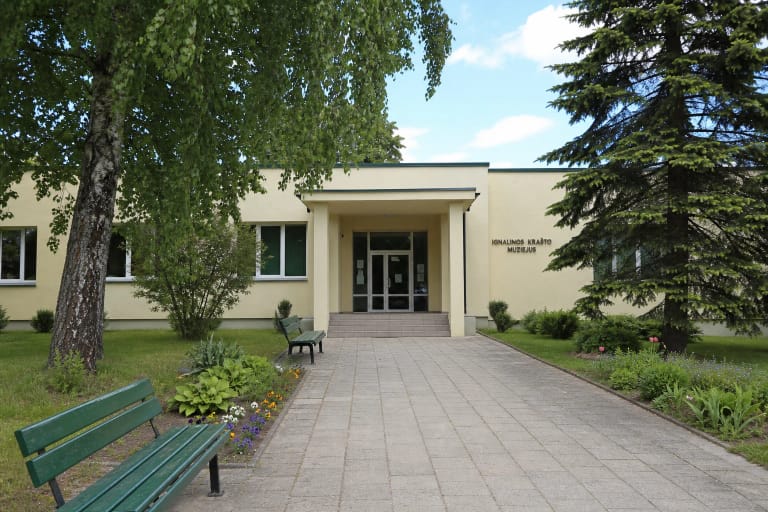
This is a separate branch at Rojus, and its map pin does not identify one doorway
The museum is at 5 Rojus village in Dūkštas eldership, approximately 3 km north-east of Dūkštas. It is not Ignalina Regional Museum at 43 Ateities Street in the town of Ignalina, but a seasonal branch operated by that institution since 2012. Both use the same municipal tariff system, yet their addresses, collections, and published 2026 schedules differ.
Coordinates 55.530621, 26.364496 reproduce the point published in official local information, but are labelled representative here. The memorial site includes the principal house, a separate first hut-granary, park, ponds, and orchard areas. The marker is not a verified entrance door, parking bay, or start of a step-free route.
The Register of Cultural Property records the Professor Adomas Hrebnickis Homestead House-Museum as object 10494, while the wider homestead is registered separately. Do not hurry directly into the white house: the wooden hut-granary and outdoor setting are independent parts of the story, not decorative annexes.
The 14 ha orchard was a research laboratory, and Rojus became the official place name in 1922
Adomas Hrebnickis was born on 6 January 1858. He graduated from the St Petersburg Forestry Institute in 1883, taught there, and headed its Horticulture and Market Gardening Department from 1902 to 1922. After marrying Stanislava Stankevičiūtė in 1886, he received about 24 ha of hilly, stony, and wet land at the Staniškiai farmstead from his father-in-law. Museum history records that the ground had been called Velnynė, roughly the Devil's Place. An orchard and nursery covering about 14 ha took shape here from 1890 to 1904.
The orchard was divided into blocks of 100 trees set in a checkerboard at intervals of approximately 6.3 by 6.3 m. A 1910 plan cited by the museum counted 437 apple, 154 pear, 116 plum, and 82 cherry and sweet-cherry cultivars: 789 distinct cultivars, or 1,085 names when synonyms were included. VLE gives wider totals researched over Hrebnickis's work: 629 apple, 223 pear, 240 plum, and 105 cherry cultivars. The figures cover different dates and counting methods and should not be combined into one supposedly exact snapshot.
Hrebnickis settled here permanently with his family in 1922, the year Rojus, meaning Paradise, became the official place name. He continued planting fruit trees and shrubs until 1936, studying yield, fertilisation, and frost resistance. Among the local cultivars he documented and distributed were Beržininkai Pineapple, Beržininkai Raspberry, Lithuanian Sugar, Lithuanian Pepin, and Panemunė White. He edited the Fruit Atlas in 1903-1906 and lived at Rojus until his death on 13 October 1941.
The principal house and first hut-granary preserve two different parts of domestic life
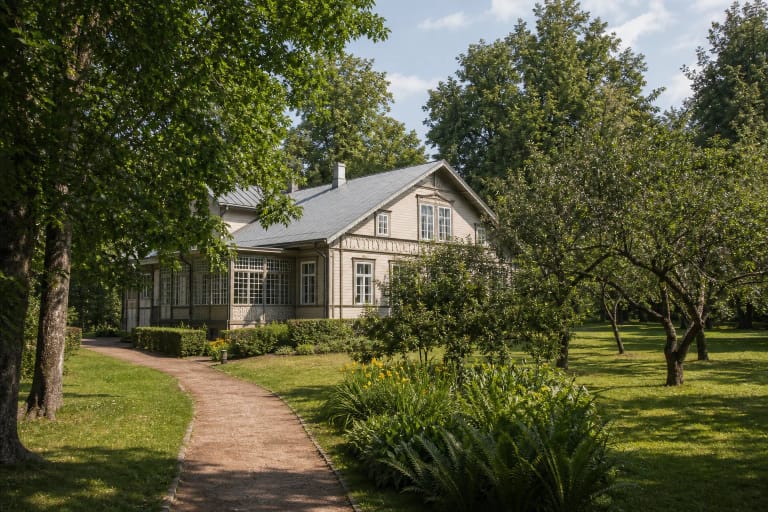
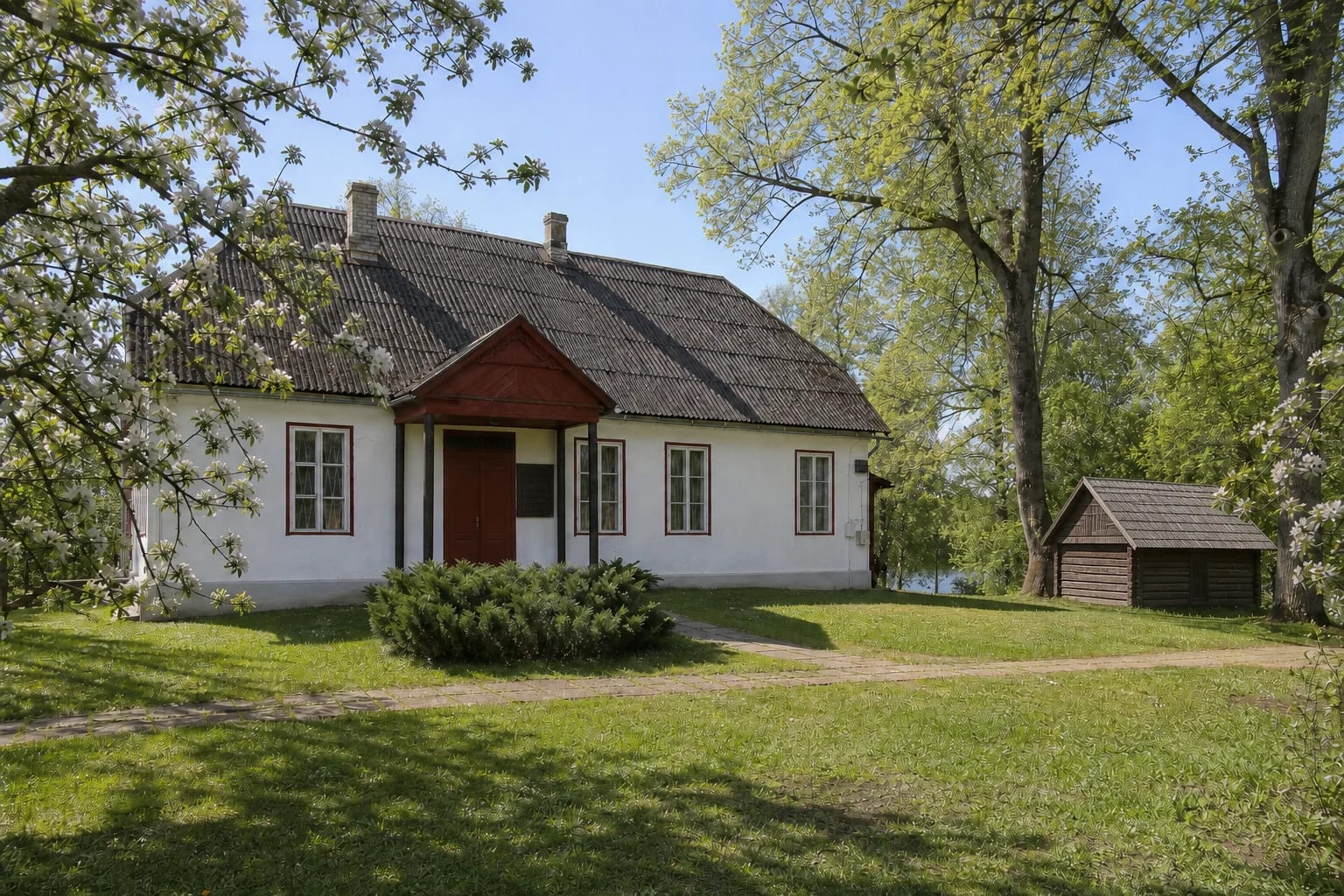
Heritage-funding documents date the principal house to 1897. Its present low white-plastered facade, steep dark roof, muted red porch, and tall windows contain rooms partly arranged as the professor's workplace and home. The branch's detailed page assigns four exhibition rooms to the main house, although its general introduction refers to five rooms across the museum. The source does not explicitly reconcile the two counts, which may reflect whether the separate building is included.
Displays include Hrebnickis's publications, manuscripts, letters, photographs, awards, personal and household objects, and models of fruit and berries. His study turns pomology from an abstract science into a routine of observation and note-taking. A room for his daughter Maria displays her paintings, while a model shows how much larger the home and working grounds once were. The second-floor terrace overlooks the ponds, but access to it on any particular day should be confirmed with staff.
The dark horizontal-log hut-granary is a separate structure. The museum identifies it as the first little house in which Hrebnickis lived, so it should not be described merely as a later farm granary or a copy of the main residence. No secure construction date for the hut was found in the authoritative public sources reviewed. Its exhibition and opening may depend on the season, event, or building work; ask whether it will be unlocked if it is central to your visit.
The museum opened in 1961 and preserves a restored orchard legacy, not an unchanged research estate
The orchard was thinned by the First World War, the severe winters of 1928-1929 and 1939-1940, and the Second World War, when trees were broken or cut for firewood and parts of the ground reverted to scrub. A support station of the Vytėnai Horticultural Experimental Station was established at Rojus on 28 February 1957. Staff then began collecting Hrebnickis cultivars surviving in the surrounding area, repairing the residential buildings, and restoring the homestead.
The museum's precise official wording says that it opened to visitors in 1961. A monument by sculptor Leonas Žuklys and architect Jonas Stravinskas was unveiled in the park in the same year. Some catalogues associate 1959 with the start of institutional formation, but that should not replace the documented 1961 public opening. The 65th anniversary celebrated in 2026 was likewise counted from 1961. Hrebnickis did not live to see the museum: he died in 1941.
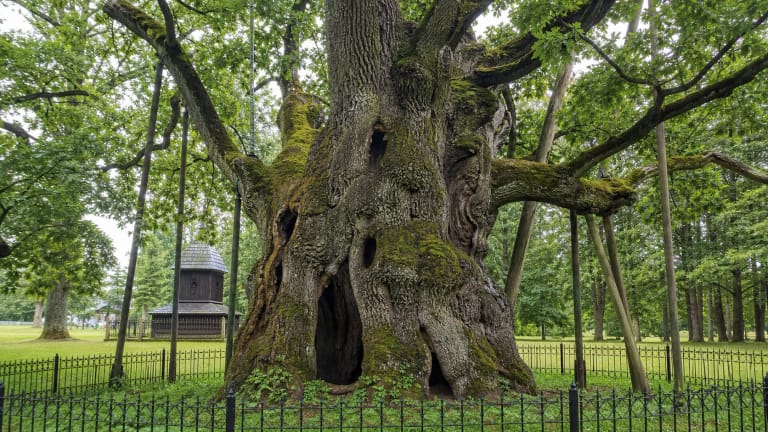
An official 2022 orchard history recorded 26 cultivated apple varieties and one pear variety in the surviving stock and also noted a small demonstration orchard. This is a dated account of restoration, not a guarantee that every visible tree was planted by Hrebnickis or remains identified in 2026. Read the present park, old oaks, flowers, and ponds against the scale of the historic plan, without mistaking them for the entire former 14 ha orchard.
Work planned across 2025-2027 brings both conservation and possible temporary restrictions
In August 2025, FIXUS Mobilis specialists inspected the registered house-museum and took samples for biological and chemical analysis. They cleared rainwater drainage, replaced broken glass, fitted temporary bargeboards, sealed the roof covering, and removed climbing growth that was damaging the building. These were preventive inspection and urgent care measures, not a declaration that the house had been comprehensively restored. The KPD 2026-2028 heritage-programme list also includes an application for applied research on the house.
A separate municipal project, Adaptation of Natural and Cultural Sites at Rojus for Visitors, began in October 2025 and is scheduled for completion by 31 October 2027. Its €568,010.25 programme includes new and renewed stabilised-earth paths, three shelters, lighting, cameras, benches, a wooden footbridge across a pond, fencing and visitor-counting gates, a car park, and a sanitary facility.
These are planned project outcomes, not a list of amenities verified as complete on 19 July 2026. Construction may alter paths, pond access, parking, or the opening of individual buildings. No public access audit confirms a continuous step-free route to every room, upper floor, hut, and WC; visible entrances in official photographs have steps. Discuss wheelchair or pushchair access and the current work area with staff before travelling.
Only six open Saturdays and €4 admission were published for 2026
The official season runs from 1 May to 30 October, but this does not mean daily opening. The only 2026 public dates listed were 16 May, 20 June, 25 July, 22 August, 19 September, and 10 October, each from 10:00 to 17:00. Independent entry on another date, or access to every building for a group, is not promised. Even for a listed date, confirm building work before setting out by calling +370 600 36592 or +370 682 13864, or email janina.cirikiene@ignalina.lt or muziejus@ignalina.lt.
The tariff approved by Ignalina District Council on 19 December 2024 sets branch admission at €4. A Lithuanian-language guide for a group of 10-25 is listed at €25, a foreign-language guide at €35, and a 45-minute guide at €10. Half-price and free-admission categories are available. Check the current tariff and ask whether the guide fee is charged in addition to individual tickets.
Allow 1-1.5 hours for the principal house, hut, and grounds, or up to 2 hours for a pre-arranged tour and a slow park circuit. Supervise children beside the ponds and stay outside fenced work zones. Because the future car park and sanitary facility remain project items, plan water, toilets, and parking in advance and follow temporary signs on arrival.