- Place
- Jonava District Municipality
- Region
- Aukštaitija
- Type
- memorial obelisk on the Kulva ridge
- Address
- Smičkiai, Kulva Eldership, Jonava District Municipality
- Coordinates
- 55.08696, 24.15704
- Visit duration
- 20-40 minutes; longer if you want to take in the fields and surrounding ridge
- Best time
- a dry, bright season, when the grass is shorter and the open horizon is clearest
A. Kulvietis Obelisk, Abraomas Kulvietis Memorial
An obelisk on the Kulva ridge
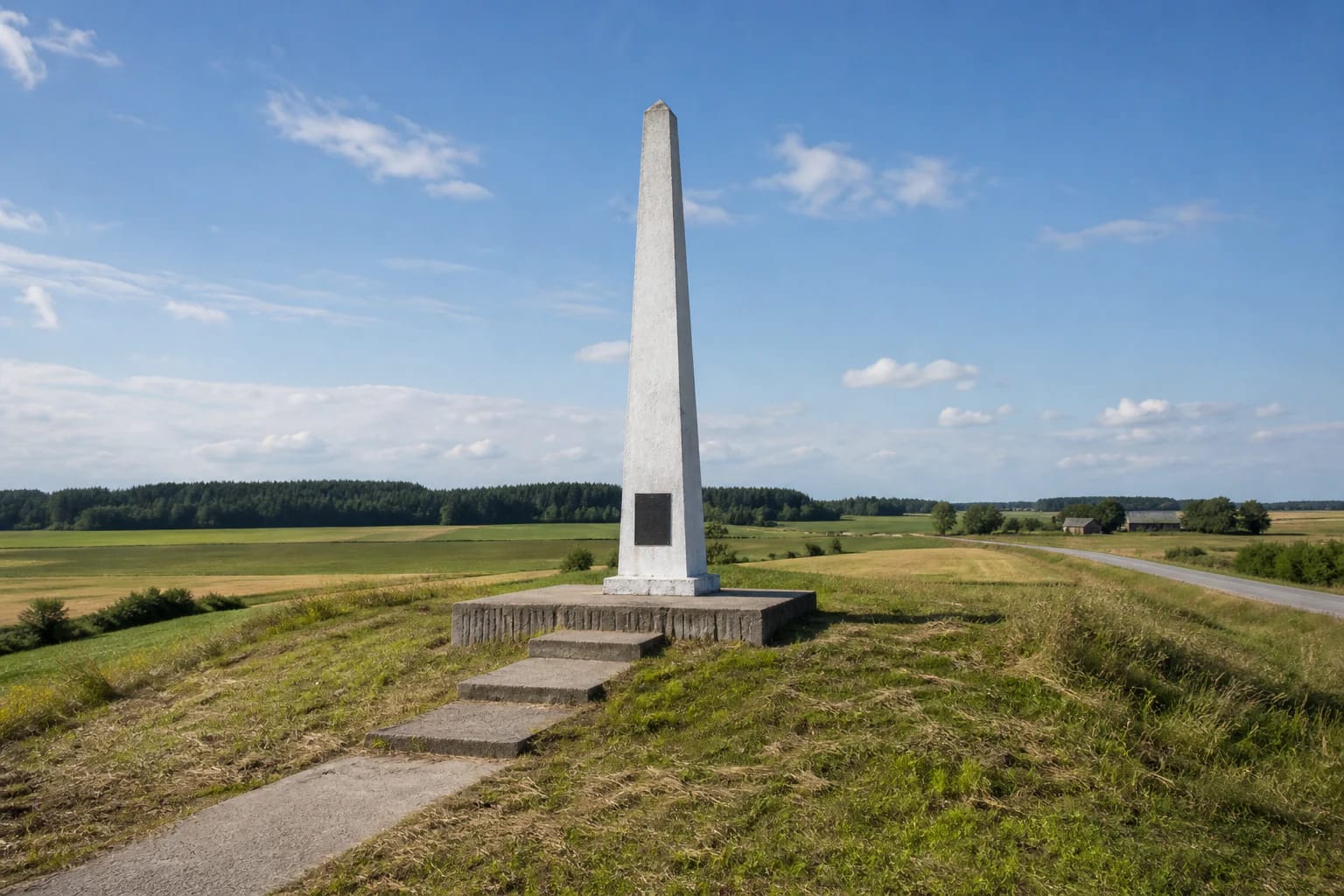
The Abraomas Kulvietis Obelisk stands not in a town square but in open country near Kulva, in the Smičkiai area of Jonava District. A solitary white shaft on a low rectangular base rises above the grassy ridge, making the surrounding landscape part of the memorial's identity.
The Jonava Regional Cultural Centre gives the precise object coordinate as 55.0869579910616, 24.157038702290865. It marks the obelisk itself, not a guaranteed parking place: assess the final approach on site and do not drive into fields without permission.
A memorial to Abraomas Kulvietis
The obelisk commemorates Abraomas Kulvietis, a humanist and Reformation-era scholar who lived about 1510-1545 and is associated with Kulva. VLE identifies Kulva as his birthplace and lists Kulva or Smičkiai as possible places of death, so the site's meaning combines biography with local memory.
Between 1528 and 1540, Kulvietis studied in Kraków, Leuven, Wittenberg, Leipzig, and Siena and received a doctorate in law in 1530. He later taught in Vilnius, moved to Königsberg, helped establish its university in 1544, and became a professor of Greek and Hebrew.
A restrained form and an open panorama
The Jonava Tourism Information Centre names architect K. Gibavičius as the designer. On the site, the important qualities are the narrow vertical form and bright white silhouette rather than elaborate sculpture: the memorial is intentionally set against a broad field and forest horizon.
From the ridge, views open over an agricultural landscape, distant woodland, and occasional farm buildings. The cultural-centre description mentions views toward Jonava and, on a clear day, toward Kėdainiai, but visibility depends on weather, season, and vegetation.
Documented biography and local tradition
Kulvietis's legacy includes the Confessio fidei text, hymn translations, and a hymn printed in Martynas Mažvydas's 1570 hymnal. VLE also records 78 known books from his library, so the obelisk opens a route into Lithuania's early intellectual history as well as remembrance.
Local descriptions say that Kulvietis may have been buried on this hill. That is a local belief, not an established archaeological fact. Keep the documented biography, the memorial's history, and the story of a possible burial place distinct when you visit.
Arrival and a respectful stop
The obelisk is an outdoor memorial without a ticket desk or fixed opening hours; daylight and firm ground make the approach easier.
The ridge may have uneven grass, a slippery slope, or a muddy roadside after rain. Do not cross private boundaries, climb the base, scratch the plaque, or leave litter. Park only in a safe lawful place without blocking a country road or access to a property.