- Field
- Lithuanian wood carvings, dievdirbystė, and household folk art
- Type
- folk art
- Heritage status
- well attested
- Context
- saints' sculptures, Rūpintojėlis, dievdirbiai, Užgavėnės masks, distaffs, distaff boards, spoons, chests, toys, reliefs, outdoor sculptures, and carving tools
Lithuanian wood carving, Wood sculpture, Carvings, Dievdirbystė
Wood Carving forms and objects
Sacred sculpture: Figures of Christ, Rūpintojėlis, Mary, saints, and chapel shrines connected with dievdirbystė, cross-crafting, and folk devotion.
Household carvings: Spoons, bowls, towel racks, chests, furniture details, distaffs, distaff boards, staffs, and toys in which function joins ornament.
Ritual and seasonal carvings: Užgavėnės masks, festive characters, cross and koplytstulpis decoration, and objects for processions or community places.
Outdoor sculpture: Wood sculptures in camps, parks, homesteads, and public spaces that continue folk-sculpture language in contemporary settings.
What is wood carving?
Wood carving is a craft of woodworking and visual expression in which form is created with a knife, chisel, gouge, saw, axe, sanding, relief, incision, or sculptural modeling. In Lithuanian folk art it includes sacred, household, and ritual objects.
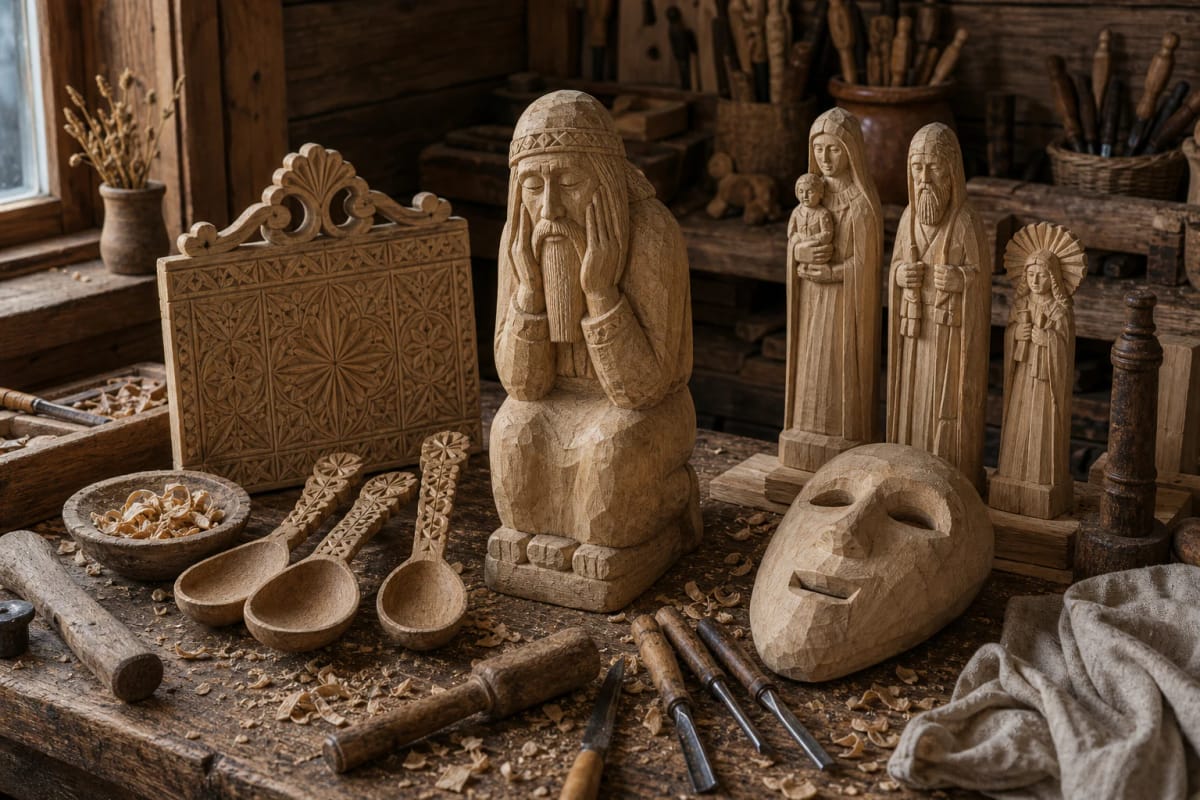
This field is much broader than decorative cutting. It includes Rūpintojėliai, saints' figures, small chapel sculptures, Užgavėnės masks, distaffs, distaff boards, towel racks, spoons, chests, toys, outdoor sculptures, and cross-crafting details.
Wood carving matters because in the Lithuanian village wood was a building, household, and sacred material. From it came the house, tool, spoon, cross, little saint, and mask. A carving can therefore be everyday and sacred at once.
How does wood carving differ from dievdirbystė?
Dievdirbystė is the making of sacred folk sculpture: carving Christ, Mary, saints, Rūpintojėlis, the Pietà, or other devotional figures. Wood carving is the wider field that includes dievdirbystė as well as household, decorative, and ritual carvings.
A dievdirbys was often a self-taught village master who created sculptures for koplytstulpiai, small chapels, cemeteries, roadsides, or sacred places in homes. Academic anatomy mattered less than a recognizable saintly subject, prayer function, and the relationship of local people to the figure.
When speaking about wood carving, dievdirbystė should not be forgotten, but neither should it be mixed with everything. A carved spoon, Užgavėnės mask, and Rūpintojėlis require different form, purpose, and respect.
Wood, tools, and the maker's hand
Carvers choose wood according to the object. Linden is easier to carve and suits sculpture; oak is durable but harder; birch, ash, and other species may be used for tools, household objects, or decoration. Wood must be properly dried, otherwise the carving will split.
The main tools are knives, chisels, gouges, saws, axes, drills, hammers, and sanding tools. A traditional carver often had a limited set of tools but knew well what each cut did to the grain.
Direction is crucial in carving. Cutting against the grain is risky because wood splits. Chisel, pressure, hand angle, and knots are constantly adjusted. Wood carving is therefore a slow dialogue with the material, not simply moving an idea onto a surface.
Sacred wooden sculpture
Lithuanian sacred wooden sculpture is one of the most vivid areas of folk art. Common subjects include Rūpintojėlis, the Crucified Christ, Mary, the Pietà, St. John Nepomuk, St. George, St. Isidore, St. Agatha, and other figures of folk devotion. The oldest surviving examples reach the eighteenth century, most are from the nineteenth, and carvers of religious figurines, dievdirbiai, are first mentioned in written sources in 1752 in Bishop Antanas Tiškevičius's synod resolutions of the Diocese of Žemaičiai.
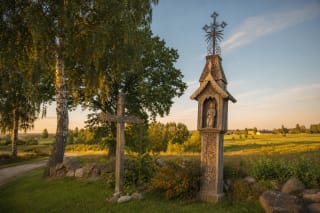
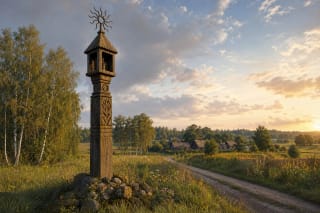
Such sculptures stood in small chapels, koplytstulpiai, stogastulpiai, cemeteries, churchyards, roadsides, and homesteads. They were not only decoration: people prayed beside them, asked for protection, gave thanks, and decorated them with flowers, sashes, or little garments.
Rūpintojėlis became one of the strongest images of Lithuanian wooden sculpture. The pensive Christ is close to human hardship and patience, so he crossed the boundaries of a purely church subject and became a sign of national memory.
Household carvings
Household carving shows that art lived in everyday life. Spoons, ladles, distaffs, distaff boards, towel racks, dowry chests, furniture details, staffs, toys, and small household objects were used and also decorated with patterns. According to VLE, the most decorated household objects included rolling pins and beetles for laundry beating, while staff handles often ended in horse, dog, ram, lion, or human heads. Noted twentieth- and early twenty-first-century carvers include A. Baranauskas, J. Binkis, J. Paulauskas, P. Peleckis, V. Sabataitis, A. Steponavičius, V. Valiukevičius, and F. Vargonas.
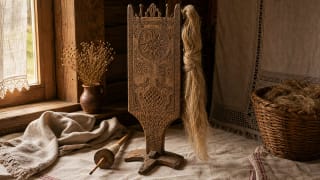
Distaffs and distaff boards are especially important because women's textile work and men's wood carving meet in them. Their ornaments may include sunbursts, teeth, plants, birds, or geometric motifs, and the object itself was often a gift.

In a household carving, beauty must not interfere with function. A spoon must be comfortable, a towel rack must hold cloth, and a chest must protect dowry. Only then does ornament become a true layer of folk art.
Masks, toys, and ritual carvings
Užgavėnės masks are one of the most expressive branches of wood carving. Here the carver does not seek calm sacred expression, but creates grotesque form: long nose, teeth, horns, animal muzzle, old person's wrinkles, or frightening humor.
Carved toys, whistles, little horses, animals, and moving mechanical objects show another side of mastery. A child's object may be simple, but it needs strength, safety, and clear form.
Ritual carvings reveal that wood carving adapts to the yearly cycle. In one place it speaks through a cross, in another through a mask, and elsewhere through a wedding or dowry object. Wood becomes an actor in celebration.
Regions and the importance of Žemaitija
Wood carving is known throughout Lithuania, but Žemaitija is especially important for sacred folk sculpture and the dievdirbiai tradition. Žemaitian chapels, koplytstulpiai, and cemeteries contain many saints' figures with strong local character.
The Kretinga region has a vivid tradition of wood carving and sculpture, presented today by local cultural institutions. Such regional histories matter because wood carving can be understood only through concrete masters, places, and commissions.
Aukštaitija and Dzūkija also have rich traditions of cross-crafting, stogastulpiai, distaffs, and household carvings. Regional differences exist, but they are not closed: makers traveled, forms spread, and objects were often shaped by a particular patron.
Lionginas Šepka and modern folk sculpture
Lionginas Šepka is one of the most famous Lithuanian wood carvers of the twentieth century. His work shows how folk sculpture can be personal, visionary, and still connected with traditional material and religious and national subjects.
Šepka's works matter because they are not simple copies of old forms. They show a distinct hand, emotion, monumentality, and strong inner logic. This helps explain that folk art is not a frozen style; it can have a powerful author's voice.
Contemporary wood carving lives through sculpture camps, parks, museums, masters' workshops, restoration of sacred objects, and souvenir work. The most valuable works know clearly whether they continue a tradition or interpret it.
How to care for wood carvings
Wood is sensitive to moisture, sun, frost, insects, and fungi. Outdoor sculptures, crosses, and small chapels inevitably age, so care is part of the tradition. Sometimes the original should be conserved, sometimes a copy made, and sometimes old wood allowed to decay respectfully.
Indoor carvings should be protected from excessive temperature and humidity changes. Old polychrome sculptures should not be repainted or cleaned with household means, because the authentic surface can be destroyed.
Responsible care begins by asking what kind of object it is: everyday spoon, folk artist's work, family relic, sacred sculpture, or outdoor monument. Each requires different treatment.