- Field
- Lithuanian carved distaffs, spinning tools, and women’s work culture
- Type
- traditional craft
- Heritage status
- well attested
- Context
- Flax, wool, thread, fiber bundle, prieverpstė, priesėdas, spindle, sunbursts, segmented stars, birds, hearts, wedding gift
Distaff, Spinning implement, Distaffs with a seat, Distaff head, Spinning board
Distaffs forms and objects
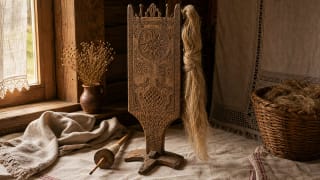
Distaff with Priesėdas: A complete spinning device with a decorated upper part for fastening the fiber bundle and a lower seat or leg on which the spinner sat.
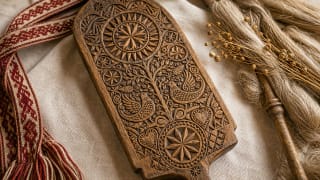
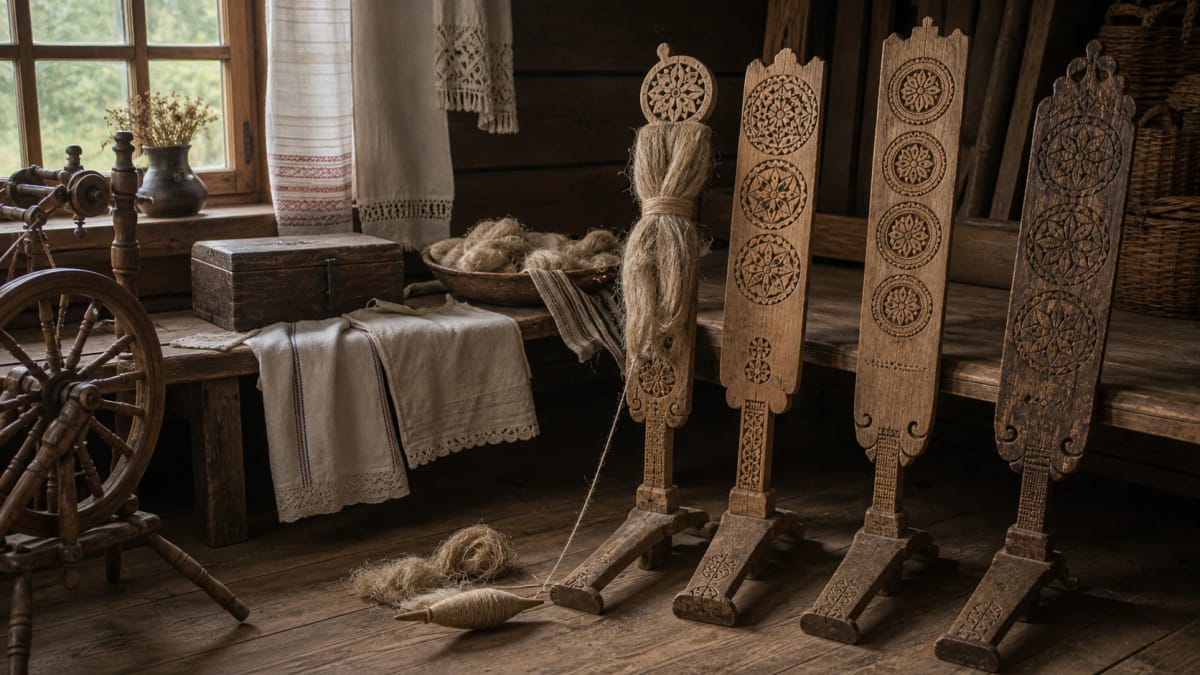
Distaff Head: The most decorated upper part, often called prieverpstė, carved with sunbursts, segmented stars, birds, hearts, plant and geometric motifs.
Spinning-Wheel Prieverpstė: The fiber-holding board of a spinning wheel, which in some traditions became a decorative woodcarving object in its own right.
Gift Distaff: A finely carved distaff or prieverpstė that could be given to a young woman as a sign of affection, work, and future household life.
What Is a Verpstė?
A verpstė is a traditional spinning device used to hold a flax or wool fiber bundle while the spinner twists thread with a spindle or spinning wheel. In Lithuania it is both a working tool, a woodcarving object, and a sign of women’s household culture.
A classic distaff has two main parts: the decorated upper part for attaching the fiber bundle and the lower leg, priesėdas, or pasėda on which the spinner sat. Sitting on the lower part stabilized the tool while leaving the hands free to form thread.
The distaff belongs to the textile chain. Flax or wool is prepared, fixed to the distaff, spun into thread, and then used for weaving, knitting, embroidery, and household textiles.
Parts of the Distaff: Head, Prieverpstė, and Leg
The most ornate part is the head or prieverpstė, to which the flax or wool bundle is attached. It may be rectangular, leaf-shaped, or widening, and decorated with openwork, incised patterns, relief, or a simpler outline.
The lower part is called the leg, priesėdas, or pasėda. It is not merely technical: by sitting on it, the spinner holds the device with her body, joining spinner, fiber bundle, spindle, and wood into one work rhythm.
Historical descriptions give concrete dimensions: the upper head is about 40-50 cm long and ends in a handle, while the slightly hollowed lower part can reach 70 cm. Distaffs were made from linden, spruce, pine, or birch. In the 19th century, rectangular, pointed willow-leaf-shaped, and cut-top willow-leaf forms were common.
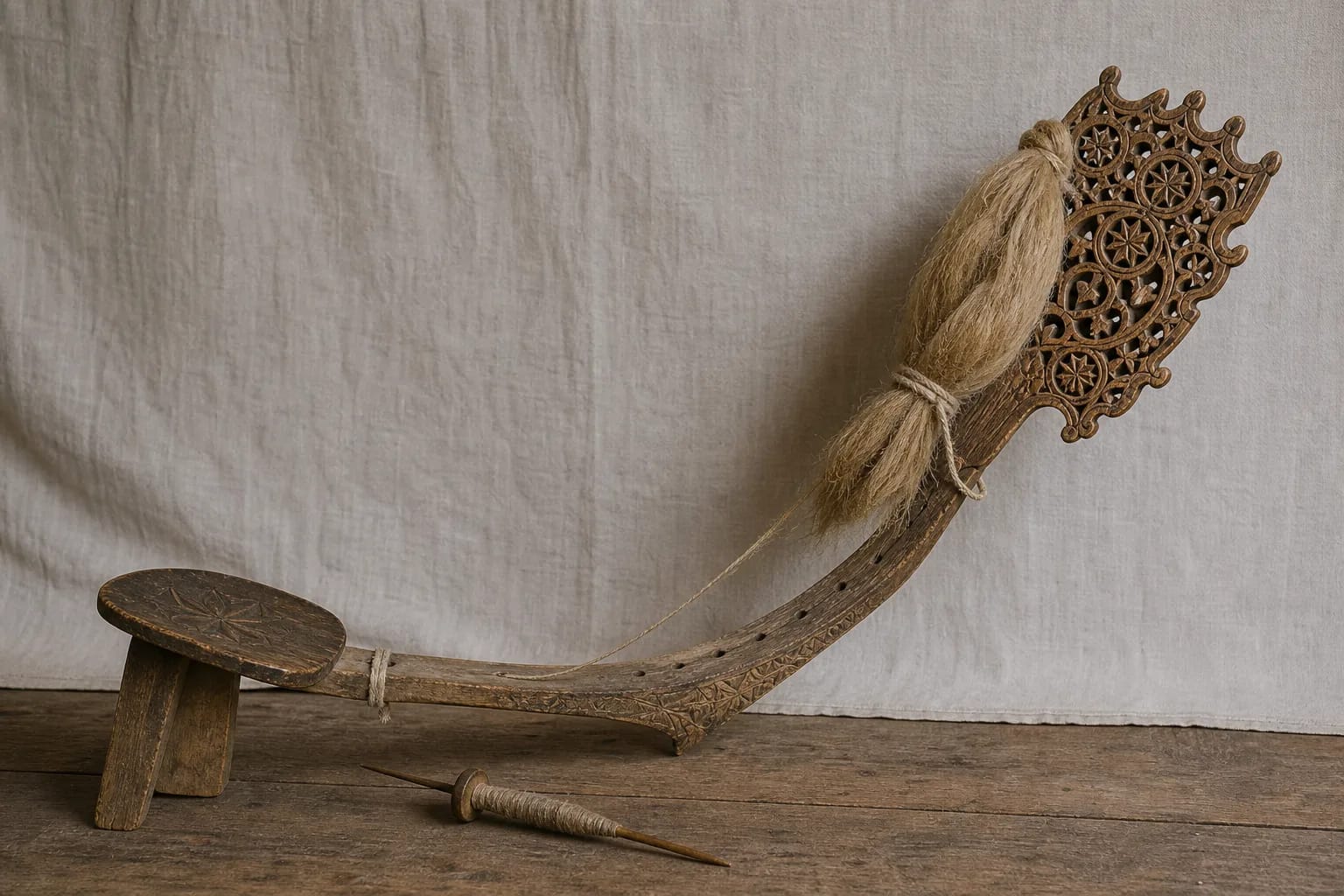
When prieverpstė is discussed separately, it often means the ornate fiber board, especially on a spinning wheel. In household context, however, it is also the upper and most decorative part of the whole distaff.
How the Distaff Was Used
The spinner sat on the priesėdas, attached a flax or wool bundle to the prieverpstė, drew fibers with her fingers, twisted them, and wound them onto a spindle or worked with a spinning wheel. The work required patience, even hand movement, and well-prepared fiber.
Spinning belonged to winter evenings, women’s daily work, and communal labor. It was not only a technical process: people talked, sang, learned, and passed on skills and social ties.
A good distaff had to be comfortable. Too heavy a tool tires the worker, too weak a tool breaks, and a poorly held fiber bundle slips. The maker had to understand not only ornament but the ergonomics of women’s work.
Wood, Carving, and Ornament
Distaffs were wooden, so their form depended on the blank, wood hardness, drying, and the maker’s tools. Surfaces could be smoothed, incised, pierced, or decorated with relief and carved lines.
Common ornaments include sunbursts, segmented stars, circles, diamonds, teeth, wavy lines, plants, birds, hearts, and hints of the tree of life. Circles with slanted cuts and segmented stars are especially widespread, often arranged with birds between them. These motifs do not always have one fixed meaning; they join beauty, maker tradition, gift language, and sometimes belief in the power of signs.
Some accounts connect distaff ornament with encouraging flax growth. That suggests the tool’s decoration could be understood as more than aesthetics: a sign of favorable order, harvest, and work success.
The Distaff as a Gift
A finely carved distaff or prieverpstė could be given to a young woman. Such a gift had practical, social, and symbolic meaning: it showed the maker’s skill, attention to the woman’s work, and possible relationship intention.
Folklore and research mention that spinning with a gifted distaff could imply quiet acceptance of marriage. Another recorded custom placed a distaff in a deceased woman’s coffin so she would not go unclothed in the next world. In eastern Lithuania, distaff spinning continued into the early 20th century.
A gift distaff is therefore not only a beautiful object. It joins a young man’s handwork, a woman’s future household labor, flax culture, and the image of founding a family.
Distaffs and Women’s Work Culture
The distaff belonged to women’s work, though it was often made by male woodworkers. The object brings together two experiences: women’s textile work and men’s wood carving, a common pattern in Lithuanian household folk art.
Spinning skills passed through family and community. Girls learned from mothers, grandmothers, or neighbors, and good thread showed orderliness, patience, and readiness for household textile work.
The distaff could also be personal. It might carry a date, initials, a distinctive ornament, or a maker’s style. In a museum, one distaff speaks not only about technology but about the person who owned it.
Regions and Variety of Form
Distaffs and prieverpstės were used in many Lithuanian regions, but forms and ornaments varied. Some places favored rectangular forms, others leaf or widening shapes; ornament could be restrained or dense.
Examples from Aukštaitija, Žemaitija, Dzūkija, and other regions show that the distaff was flexible. It performed the same function while allowing the maker to alter silhouette, ornament rhythm, seat form, or decorative density.
Region should be treated as a guide rather than a strict rule. Distaffs traveled with dowries, gifts, families, and museum collectors, so one collection can include very different local styles.
Museums and Preservation
Many old distaffs are preserved in museums because changes in textile production removed their daily function. Collections include both simple working tools and richly decorated, dated, or initialed prieverpstės.
Preservation should avoid humidity swings, direct sunlight, mechanical pressure, and aggressive cleaning. Darkened surfaces, polished hand-worn areas, and scratches are part of the object’s history.
Contemporary distaffs can be made for education, demonstration, or folk-art work. They are strongest when they preserve functional logic: the fiber bundle must hold, the hand must work comfortably, and ornament should support rather than smother the tool.