- Field
- Lithuanian sacred wooden sculpture and the rural dievdirbiai tradition
- Type
- folk art
- Heritage status
- well attested
- Context
- Dievdirbiai, dievadirbiai, Rūpintojėlis, Crucified Christ, Pieta, Mary, saints' sculptures, chapel-shrines, chapel-posts, roofed posts, Samogitia, polychromy, folk piety
Dievdirbiai, Dievadirbiai, Folk sacred sculpture, Lithuanian saints' sculptures, Dievukai
Dievdirbystė forms and objects
Rūpintojėlis: The pensive Christ, usually seated with his head resting on one hand. In Lithuanian tradition he became one of the most recognizable images of patience, concern, and human hardship.
Figures of Christ's Passion: The Crucified Christ, Nazarene, Christ at the Column, Christ in the Tomb, and other Passion scenes intended for prayer, remembrance, and Lenten or cemetery devotion.
Mary and Pieta sculptures: Figures of the Blessed Virgin Mary, Our Lady of Sorrows, Our Lady of Grace, Pieta, and other Marian iconographic types, especially important in chapel-shrines and homestead piety.
Figures of saints: St. George, St. John Nepomuk, St. Isidore, St. Agatha, St. Roch, St. Anthony, St. Casimir, and other saints chosen according to local patronage, illness, work, or parish devotion.
What is dievdirbystė?
Dievdirbystė is the making of Lithuanian folk sacred wooden sculpture. Dievdirbiai, also called dievadirbiai, carved figures of Christ, Mary, and saints placed in chapel-shrines, chapel-posts, roofed posts, cemeteries, churchyards, roadsides, homesteads, and home prayer places.
The oldest surviving Lithuanian folk sculptures date to the eighteenth century, with many preserved examples from the nineteenth century. The dievdirbiai themselves are first mentioned in written sources in 1752 in the synod decrees of Bishop Antanas Tiškevičius of the Samogitian diocese; VLE describes them as poor self-taught peasants working across Lithuania, especially in Samogitia.
This tradition is not simple carving of saints as souvenirs. A dievdirbys' work had a religious purpose: people prayed before it, asked protection, gave thanks, remembered the dead, marked misfortune or a vow. Sculpture worked together with place, patron, piety, and community memory.
Dievdirbystė is closely related to cross-crafting, but the two should not be fully equated. Cross-crafting includes the monument form, erection, blessing, and care; dievdirbystė speaks first of the wooden figures that gave those monuments a face and story.
Who was the dievdirbys?
A traditional dievdirbys was often a self-taught village master. He might also be a cross-maker, carpenter, joiner, woodcarver, or a person who worked with wood for many years and absorbed iconographic images from churches, prayer books, devotional prints, old sculptures, or other masters.
Academic precision was not the main value. In folk sculpture, figures may be disproportionate, faces schematic, hands large, and clothing folds simplified. This is not a defect; it helps identify the local master's hand, emotion, and a form of holiness close to village people.
Patrons could be families, village communities, parishioners, individual believers, or relatives of the dead. A figure did not appear in empty space: it was commissioned for a particular chapel-shrine, cross, grave, homestead, or vow.
Rūpintojėlis: the center of Lithuanian sacred carving
Rūpintojėlis is one of the most important images of Lithuanian dievdirbystė. It is the pensive Christ, usually seated with his head resting on one hand, crowned with thorns, sometimes with a cloak and sometimes without. His posture is quiet, human, and close to everyday concern.
In Lithuanian tradition Rūpintojėlis moved beyond a narrow church-iconographic frame. He became a sign of patience, endurance, national suffering, family hardship, and quiet concentration. In Samogitia such small figures were often placed in trees or homestead chapel-shrines, where they could be called Rūpintojas or Aprūpintojas.
Folk Rūpintojėlis figures are usually small, about 20-31 cm high. They spread in the second half of the nineteenth century and became especially popular in the second half of the twentieth. The term Rūpintojėlis itself became established only in the 1920s-1930s; earlier the name smūtkelis was more common.
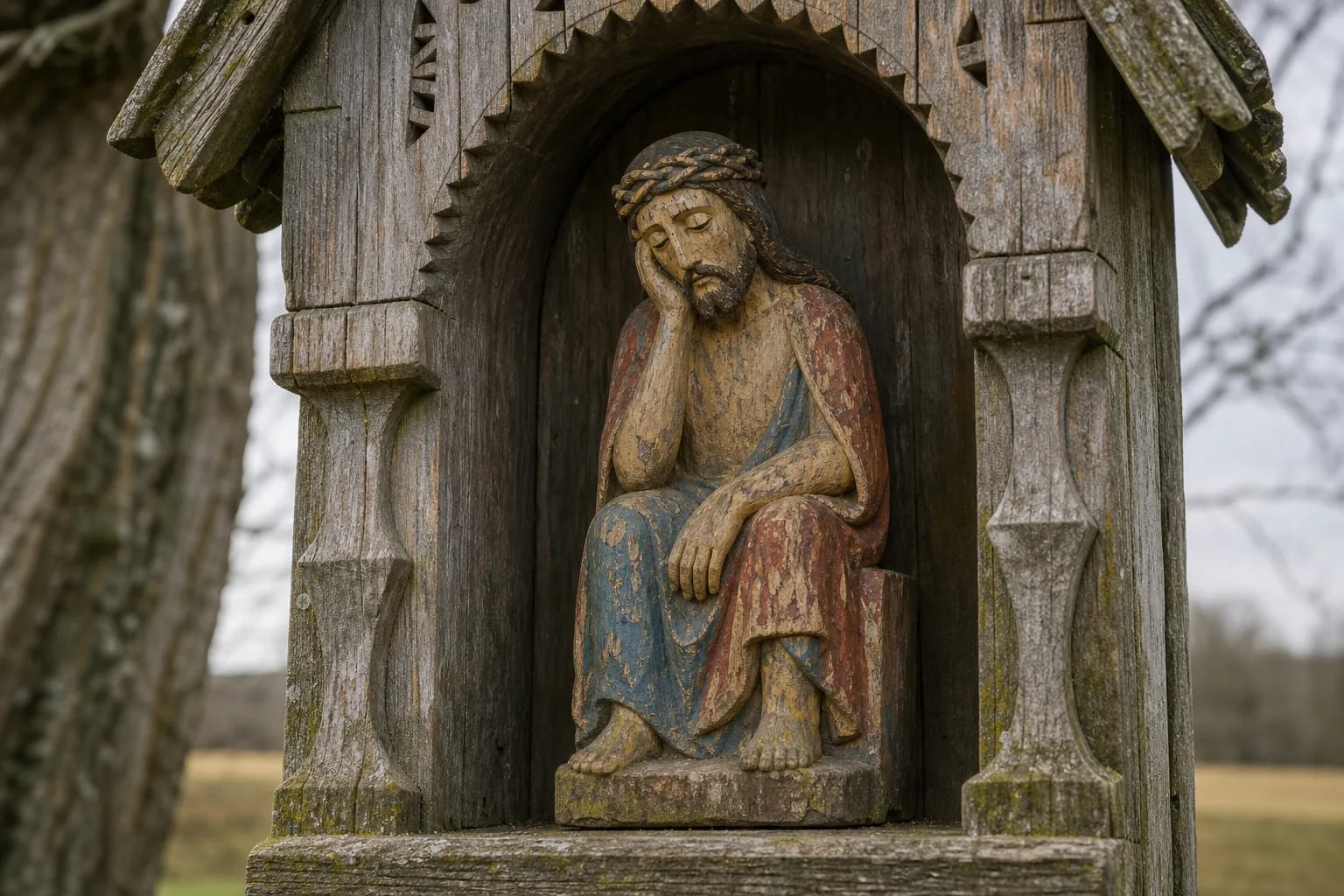
It is important not to turn Rūpintojėlis only into an abstract national symbol. First of all he is an image of Christ and an object of folk devotion. His cultural power grew from people seeing him as close, suffering, understanding, and protective.
Other figures: Christ, Mary, and saints
Dievdirbiai carved many sacred subjects. Themes of Christ's Passion included the Crucified Christ, Christ at the Column, the Nazarene, Christ in the Tomb, and other images suited to cemeteries, churchyards, Lent, and meditation on suffering.
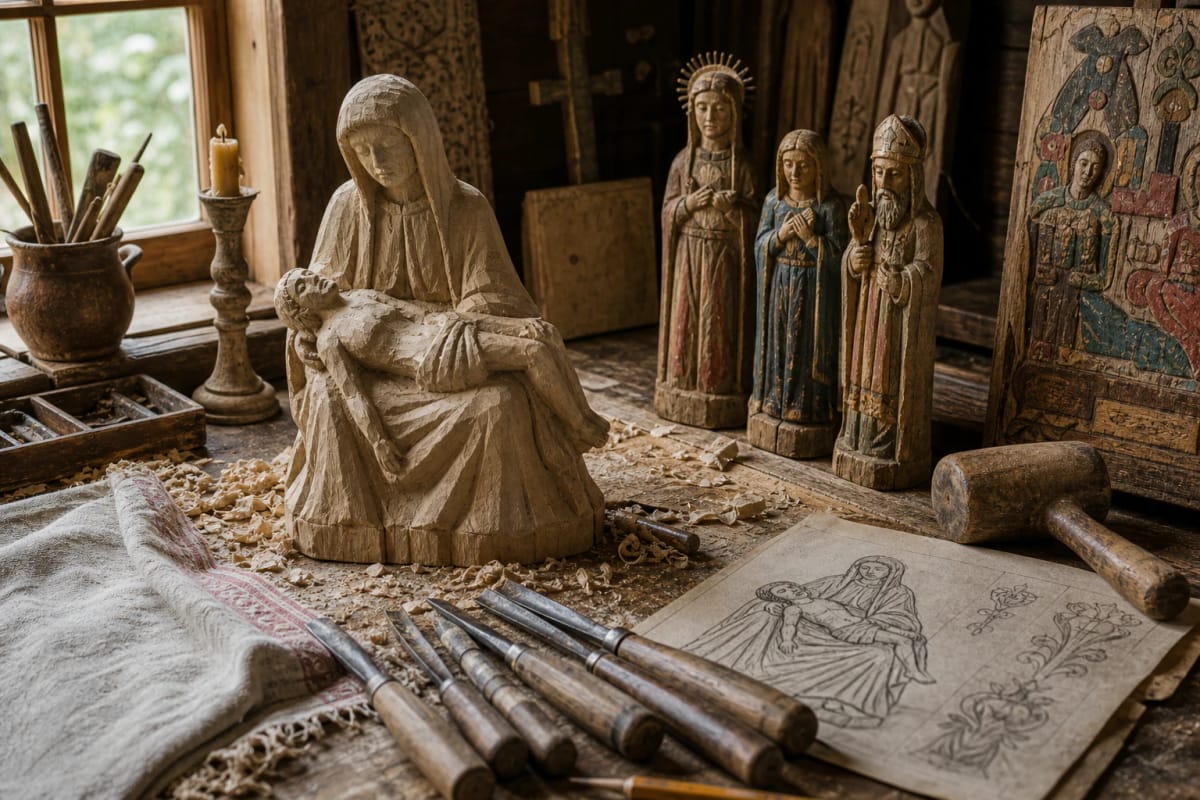
Mary's figures were equally important. Chapel-shrines include the Blessed Virgin Mary, Our Lady of Sorrows, Our Lady of Grace, the Pieta, and other Marian types. The Pieta, in which Mary holds the dead Christ, joins maternal grief, mourning, and compassion, so it was close to funerary and memorial settings.
The choice of saints depended on local devotion and practical expectations. St. John Nepomuk is linked with water and bridges, St. George with struggle and livestock protection, St. Isidore with farmers, St. Agatha with fire and home protection, St. Roch with illness, St. Anthony with everyday requests, and St. Casimir with Lithuania's patron saint.
Relation to chapel-shrines, chapel-posts, and roofed posts
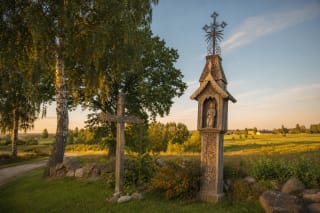
A dievdirbys' sculpture was usually not made for a museum hall but for small sacred architecture. It had to fit inside a chapel-shrine, be visible under a roofed post, rest in the niche of a chapel-post, or stand on a grave, churchyard, or homestead monument.
Figures were therefore often modeled according to their place. In Samogitia, where chapel-shrines and chapel-posts are abundant, sculptures could be visible from several sides, though backs sometimes remained flat or hollowed so the wood would split less. Such choices show a practical relation to structure as well as artistic style.
The chapel-shrine gave the sculpture a home. A small roof protected it from rain, a door or glass from wind and touch, and the surroundings - tree, roadside, cemetery, or homestead - explained why this figure was needed there.
Wood, tools, and polychromy
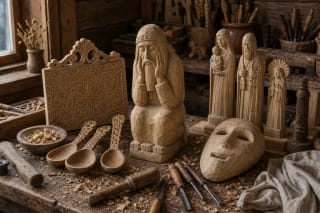
Softer, more easily carved wood, especially linden, often suited sacred sculptures. It allows faces, hands, clothing folds, and smaller details to be shaped. The exact choice still depended on local trees, the master's habits, the commission, and desired durability.
The dievdirbys worked with knives, chisels, gouges, saws, an axe, drills, and a hammer. A village master's tool set was not necessarily large, but he had to understand grain, drying, splitting, and how much material could be hollowed without weakening the figure.
Many old sculptures were painted. Polychromy helped identify the saint, emphasize garment, blood, halo, eyes, attributes, and emotion. Repainting was also part of tradition, but today old sculptures should not be cleaned or repainted with household materials, because authentic surfaces may be destroyed.
Samogitia and regional traits
Dievdirbystė is known across Lithuania, but Samogitia is especially important for old folk sacred sculpture. Lithuanian museum collections include many works by Samogitian dievdirbiai, and the region's chapel-shrines, chapel-posts, and cemetery environments long preserved a rich world of saints' figures. In Samogitian chapel-shrines, figures of Jesus the Nazarene or Christ carrying the cross could be large, up to 1-1.5 m high.
Samogitian sculptures often have a strong, sometimes rough, but very vivid character. Academic beauty is less important than expression: a suffering face, large crown, simplified garment, clear saint's attribute, and earthy closeness.
Aukštaitija, Dzūkija, Suvalkija, and Lithuania Minor also have sacred wooden sculpture, but regional differences should not be presented as closed rules. Masters traveled, forms spread, and the needs of a particular parish or patron could matter more than an ethnographic boundary.
Catholic purpose and older symbolic layers
Dievdirbystė needs careful presentation. Its figures are Catholic: Christ, Mary, and saints. Older images of nature, trees, sun, plants, or local sanctity may appear in folk art, but that does not mean dievdirbiai carved 'pagan gods' alongside Christian saints.
It is more accurate to say that Lithuanian sacred sculpture lived in a syncretic cultural environment. A Christian subject was placed in a rural landscape, decorated with local ornament, visited according to family and community custom, and tied by people's faith to land, home, road, illness, harvest, or the dead.
This caution avoids two mistakes: reducing everything to church iconography or explaining everything as hidden paganism. The strength of dievdirbystė is precisely its human, local, and devotional meeting of layers.
Museums, restoration, and living memory
Many works by old dievdirbiai are now kept in Lithuanian museums, because outdoor sculptures decay quickly: moisture, sun, frost, insects, repainting, and mechanical damage all affect them. Museum collections let us see what has already disappeared from roadsides and cemeteries.
In restoration it matters whether an object is a sacred relic, family memory, museum exhibit, part of a communal monument, or a contemporary copy. Old polychromy, cracks, and traces of earlier repairs should be treated not as dirt but as the object's history.
Among the best-known old dievdirbiai are Vincas Svirskis, A. Potockis (c. 1844–1945), A. Norvaiša (c. 1824–1902), J. Paulauskas (1860–1945), and K. Piaulokas (1870–1938); in the second half of the twentieth century Lionginas Šepka and Stanislovas Riauba became famous. Classic studies include Ignas Končius' Žemaičių kryžiai ir koplytėlės (1965), Irena Kostkevičiūtė's monograph Vincas Svirskis (1966), and Zita Žemaitytė's book Lionginas Šepka (1984).
Today dievdirbystė lives through folk artists, cross-makers, conservators, museum education, restoration of chapel-shrines, and new sacred commissions. The most valuable continuation is not mechanical copying but respectful understanding of why the figure was made and where it should live.