- Field
- Lithuanian carved flax-bundle boards and ornamented spinning tools
- Type
- folk art
- Heritage status
- well attested
- Context
- prieverpstė, flax-bundle board, spinning wheel, distaff, flax, wool, segmented stars, sunbursts, birds, hearts, tree of life, deep carving, openwork
Prieverpstė, Flax-bundle board, Distaff head, Ornate prieverpstė, Spinning-wheel distaff board
Distaff Boards forms and objects
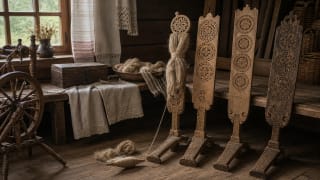
Distaff prieverpstė: The upper part of a distaff to which a flax or wool bundle is fastened; it may be rectangular, leaf-shaped, widened, or profiled.
Spinning-wheel prieverpstė: A fiber-bundle board used with a spinning wheel, often becoming an independent decorative wood-carving object.
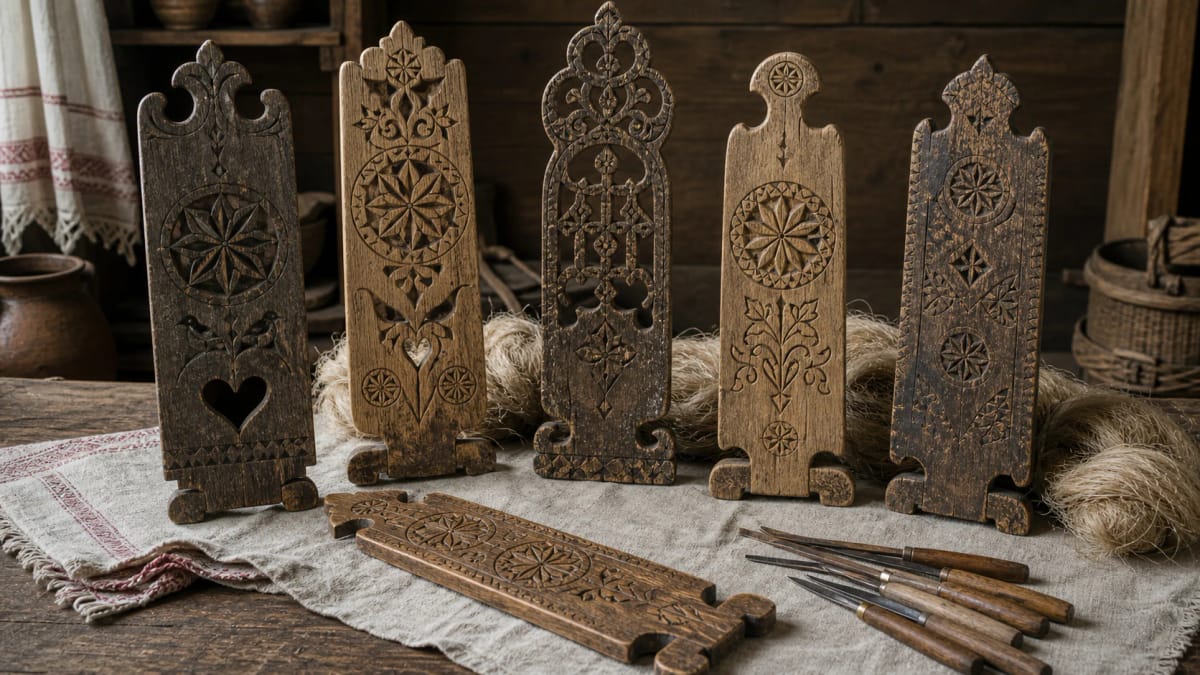
Openwork prieverpstė: A prieverpstė in which ornaments are cut through, leaving an airy pattern of light and shadow.
Gift prieverpstė: A particularly finely carved personal object that could be given to a girl and marked with initials, a date, or signs of relationship.
What is a prieverpstė?
A prieverpstė is a wooden board, or the upper part of a distaff, to which a flax or wool bundle is pinned, tied, or otherwise fastened. It is a functional spinning tool, but in Lithuanian folk art it became one of the most ornate forms of wood carving.
When speaking about a distaff, we mean the whole device with foot or seat. When speaking about a prieverpstė, attention turns to the fiber-bundle board: its silhouette, ornament, carving, openwork, date, initials, and gift meaning. VLE notes that prieverpstės are 29-37 cm long and 9-14 cm wide, and may be rectangular, two disks joined by a neck, or variously profiled.
Because of their dense ornament, prieverpstės are often shown in museums as independent works of folk art. Yet their beauty arose from work: the board had to hold fiber and be convenient for the spinner.
Function: fastening the fiber bundle
The practical purpose of a prieverpstė is to hold the fiber bundle. Flax or wool fiber has to be fixed so the spinner can gradually draw fibers, twist thread, and keep an even work rhythm.
The form is therefore not accidental. The top must be wide enough for the bundle, the sides convenient for wrapping or pinning, and the bottom adapted for fastening to a distaff, spinning wheel, or other construction.
Ornament could not interfere with work. Edges that are too sharp catch fiber, weak openwork breaks, and a board that is too heavy tires the spinner. A good maker balanced ornament with tool durability.
Carving techniques
Prieverpstės use deep carving, relief, incised lines, openwork, profiled contour, and sometimes surface polishing or painting. Each technique changes the object: one creates shadow, another openings of light, another a graphic line.
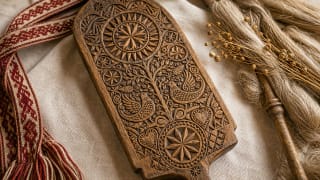
Openwork is especially impressive because the board becomes airy. Such work needs enough wooden connections left so the prieverpstė does not break. Deep carving highlights segmented stars, sunbursts, hearts, or plant stems.
Some prieverpstės show initials, dates, or owner's signs. They turn the object from anonymous ornament into a personal thing connected with a concrete person, family, or gift.
Motifs: sunbursts, birds, hearts
Prieverpstės often feature sunbursts, segmented stars, circles, rhombi, teeth, fir trees, plant stems, birds, hearts, and tree-of-life compositions. These motifs make the prieverpstė one of the best objects for learning Lithuanian ornament.
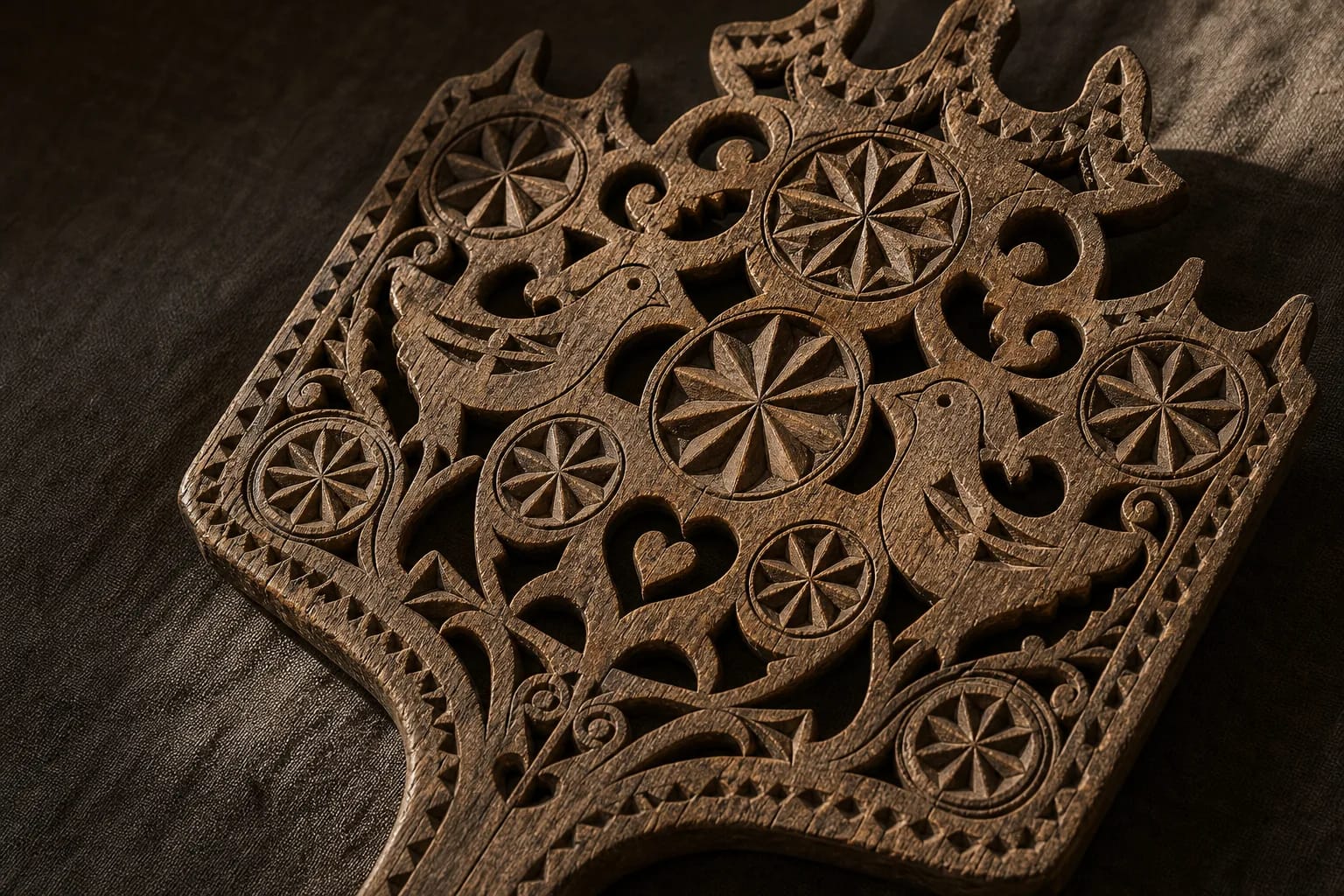
Sunbursts and segmented stars create rhythm and an impression of light. Birds may be connected with life, a pair, home, or the spiritual world. Hearts are often read as signs of love, gift, or relationship, but in a concrete prieverpstė meaning depends on context.
Each ornament should not be explained as one fixed formula. A motif may be inherited from a maker's repertoire, chosen for beauty, copied from another object, or personally meaningful. The strength of the prieverpstė lies in several meanings meeting.
Gift and personal object
Prieverpstės are often mentioned as handsome gifts for a girl. A young man who carved or commissioned one gave not jewelry but a work tool that also spoke of attention, ability, future household life, and relationship.
That is why hearts, birds, paired motifs, dates, or initials often appear. They do not always mean the same thing, but they clearly show that the object could be personal, not only a common tool.
This gift layer explains why prieverpstės are so carefully decorated. The maker demonstrates hand, taste, patience, and relationship with the future owner.
Regional traits
Prieverpstės are known in various Lithuanian regions, but their forms and ornaments differ. According to VLE, Žemaitian prieverpstės are the most richly decorated: the sun motif and segmented stars dominate, and the outer side is usually decorated more than the inner. They were often painted dark red, green, or yellow, and production years and maker initials were carved into them.
Regional differences appear in silhouette: some prieverpstės are rectangular, others leaf-shaped or widened, others have cut tops, rounded sides, or openwork contours. Ornament density also differs.
In museums, however, region is sometimes based on collection place rather than place of making. Prieverpstės could travel with dowry, gifts, or families, so regional labels should be read carefully.
Prieverpstė and souvenir folk art
In the twentieth century the prieverpstė became both a folk-art and souvenir object. Makers created decorative prieverpstės for exhibitions, interiors, gifts, or national-style presentation. In the late twentieth and early twenty-first centuries souvenir prieverpstės were carved by Pranas Paleckis, Almutis Pranciulis, Vitalijus Baltutis, Albinas Šileika, and other folk artists, and the field has its own study, Lietuvių liaudies menas. Prieverpstės, Kaunas, 2000.
This is not automatically bad, but it is important to distinguish a working tool from a decorative interpretation. A traditional prieverpstė has functional logic: a fiber bundle can be fixed to it. A souvenir may be beautiful, but its proportions or openwork may no longer suit real spinning.
The best contemporary prieverpstės keep a link with function, wood grain, regional ornament, and restrained form. They do not overload the board with random signs but let ornament grow from traditional structure.
How to preserve prieverpstės
Prieverpstės are sensitive to moisture, direct sun, mechanical pressure, and aggressive cleaning. Thin openwork parts break especially easily, so old objects should not be hung or pressed by weak ornament areas.
When preserving an old prieverpstė, it is important not to remove the historical surface. Darkening, smoothing by hands, scratches, small repairs, or old wax layers can be valuable parts of the object's history.
If a prieverpstė has museum, family, or heritage value, it should not be sanded, varnished, or repainted without specialist assessment. It is better to document its condition, keep it in a stable environment, and consult a conservator if needed.