- Field
- Extracting flax fiber: from pulled stalk to combed fiber ready for thread
- Type
- traditional craft
- Heritage status
- well attested
- Context
- flax processing, pulling flax, retting, soaking, drying, breaking, scutching, hackling, long fiber, tow, shives, linseed, spinning, weaving
Primary flax processing, Flax fiber extraction, Breaking and scutching flax, Flax-growing fiber preparation, Flax preparation
Flax Processing forms and objects
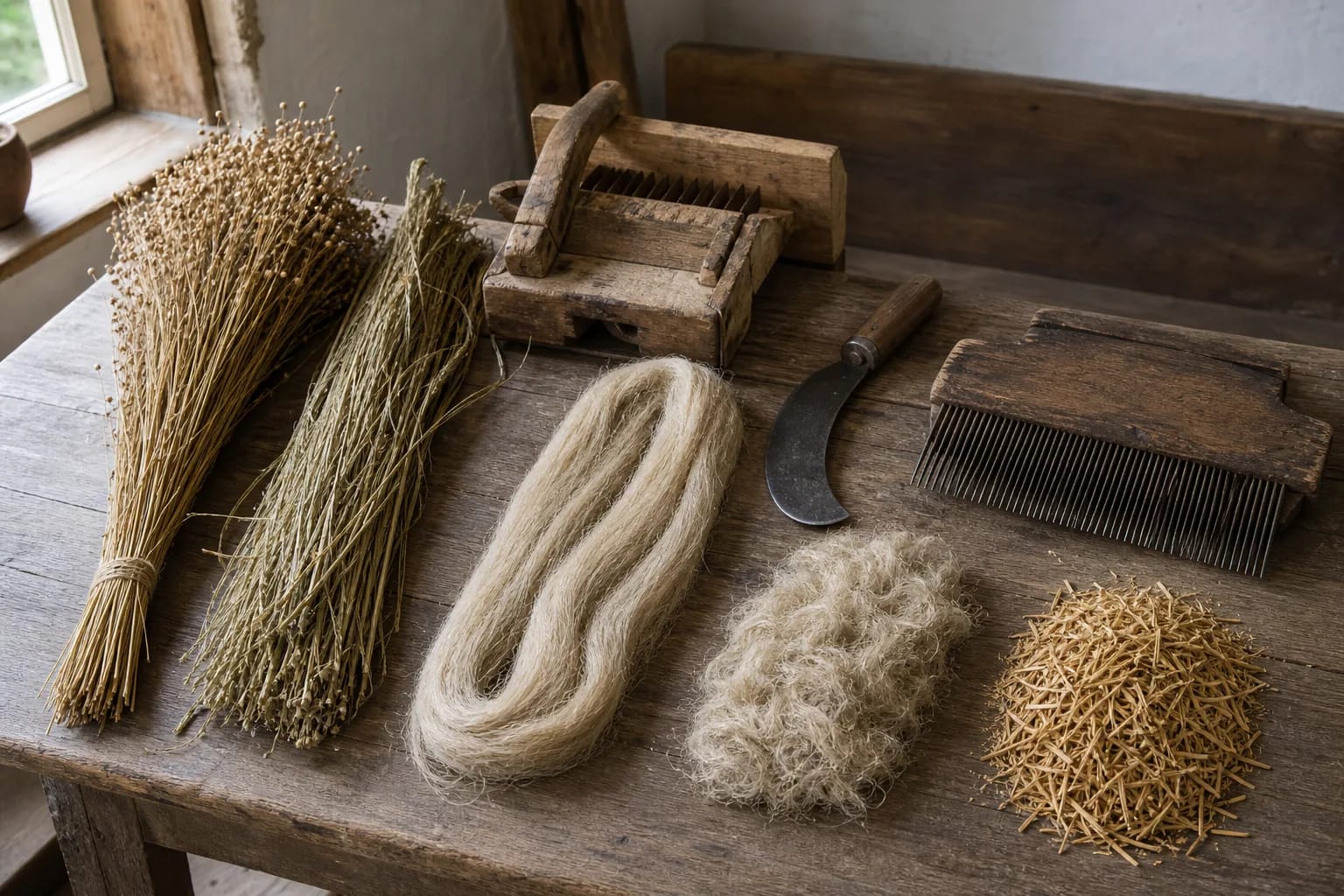
Long fiber: The most valuable, long, parallel, clean flax fiber (about 10-12 percent), suitable for spinning fine thread and weaving good linen.
Tow (short fiber): Shorter, tangled fiber (about 14-16 percent) left during hackling and cleaning, used for coarser yarn, ropes, working textiles, stuffing, and household needs.
Shives: Woody parts of the flax stalk (about 65 percent) separated during breaking and scutching; in the village they could be used for litter, fuel, or fill.
Linseed: Seeds ripening in flax capsules, valued as a secondary raw material for oil and animal feed.
What is flax processing?
Flax processing is the primary sequence of work by which fiber is extracted from flax stalks. Flax fibers lie within the tissue of the stem and are glued to it by pectic substances, so to obtain fiber this bond has to be broken down and the soft fiber mechanically separated from the woody part of the stalk.
This craft is only one link in the road of flax. Before it comes flax cultivation, and after it come spinning and weaving. A page about flax processing describes precisely the stage between field and loom: how a pulled plant becomes combed fiber ready for spinning. It therefore does not duplicate weaving or spinning, but feeds both with raw material.
The traditional peasant work sequence had clear names: pulling, dew retting or soaking, drying, breaking, scutching, and hackling. These ethnographic terms describe village work with hand tools; modern flax-processing industry performs the same tasks by machines and in factories, but the logic remains the same: break down pectins and separate fiber.
Historical depth and importance
Flax began to be grown in Lithuania about 4,000 years ago. Archaeological finds support this: remains of linen fabrics and ropes have been found in old burial grounds. The craft of extracting fiber is therefore very old, because without it flax could not have been spun into thread or woven into linen.
Flax areas expanded greatly in the sixteenth-eighteenth centuries as flax exports grew. In the Republic of Lithuania from 1918 to 1940 they kept increasing: more than 90,000 hectares were sown in 1928, and 85,500 hectares in 1939. Before the Second World War Lithuania ranked third in the world in exports of flax raw material, after Russia and Poland, so fiber preparation was not only a household matter but also a major economic activity.
In the second half of the twentieth century, especially in the 1960s-1980s, sown areas fell by half, and by the beginning of the twenty-first century fiber flax was almost no longer grown in Lithuania. Old hand processing of flax today is therefore not daily work but a field of ethnographic heritage and craft education, presented by museums such as the Lithuanian Ethnography Museum.
Raw material: the flax plant and its fiber
Fiber flax (Linum usitatissimum) is processed: an annual plant 70-120 cm high, with sparse leaves and few flowers. Its long, slender stems give the best fiber; according to the Universal Lithuanian Encyclopedia, this fiber is used for many textile products, from the thinnest batiste to the thickest sacks or tarpaulin.
Fiber flax should be distinguished from seed or oil flax. Seed flax is lower and more branched, its stems have little fiber, and after processing it yields only short fiber; it is grown mainly for seeds from which oil is pressed. The craft of flax processing as understood here focuses on fiber flax and quality fiber, although the seeds ripening in capsules were also a valued secondary raw material.
In the flax stem, fiber is bound to surrounding tissues by pectic substances. The whole art of processing rests on this fact: pectins have to be broken down in a controlled way through dew retting or soaking without damaging the fibers themselves, and then the woody part of the stem has to be removed mechanically. If the bond is broken too strongly, the fiber disintegrates; if too weakly, it stays stuck to the shives.
Tools and equipment
Traditional flax-processing tools are simple, but each has a clear task. Dew retting required only a lawn or meadow; soaking required a pond or special pit called a linmarka. Drying used heated village buildings such as the jauja or bathhouse, where stalks could be thoroughly dried before breaking.
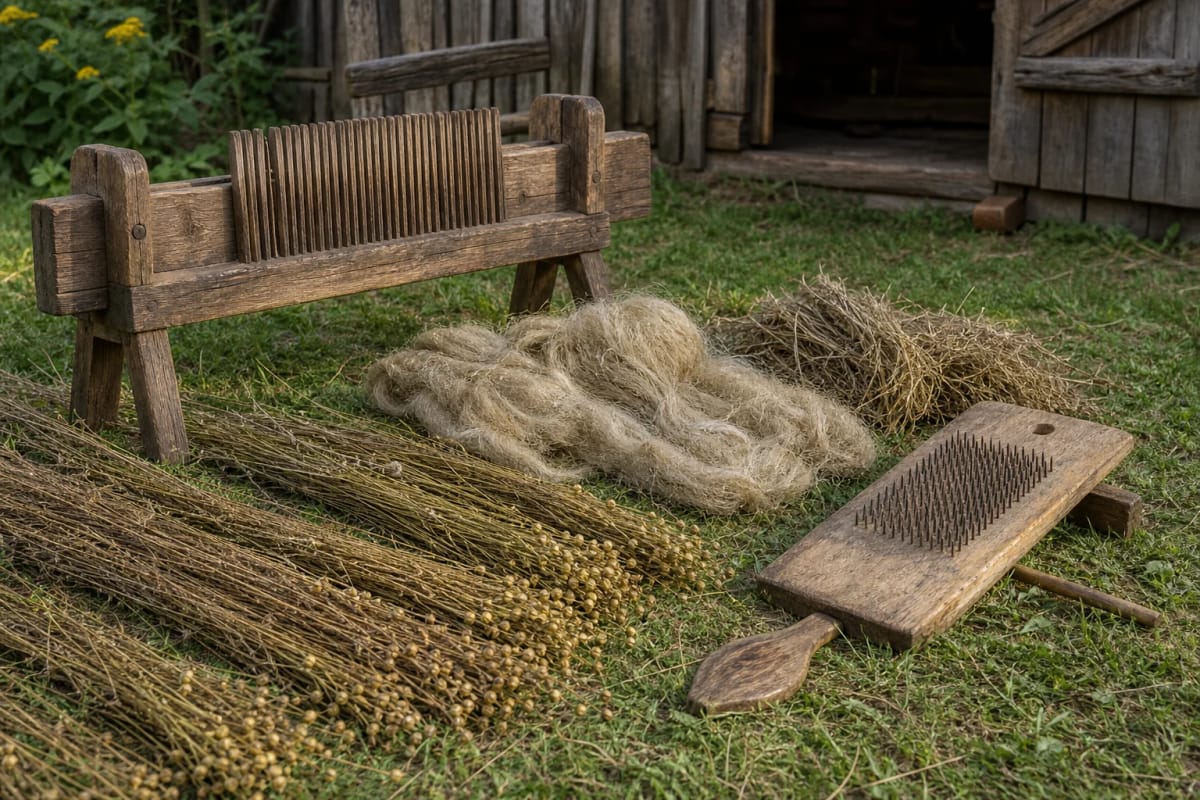
Wooden flax brakes, called mintuvai or linamynė, separated the fiber by using a moving blade to break and crush dry stalks. After breaking came the scutching blade, or brukamoji mentė, a flat paddle with which the fiber was beaten so crushed shives would fall away. Finally the fiber was drawn through hackles: rows of metal or wooden teeth that separate long fiber from short.
These tools were uncomplicated and often made by peasants themselves or by village craftspeople, so flax processing remained essentially household and neighborhood work. It is important not to overstate technology: large machines, autoclaves, and factory processing lines belong to the industrial period, not the traditional preindustrial village.
The process step by step
The first step is pulling: flax is not cut but pulled up with the roots so the fiber remains as long and continuous as possible. Then the fiber is loosened from the stem in one of two ways. In dew retting, the stalks are laid in a thin layer on grass; moisture supports fungal growth whose enzymes break down pectic substances. Retting stalks are later gathered for further processing.
The second method is soaking: stalks are submerged in water, traditionally in ponds or linmarkos, where pectins also break down. In industry flax is soaked in water at about 36-38 °C and an autoclave can be used for further breakdown; in the traditional village, however, soaking took place in cold standing water for longer, with careful watching so the stalks did not over-rett. After retting or soaking the stalks had to be thoroughly dried in a jauja or bathhouse.
Then comes mechanical fiber extraction. Breaking in a flax brake breaks and crushes the dry woody stems. Scutching with a scutching blade knocks the crushed shives off the fiber. Finally hackling through combs separates the fiber into long fiber, parallel, clean, and suited to fine thread, and short fiber left among the hackle teeth. Industrial yield gives the proportions: about 10-12 percent long fiber, another 14-16 percent short fiber or tow, and about 65 percent shives.
Products: long fiber, tow, and shives
The most valuable result is long fiber. Once hackled and spun, it is used to weave textiles, especially thin white linen. The finest linen shirts, towels, tablecloths, and other festive household textiles come from it, so the quality of long fiber was the main goal of the whole processing sequence.
Tow, or short fiber, consists of shorter, tangled fibers left during hackling and cleaning. It was spun into thicker, coarser thread suitable for work textiles, ropes, and sacks; tow was also used for stuffing and household purposes. Because this fiber is more uneven, it was valued less than long fiber.
Shives are the woody parts of the stalk separated during breaking and scutching. They are not textile raw material, but in the village nothing was wasted: shives were used for litter, fuel, and sometimes wall fill. The seeds ripening in the capsules were separated during combing; linseed oil was pressed from them, and seed cake could be used as feed. Thus one plant yielded fiber, oil, and practical farm material.
Research, varieties, and scientific work
Knowledge of flax farming in Lithuania was also gathered scientifically. The Upytė Experimental Station of the Lithuanian Institute of Agriculture studied flax physiology, agrotechnics, retting, and seed production. Flax breeding began in 1922 at the Dotnuva Breeding Station, where varieties were created by D. Rudzinskas from 1922 and Z. Mackevičius from 1932.
At the Upytė Experimental Station in 1965-2005, intervarietal hybridization, chemical mutagenesis, and individual plant selection produced a number of fiber-flax varieties, including 'Viltis' in 1968, 'Upytė' in 1980, 'Baltučiai' in 1987, and 'Kastyčiai' in 1997; the last was entered in the European Union common catalogue of varieties. These efforts show that flax was not only ethnographic heritage but also an object of targeted agricultural science.
The ethnographic heritage of fiber processing is described most fully in A. Vyšniauskaitė and J. Laniauskaitė's study Valstiečių linininkystė ir transportas, volume 9 of the series Iš Lietuvių kultūros istorijos, Vilnius, 1977. It discusses peasant flax-processing work and tools and remains a foundational source for the traditional image of this craft.
Flax in customs and culture
Flax work was surrounded by folklore and customs. Flax is mentioned in the oldest Lithuanian sutartinės, mostly work songs connected with growing, pulling, spinning, and weaving flax. In folklore flax was called a sacred plant, sun herb, and women's grain; it was believed to protect against evil spirits. A good harvest was sought by offerings to the deity Vaižgantas.
Specific ritual actions were directly connected with fiber length and quality. It was believed that during Užgavėnės one should ride far, slide downhill sitting on a distaff, swing, and dance so the flax would grow tall. To make the fiber long and white, a tall sower dressed in long clothes or a white shirt sowed flax. During flax pulling, the lead woman gave the first handful of flax to the pullers to gird their waists so they would not hurt; the end of flax breaking was also celebrated.
These customs remind us that flax processing was not only technique. It was a rhythm of yearly work, communal labor, and a field of meanings in which farming, belief, and women's work culture joined. The mythology page on flax, thread, and linen explains this symbolism more broadly.
How to recognize and evaluate it today
When looking at a flax product or demonstration, it is worth distinguishing fiber types. Long fiber is smooth, silky-shining, and made of long parallel fibers; tow is shorter, hairier, and more uneven. This appears in cloth: thin, smooth white linen points to long fiber, while a coarser, lumpier textile points to short or tow yarn.
When evaluating a traditional processing demonstration, it is meaningful to ask which loosening method was used, dew retting on grass or soaking, and how the stalks were dried, because fiber color and strength depend on it. Honest education distinguishes between hand-village craft steps such as pulling, breaking, scutching, and hackling, and industrial production technology.
Today hand processing of flax survives mostly in museum education, craft centers, and folk artists' workshops. Traditional crafts are supported and presented by institutions such as the Lithuanian National Culture Centre. Transmission of this craft becomes most valuable when it shows not only a beautiful result but the whole logic of action: why flax is pulled, retted, dried, broken, and hackled in exactly this order.