- Field
- Lithuanian traditional and artistic iron blacksmithing
- Type
- traditional craft
- Heritage status
- well attested
- Context
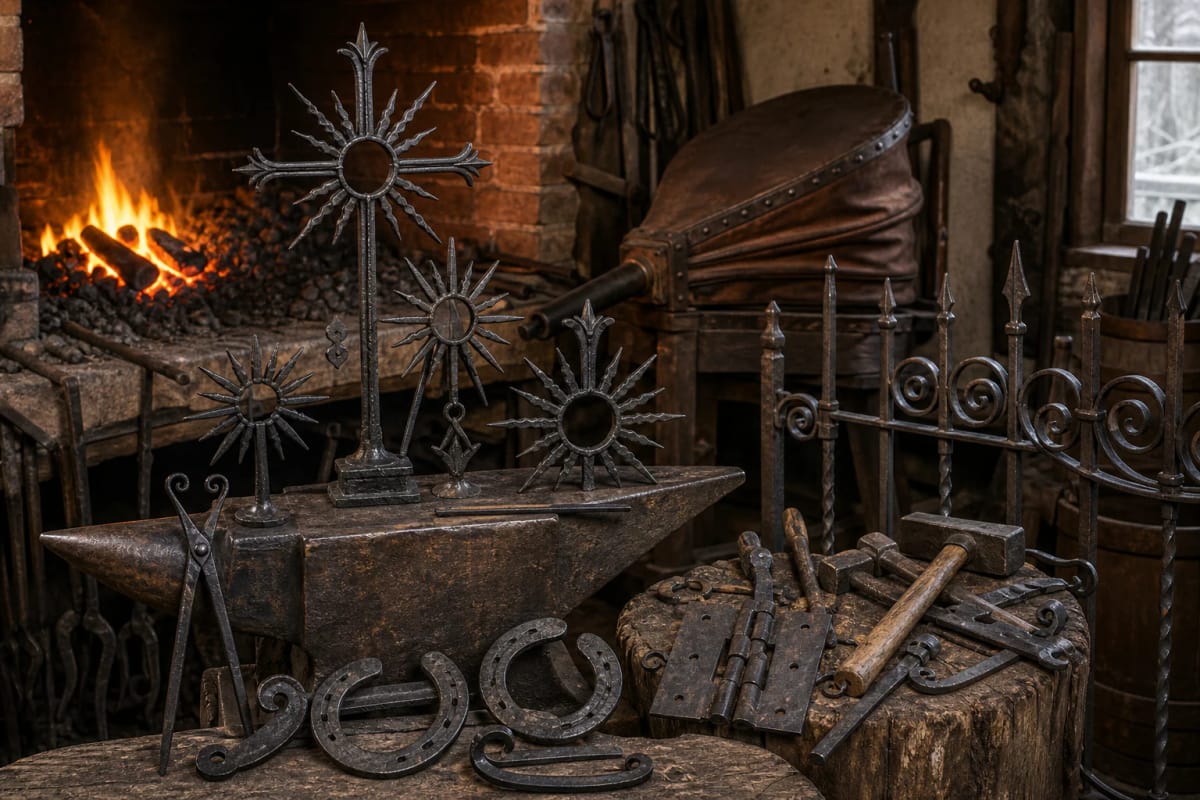
- Forge, hearth, anvil, bellows, hammer, forged tools, horseshoes, hinges, gates, fences, cemetery crosses, iron finials, sunbursts, artistic blacksmithing
Lithuanian blacksmithing, Traditional blacksmithing, Artistic blacksmithing, Forged ironwork, Iron blacksmithing
Blacksmithing forms and objects
Farm ironwork: Agricultural tools, horseshoes, chains, axes, knives, scythe parts, nails, hooks, and other everyday metal objects of the rural farm.
Architectural ironwork: Gates, fences, hinges, locks, handles, window grilles, balcony and stair details that join function with decoration.
Sacred ironwork: Iron finials for crosses and chapel-posts, sunbursts, cemetery crosses, fences, and memorial signs.
Artistic blacksmithing: Contemporary decorative and sculptural metalwork often drawing on the language of traditional sunbursts, gates, or crosses.
What is blacksmithing?
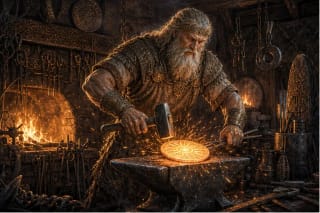
Blacksmithing is metalworking through heat and impact: iron is heated in the hearth, held with tongs, struck on the anvil, drawn out, bent, split, welded, drilled, riveted, or decorated. In traditional Lithuania it was one of the most necessary crafts.
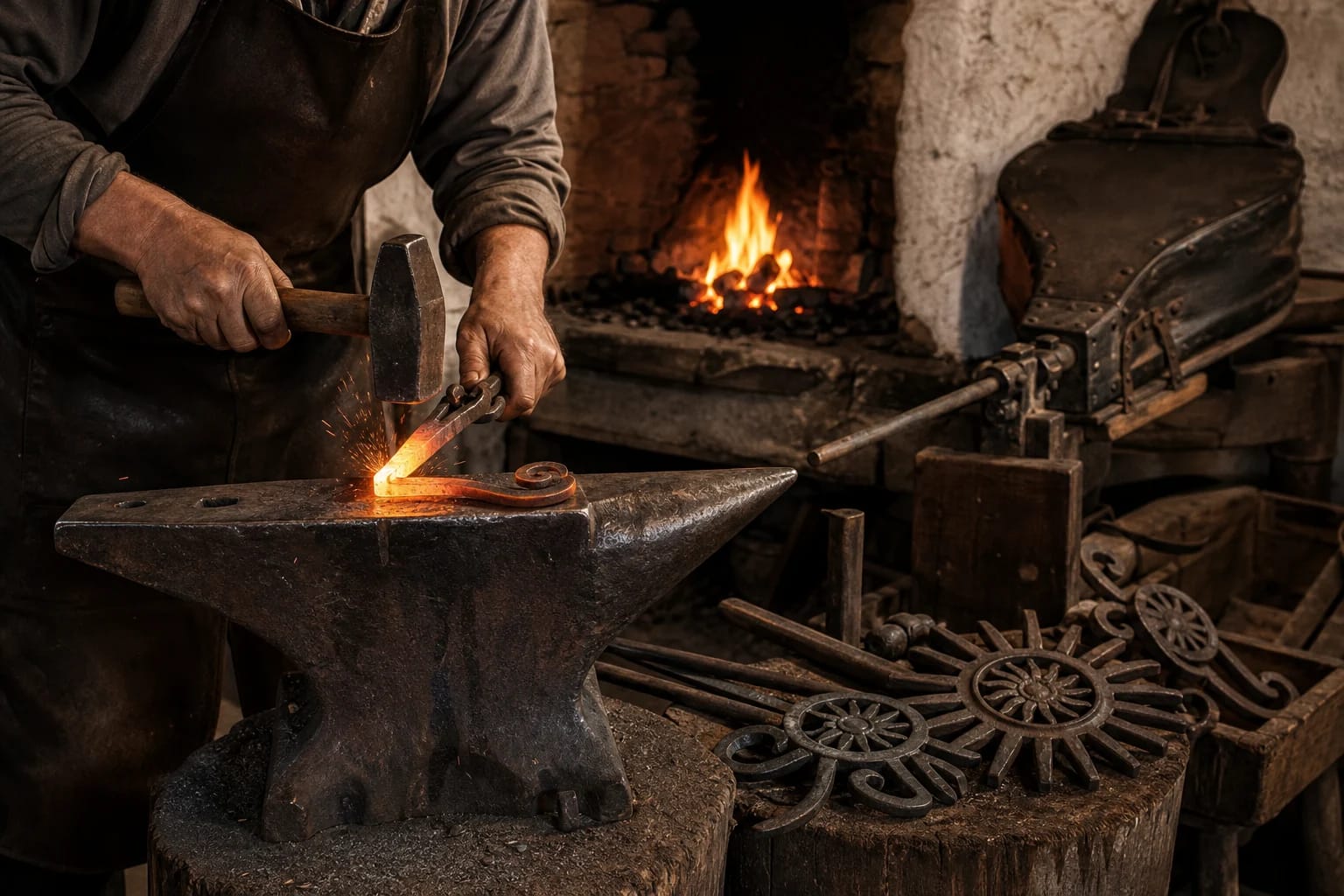
The blacksmith was needed by village, manor, town, and farm. He made tools, repaired implements, shod horses, made nails, hinges, locks, chains, knives, gates, fences, crosses, and cemetery signs. Without the blacksmith, work stopped in the field, on the road, and at home.
Today blacksmithing is often seen as artistic or heritage craft, but its base was practical. Iron had to hold, cut, hang, protect, pull, cover, and serve. Beauty appeared once function had been solved.
Forge, hearth, and tools
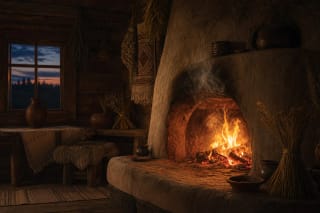
The center of a traditional forge is the hearth, where iron is heated. Bellows feed air to the fire, the anvil gives a surface for shaping metal, and hammers, tongs, chisels, punches, and templates allow specific actions.
A blacksmith works with hot time. Metal has the right temperature only briefly: too cold and it no longer obeys, too hot and it may burn or weaken. The smith's eye learns colors: red, orange, and yellow light say what can be done.
Sound also matters. The rhythm of the hammer on the anvil is not random. It shows when metal is being drawn out, leveled, or corrected. An experienced smith hears whether the blow is working correctly.
What did the village blacksmith make?
The village blacksmith made and repaired agricultural tools: ploughshares, axes, hoes, scythe parts, knives, chains, hooks, nails, and wagon and sleigh fittings. Such work was everyday but required precise knowledge of how the object would be used.
Horseshoeing was one of the smith's most important services. The horseshoe had to suit hoof, road, season, and horse's work. A poorly shod horse could not pull a wagon or work well in the field.
The blacksmith also made iron for the home and homestead: locks, hinges, handles, window grilles, gate details, fences, stair and balcony parts. Blacksmithing therefore directly shaped the appearance of village and small-town architecture.
Forged sunbursts and cross-crafting
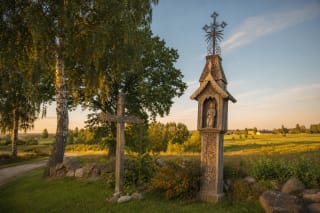
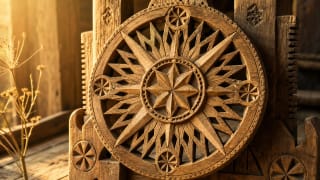
One of the most vivid signs of Lithuanian blacksmithing is the forged sunburst and iron finial on crosses, chapel-posts, and roofed posts. They join iron, fire, heavenly light, and sacred small architecture.
In cross-crafting, the blacksmith's work complements wood. The carver or carpenter creates the post, shrine, or cross structure, while the smith raises the finial: rays, small crosses, moons, spears, rings, rosettes, and other ornaments.
The sunburst should not be understood only as decoration. It is a meeting of light, sky, Christ's victory, life, and older ornamental images. Because of this layering, blacksmithing looks especially strong in Lithuanian crosses.
Cemetery, gate, and architectural iron
Blacksmithing is very visible in cemeteries: iron crosses, fences, small gates, grave enclosures, ornamented finials, and memorial details. Cemetery iron joins the wish for durability with decoration and memory.
In homesteads and towns, blacksmiths made gates, hinges, latches, locks, handles, window grilles, balcony railings, and other details. Each object is both function and the face of a place. A good hinge opens, but a good blacksmith's hinge also looks like handwork.
Architectural blacksmithing survived into modern times, though its form changed. Today it may be restorative, historical, decorative, or authorial. What matters is that metal is not only a standard factory profile but carries blacksmith work.
Regional centers and museums
According to VLE, the first blacksmithing objects in Lithuania appeared in the fifth century BCE, first bronze spiral ornaments. Urban blacksmiths organized into guilds from the sixteenth century; the Vilnius blacksmiths' guild was founded in 1560. In the late nineteenth and early twentieth centuries blacksmithing centers operated in Joniškis, Klaipėda, Kupiškis, Seirijai, and Varniai.
The Blacksmithing Museum opened in Klaipėda in 1979 is an important memory point for Lithuania Minor and urban blacksmithing. Blacksmithing was also popularized through blacksmith days held in Druskininkai in 1971, 1974, 1977, and 1986. Exhibitions at the Lithuanian Ethnography Museum show how the craft changed from rural necessity to artistic heritage.
Collections of forged crosses and sunbursts at Kelmė Regional Museum remind us that contemporary artistic blacksmithing can consciously continue the tradition of cross-crafting finials. Regional history is best told through concrete museums, masters, and objects.
Traditional and artistic blacksmithing
Traditional blacksmithing was first a service: to repair, make, shoe, fasten, and lock. Artistic blacksmithing emphasizes form, ornament, authorial decision, and the object as artwork.
These fields are not opposites. An old gate hinge can be highly artistic, while a contemporary sunburst can rest on practical smithing technology. The difference lies more in purpose and in the viewer's attention.
Good contemporary blacksmithing does more than imitate old ornament. It understands metal: how to bend it, join it, leave hammer marks, and keep decoration from becoming a thin factory-metal silhouette.
Blacksmithing and the mythological smith
Lithuanian mythological sources mention Teliavelis or Kalvelis, connected with the image of a smith and a forged sun. This motif is not a direct historical document of blacksmithing, but it shows the strong symbolic place a smith can occupy in imagination.
The blacksmith works with fire and metal, so his work easily gains special force. From hard, resistant material he makes a tool, lock, cross, or sunburst. Such transformation naturally appears almost magical in culture.
Still, the page on blacksmithing should not replace the historical craft with mythology. The mythological smith enriches cultural imagination, while the real blacksmith stands at the hearth, repairs a ploughshare, and forges a gate hinge.
How to preserve forged iron
Iron is affected by rust, moisture, and unsuitable paints. Old forged objects should not simply be scrubbed to a shine, because that can destroy the authentic surface history, old paint traces, or marks of the smith's work.
Cemetery, cross, and architectural ironwork should be handled with heritage sensitivity. Sometimes rust must be stabilized, sometimes a missing part reconstructed, sometimes a copy made while the original is kept in a museum.
For household ironwork, the main need is protection from moisture and mechanical damage. If the object has historical value, consult a conservator or blacksmithing specialist rather than using household fixes.