- Field
- Wooden grave markers of Lithuania Minor
- Type
- folk art
- Heritage status
- living tradition
- Context
- Krikštai, krikšteliai, krikštužiai, Lithuania Minor, Curonian Spit, Nida, Evangelical Lutheran cemeteries, wooden grave markers, profiled boards, birds, hearts, plant motifs
Krikštai of Lithuania Minor, Krikšteliai, Krikštužiai, Wooden grave markers, Curonian Spit krikštai
Krikštai forms and objects
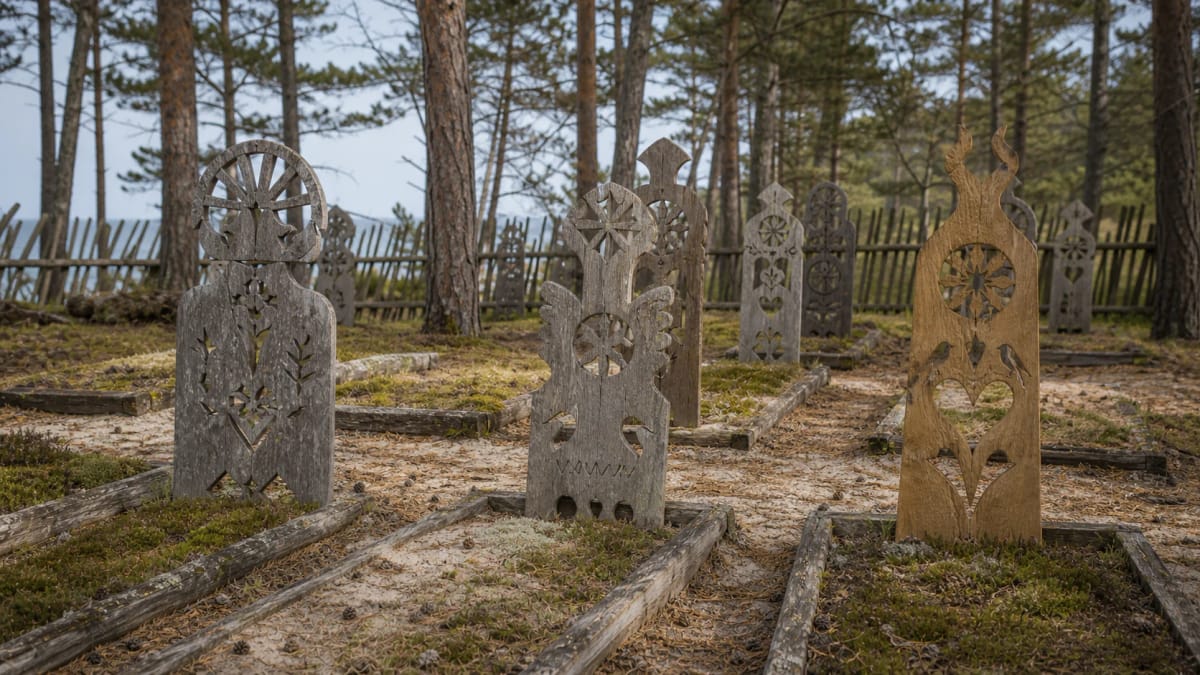
Profiled board krikštas: A grave marker cut from a board, with a silhouette shaped at the top and sides, fretwork ornament, and plant, bird, or geometric motifs.
Men's and women's grave krikštai: Folk and scholarly interpretations sometimes distinguish different silhouettes and wood species for men's and women's graves, but these explanations should be presented carefully as an interpretive layer.
Curonian Spit cemetery krikštai: Krikštai in Nida and other coastal and lagoon-area cemeteries are today among the most visible signs of Lithuania Minor grave culture.
Reconstructed and museum krikštai: Some krikštai have been restored, reconstructed from old examples, or preserved in museums because outdoor wooden grave markers decay quickly.
What are krikštai?
Krikštai are wooden grave markers characteristic of Lithuania Minor. Most often they are profiled boards cut into forms of plants, birds, hearts, little stars, geometric shapes, or other silhouettes. They mark a grave while also speaking about memory of the dead, local belief, and wood craftsmanship.
Krikštai are connected with the Evangelical Lutheran cemetery culture of Lithuania Minor, the Curonian Spit, and the lagoon region. They have been widespread in Lithuania Minor from the 15th century and are mentioned in 16th-century historical sources; their origins are linked with Prussian and German cultural influence and with the spread of Protestantism in the 17th and 18th centuries. Today they are best recognized in the Nida ethnographic cemetery, but their historical world is broader: the Nemunas Delta, the coast, Prussian Lithuanian villages, and vanished small cemeteries.
Although the word krikštas can be misleading today, here it does not mean the sacrament of baptism. It means a grave marker: a distinctive wooden memorial tradition close to Lithuanian small sacred architecture but with its own Lithuania Minor context.
Form: a profiled board, not a simple cross
A krikštas is usually not a cross with a crossbar. Its base is a board or flat wooden blank whose top and sides are cut into a decorative silhouette. This silhouette may recall a tree, plant, bird form, heart, small window, little cross, or abstract ornamental composition.
Fretwork and profiling are essential techniques. The maker cuts open spaces that form little stars, hearts, birds, leaves, or geometric rhythms. This form is beautiful not only from the front: light and shadow through the openings change the appearance of the marker in the cemetery.
According to the Universal Lithuanian Encyclopedia, krikštai are boards 0.5-2 meters high and 0.2-0.6 meters thick, with profiled edges that give the whole monument a plant, geometric, or zoomorphic silhouette. They were attached to a shaft, a long oak board reaching to the bottom of the grave. This wooden fragility and flat silhouette give krikštai their distinctive, human-scale recognizability, different from a monumental stone marker.
Grave placement: why at the foot?
An important feature of krikštai is their position in the grave. In the Lithuania Minor tradition, they were often placed not at the head, as in many later cemetery monuments, but at the foot of the grave. This helps identify older cemetery order and distinguishes krikštai from many other grave markers.
The foot-of-grave position is not merely a technical fact. It belongs to local burial customs, grave orientation, and communal understanding of how the deceased person's place should be marked. When krikštai are moved or reconstructed, the original cemetery plan should not be lost.
Today visitors often see a reconstructed or maintained cemetery view, so it is worth reading information panels, museum explanations, and local history. A krikštas is not only an object; it belongs to the whole of the grave, family, and cemetery.
Wood, cutting, and surface
Krikštai were made of wood, so their durability depended on the blank, drying, surface protection, and cemetery environment. Pinewood sand, sea air, dampness, and wind affect wood differently than indoor museum conditions.
The maker had to cut not only a beautiful silhouette but also leave enough strength. Fretwork that is too fine breaks quickly, thin connections split, and outdoors every cut becomes a place where water can collect.
Krikštai could be natural wood, painted, or repainted later. In surviving examples it is often difficult to distinguish the first surface from later restoration, so the surface history should be assessed carefully.
Motifs: plants, birds, hearts, little stars
Krikštai ornament often includes plant motifs, birds, hearts, little stars, small crosses, circles, segment stars, rhombs, and various stylized silhouettes. They may be read as signs of memory, journey, love, sky, life, and passage through death. Blue, yellow, green, red, black, and gray color combinations were used: blue and black most often covered the background, on which the deceased person's name, surname, and life dates were written in green, gray, or white; skilled makers sometimes bound the upper edge with a strip of sheet metal to protect it from rain.
In the tradition of the Encyclopedia of Lithuania Minor, krikštai are linked with the World Tree image, the soul's journey, birds, and dausos, the heavenly realm. Marija Gimbutienė associated their toad, grass snake, butterfly, and flower motifs with a very old layer of Rebirth Goddess symbolism. These are important symbolic interpretations, but they should be presented as interpretation, not as the single explanation for every specific ornament.
Grave markers often join several layers: Christian remembrance, Lithuania Minor burial custom, wooden ornament, local aesthetics, and family choice. The same bird can therefore be both a beautiful silhouette and a sign of soul, sky, or remembrance.
Gender, wood species, and careful interpretation
Gender distinction in krikštai is fairly well attested. The Universal Lithuanian Encyclopedia notes that in the 17th century men's grave markers were characterized by a horse-head silhouette and women's by a bird, usually cuckoo, head silhouette; men's graves used oak, birch, or ash, while women's used linden, aspen, or spruce, and decorative motifs were chosen according to the deceased person's gender. In the 18th century, stylized plant, animal, and heart motifs began to dominate. Even so, these links should not be applied mechanically to every object, because available wood, maker habits, and later reconstructions also mattered.
Actual cemetery examples could depend on available wood, a maker's habits, family means, local fashion, and later reconstructions. It is therefore best to say that the links between gender and wood are a known interpretive layer, not an absolute rule.
This caution matters because krikštai are often presented as very archaic signs. They do preserve old symbolic layers, but they are also concrete 19th- and 20th-century cemetery objects that operated in Christian, Lutheran, and Lithuania Minor community settings.
Nida, the Curonian Spit, and visible heritage
The Nida ethnographic cemetery is one of the best-known places where visitors can see krikštai today. Sand, pines, wind, wooden fences, and profiled grave markers create a very clear image of Curonian Spit memory.
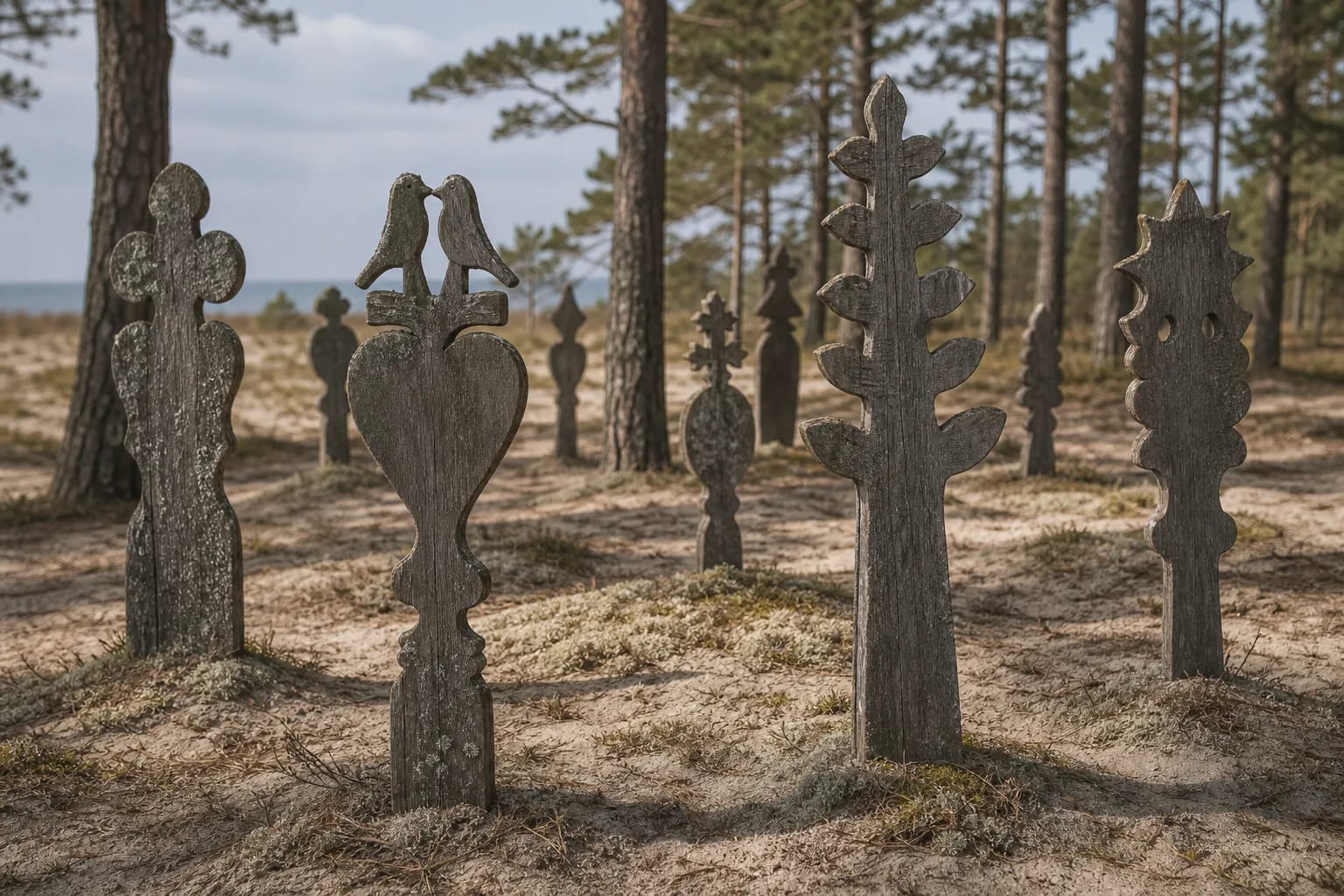
Nida should not, however, overshadow the whole tradition. Krikštai are a Lithuania Minor phenomenon connected with the wider cemetery culture of the lagoon, coast, and Prussian Lithuania. Many old cemeteries have decayed, been reorganized, or lost their original wooden markers.
For that reason, museums, the heritage inventory, and local communities are important. They document, reconstruct, and explain a tradition that, because of the fragility of wood, could not survive as steadily as stone grave monuments.
Krikštai today: reconstruction and continuity
Today krikštai live in several ways: as surviving cemetery objects, restored or reconstructed markers, museum exhibits, subjects of research and education, and contemporary makers' attempts to continue the Lithuania Minor form.
When reconstructing a krikštas, it is important not to create merely a decorative board with random ornaments. The cemetery place, silhouette logic, materiality of wood, foot-of-grave tradition, Lithuania Minor context, and restraint of symbols all need to be understood.
A good contemporary reconstruction of a krikštas should clearly distinguish what is based on a historical example, what is reconstruction, and what is new interpretation. That makes it possible to respect heritage while sustaining living craftsmanship.