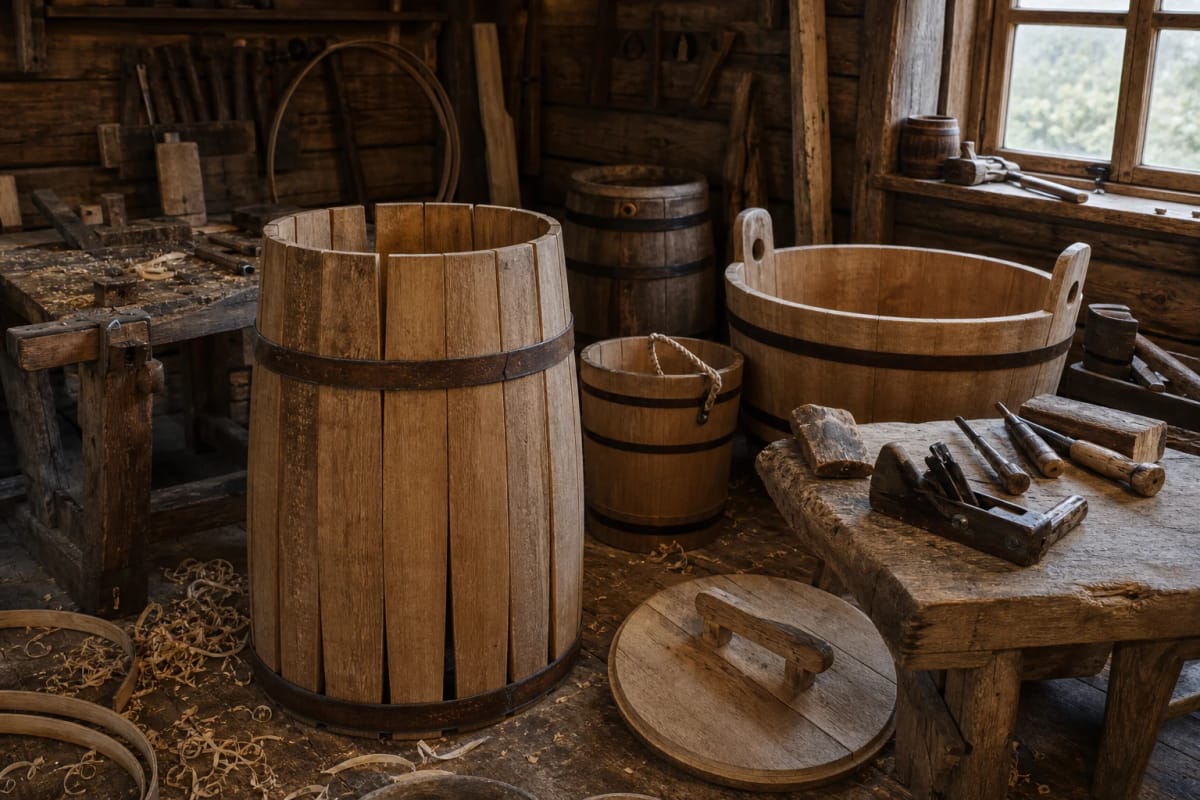
- Field
- Staved wooden vessel-making: barrels, tubs, and buckets made from wooden staves and hoops
- Type
- traditional craft
- Heritage status
- well attested
- Context
- Bačkininkystė, kubilystė, cooper, tub-maker, barrel, bačka, tub, bucket, staves, hoops, lid, beer barrel, fermentation tub, wooden vessel-making
Kubilystė, Bačkininkystė, Staved wooden vessel-making, Barrel making, Cooper's craft
Cooperage and Tub-Making forms and objects
Barrels and bačkos: Staved barrels for beer, mead, meat, herring, fermented vegetables, and grain. The word statinė means both the vessel and an old unit of volume, so the size of a 'barrel' depends on context.
Tubs: Wooden vessels widening or narrowing upward, used for grain, flour, vegetables, beer fermentation, washing, or bathing. Their usual height was 0.70-1.3 m, with a capacity of about 50-200 liters.
Buckets and viedrai: Wooden vessels for drawing, carrying, and storing water: widening upward, about 22-30 cm high and about 30 cm in diameter, with a handle attached through stave ears or iron loops.
Troughs and hollowed vessels: Related to wooden vessels but technologically different: troughs and hollowed vessels were usually carved from one piece of wood rather than built from staves, so they belong to hollowed woodenware.
What are cooperage and tub-making?
Cooperage and tub-making are wooden vessel crafts in which the vessel is not hollowed from one piece of wood but built from separate narrow boards called staves. The staves are shaped, their edges beveled, set in a circle, and tightened with hoops; the bottom is fitted into a groove. This creates the body of a barrel, tub, or bucket that can hold liquid or loose material without nails.
The craftsperson was called a kubilius or bačkininkas. According to the Universal Lithuanian Encyclopedia, tubs made from staves were the work of kubiliai, while peasants often made hollowed vessels from a single piece of wood themselves. Wooden buckets also developed from hollowed early forms to later staved forms tightened with hoops, and these too were the work of tub-makers. Cooperage and tub-making is therefore a specialized craftsman's field, not just home work.
The scope should be clear: cooperage and tub-making are about staved vessels, namely barrels, tubs, and buckets. Troughs, ladles, and bowls, though wooden and everyday, were usually hollowed from one piece of wood and belong to hollowed woodenware and carving. This distinction is basic here.
Hollowed or staved: what makes the craft distinct
Wooden vessels in Lithuania are known in two main constructions. The first is hollowed: the vessel walls are carved out of a single, often hollow, log. VLE notes that the oldest tubs had sides hollowed from one piece of hollow timber. The second is staved: the vessel is assembled from separate staves. Cooperage and tub-making concern this second construction.
The difference is more than technological. The size of a hollowed vessel is limited by the thickness of the tree, while staved construction allows large, tight vessels that widen or narrow upward. Hoops pull the staves into a strong, elastic body that can withstand liquid pressure and the gases of fermentation.
For that reason cooperage should also be separated from general woodcarving, which includes sculpture, decoration, and hollowed objects. In the cooper's work the main value is not ornament but a precise joint: the staves must form a watertight circle, and the hoops must keep them pressed together. It is an engineering craft as much as a decorative one.
Tubs and barrels: historical depth
VLE describes the kubilas as a wooden vessel used to hold grain and flour and to ferment vegetables and beer. In Lithuania, tubs were made both widening and narrowing upward. This shows a set of clearly defined forms suited to different needs: some vessels were easier to pour and scoop from, others easier to cover tightly.
The word statinė has two meanings that must be kept apart. First, it is a vessel, a barrel or bačka. But the VLE article mostly discusses another meaning: statinė was also an old unit of dry volume used in the Grand Duchy of Lithuania in the fifteenth-eighteenth centuries; in the sixteenth century it became the basis of the volume-measure system. The Lithuanian or Vilnius statinė equaled 407 liters, with local variants in Kaunas, Kėdainiai, Ukmergė, Šėta, Luokė, and Labanoras.
The figure of 407 liters should be understood correctly: it is the size of a unit of measure, not a fixed standard for every barrel. Real barrels varied by purpose. Still, the history of the unit matters to the craft, because it shows that the barrel was so fundamental to storage and trade that its name measured quantities of grain and other dry goods across the state.
Raw material: which wood is suitable
A staved vessel needs straight-grained wood that splits easily and can be made tight enough. Different species suited different parts and uses. The VLE article on buckets states directly that good buckets were made from linden or maple, while work buckets were made from spruce. This also guides broader tub-making: softer, smooth linden or maple suited cleaner vessels, while cheaper resinous spruce suited everyday farm use.
The content also shaped the choice of wood. Food and drink, such as beer, mead, milk, and fermented vegetables, required wood that would not pass on an unwanted smell or flavor. Resin could be a defect or a benefit depending on the use. A cooper therefore chose material according to whether the vessel would hold water, grain, or a fermenting drink.
The wood had to be dried properly so the staves would not shrink and open gaps. Wood that is too wet causes leaks as it dries; wood that is too dry is harder to adapt to hoop tension. Knowing this balance distinguished an experienced kubilius, even if exact drying times of old masters are often not recorded.
Tools and hoops
The cooper's work rests on several basic operations: splitting timber into blanks, dressing and profiling staves, beveling their edges, assembling the vessel and applying hoops, and fitting the bottom. Each operation needs its tool: axe and knife for blanks, shaving and carving tools for staves, drills for holes, and tools for cutting the groove that receives the bottom.
Hoops are essential because they tighten the staves into one body. VLE notes that tubs were encircled with wooden or iron hoops. Wooden hoops were often bent from hazel or other flexible rods; the bucket article directly states that later buckets were tightened first with hazel and later with iron hoops. The spread of iron hoops was an important change: they were stronger, longer-lasting, and allowed larger, more heavily loaded vessels.
The top of a vessel was often covered. VLE notes that tubs were closed with a lid woven from straw or hazel splints or made from boards. This shows that cooperage touched neighboring crafts: weaving or braiding for straw and rods, and simple carpentry for a board lid.
How a staved vessel is assembled
In general, the making of a staved vessel can be described in several steps, though details varied by region and master. First the timber is split into blanks and left to dry. Second, each stave is shaped: it is given the right form, and the edges are beveled so that the staves set together form a closed circle without gaps.
Third, the staves are set up and temporarily tightened so their fit can be checked. Whether the vessel widens or narrows upward depends on how the stave edges are angled. Fourth, the body is tightened with permanent hoops, wooden or iron, which are driven on and fixed so they press the staves together and keep the vessel tight.
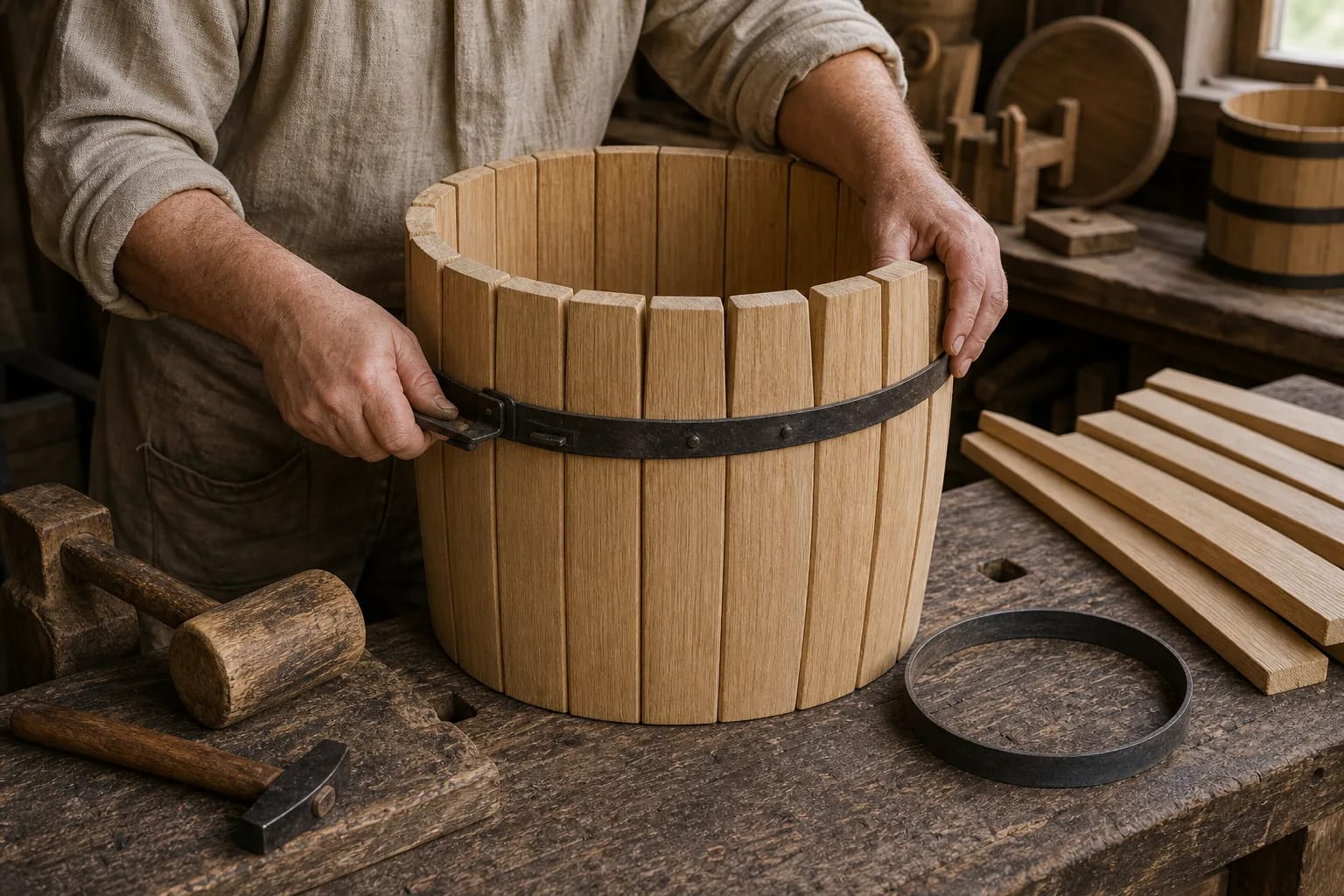
Fifth, an internal groove is cut for the bottom, and for a barrel for both bottom and top; a round board is fitted into it. Finally a lid, handles, or a bucket handle may be added. The whole construction usually holds without nails, through precise joints and hoop tension.
Products and their uses
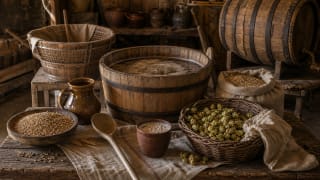
Barrels and tubs supplied the whole farm. According to VLE, a tub was used to hold grain and flour and to ferment vegetables and beer; its usual height was 0.70-1.3 meters and capacity 50-200 liters. Barrels and bačkos held beer, mead, water, meat, salted fish such as herring, and fermented vegetables. Staved vessels were a basis of everyday provisioning, especially for winter stores.
The bucket was the most important everyday vessel for carrying and drawing. VLE notes that in Lithuanian villages and small towns in the nineteenth and early twentieth centuries wooden buckets were used: widening upward, about 22-30 cm high and about 30 cm in diameter, with two ears projecting from the staves or later iron loops, and a handle of hemp rope, juniper rods, or thick wire. Wooden buckets were also used instead of milk pails and survived longest, until the mid-twentieth century, in eastern Lithuania.
Troughs and hollowed vessels are closely related but technologically different. They are usually hollowed from one piece of wood rather than built from staves, so they belong to hollowed woodenware. They are mentioned here as a neighboring product group without blurring the definition of the craft.
Craft, trade, and links with other fields
Cooperage was closely tied to beer, mead, dairy, and meat economies. Without proper barrels and tubs there was nowhere to ferment beer, mature mead, store fermented vegetables, or salt meat. The cooper or tub-maker therefore served the whole village or small-town household world; in some places such a master was indispensable.
The barrel as a unit of volume also shows a link with trade. Since the statinė became a basis of dry volume measurement in the Grand Duchy of Lithuania, the staved vessel was not only a domestic object but an economic and trading unit. Grain, malt, and other stores were measured and transported in such capacities, so the craft also had economic significance.
Cooperage borders several neighboring crafts. It differs from woodcarving and hollowed vessels through staved construction; it shares precise wood shaping and joints with furniture-making and carpentry; it connects with weaving or braiding through straw or rod lids; and with blacksmithing through iron hoops and loops.
How to recognize and evaluate it today
A staved vessel is easy to recognize: its wall is made of separate vertical staves held by hoops, not one hollowed piece of wood. Hoops, visible stave joints, a bottom fitted into a groove, and a shape that often widens or narrows upward are the main signs of cooper's work. A hollowed vessel, by contrast, has a continuous wall without joints.
When evaluating a vessel, ask what it was made for and from what wood. Better, cleaner vessels were made from linden or maple, work vessels from spruce; capacity, height, and form indicate whether the object was meant for beer fermentation, carrying water, or storing grain. Region, period, and museum context help determine the value of a historical example.
Today staved vessel-making is maintained as a traditional craft. Lithuania has a National Heritage Products system and institutions that support traditional crafts, including the Lithuanian National Culture Centre. When assessing modern work, it is fair to distinguish an authentic traditional craft object from a decorative imitation.