- Field
- Lithuanian mead, honey fermentation, and the protected Stakliškės tradition
- Type
- traditional craft
- Heritage status
- well attested
- Context
- mead, honey, honey solution, fermentation, mead nectar, mead balm, Stakliškės, Midaus Stakliškės PGI, Aleksandras Sinkevičius, beekeeping, wax, spices
Lithuanian mead, Honey drink, Midaus Stakliškės
Mead forms and objects
Fermented mead: A drink fermented from honey solution; its basis is fermentation, not distillation.
Midaus Stakliškės: A Stakliškės mead name registered as a protected geographical indication, connected with local production reputation.
Mead nectar: A drink related to mead, usually sweeter and stronger than ordinary mead, but belonging to its own category.
Mead balm: A stronger honey-based drink enriched with spices and extracts, which should not be confused with fermented mead.
What is mead?
Mead is a fermented honey drink. Its basis is honey solution fermented with yeast. Mead should therefore first be understood as a fermentation tradition, not a distilling or strong-spirits tradition.
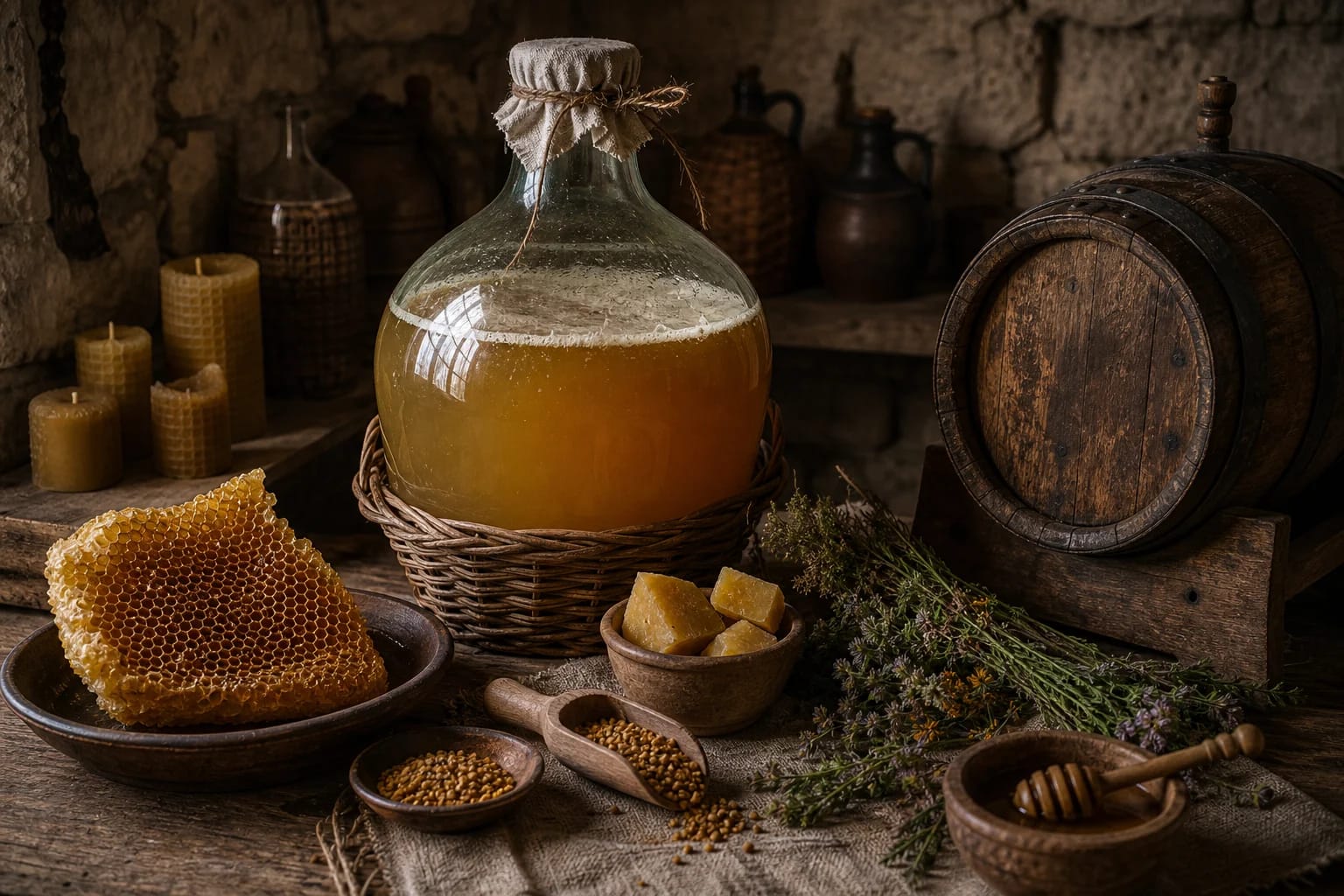
In Lithuania mead has strong historical memory. It is remembered as an old drink connected with beekeeping, honey, feasts, the tables of rulers or nobles, and later revival of national culture.
Today it is important to distinguish several categories: ordinary fermented mead, mead nectar, mead balm, and strong honey-based drinks. They are related, but not the same.
Honey as raw material
Mead quality begins with honey. Different honey, linden, buckwheat, meadow, forest, or honeydew, can change aroma, color, and flavor. Beekeeping is therefore the natural foundation of the mead tradition.
The honey solution must be prepared so that it can ferment. Too much sugar can suppress fermentation, while too weak a solution gives a flat drink. The maker must understand not only flavor but the logic of fermentation.
A mead page should not become a health text. Honey is culturally important, but an alcoholic drink should not be presented as medicine.
Fermentation and aging
Fermentation turns the sugars of the honey solution into alcohol and flavor. This process requires time, proper temperature, cleanliness, and patience. Mead is often perceived as a slower drink than beer.
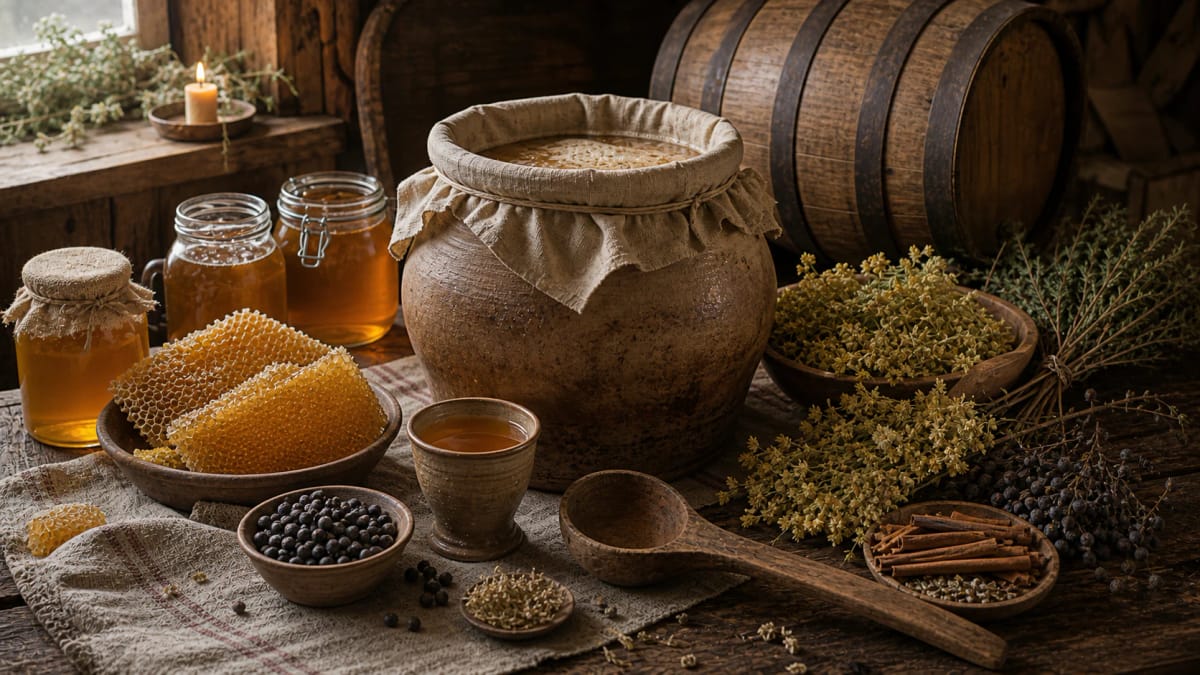
Aging can take place in vessels or barrels, depending on production method. Wood, time, spices, and honey type change the result. Mead making has many variations, but the basic principle remains honey fermentation. VLE states that fermented mead has up to 16 percent alcohol by volume and 30-180 g/l sugar: honey solution with aromatic additions is heated, strained, and fermented for 30-80 days with beer or wine yeast, while the semi-finished product is aged about a year in oak barrels.
In contemporary practice, hygiene and law are necessary. Tradition does not mean random fermentation without safety knowledge.
Spices and herbs
Mead can use spices, herbs, berries, or other aromatic additions. In the Lithuanian imagination, linden blossom, juniper, thyme, forest berries, or warming spices naturally appear.
Additions, however, should not hide the base. If the drink loses its honey character, it becomes another product. Good mead should have a clear relationship with honey.
Herbal use should be separated from medical promises. Aroma and cultural memory are one thing; treatment claims are another.
Stakliškės and the revival of mead
Stakliškės is the most important modern Lithuanian mead place. According to VLE, mead production there was renewed in 1959 at the Gintaras brewery, now Lietuviškas midus, on the initiative of Aleksandras Sinkevičius using technology he restored. Mead of 12-15 percent strength is produced, including Bočių, Trakai, and Stakliškės, as well as 30-50 percent mead nectar and the 75 percent mead balm Žalgiris.
The name Midaus Stakliškės is registered as a protected geographical indication. It is therefore connected with a concrete place, production method, and reputation, not with any honey drink.
As with Daujėnai bread or Jovarai beer, a protected name helps speak precisely: Lithuania's mead tradition is broader, but the Stakliškės name has concrete protection.
Historical memory
Mead is often imagined as an old Baltic or Grand Duchy of Lithuania drink. That memory matters, but it should be presented without exaggeration. Not every bottle of modern mead is a direct continuation of an unbroken ancient practice.
Historical mentions, the importance of beekeeping, and the value of honey help explain why mead became a cultural symbol. Modern production, however, has its own twentieth-century history and technology. VLE notes that alcoholic honey drinks were made already in 7000-5000 BCE, that mead was drunk in Prussia from the eleventh century, and that in Lithuania production flourished until the eighteenth century and later declined as tree beekeeping disappeared; in the early twentieth century, until 1940, mead was made at the Prienai brewery.
The strongest story is not an uninterrupted legend, but an honest chain: the old status of honey drinks, later breaks, and modern revival.
Mead, nectar, and balm
Mead in the narrow sense is a fermented honey drink. Mead nectar and mead balm are related but separate categories. They may be sweeter, stronger, or supplemented with spirit, spices, or extracts.
This difference matters to visitors because in shops or tastings all these products may be associated with mead, while their technology and taste differ.
The aim of the page is not to judge which product is better, but to explain that the word mead has a core meaning of fermented honey drink.
Responsible consumption
Mead is an alcoholic drink, so a cultural heritage description must be responsible. It may be part of tastings, museums, gastronomy, and regional identity, but should not be romanticized as a symbol of unlimited drinking.
Healing properties should not be attributed to mead. Honey, herbs, and old memory can have cultural value, but alcohol has risks and requires moderation.
The best way to understand the tradition is through history, production principles, its link with beekeeping, and the context of protected names.