- Field
- Lithuanian curd-cheese pressing, dairy craft, and household cheese traditions
- Type
- traditional food craft
- Heritage status
- living tradition
- Context
- Milk, curd, cheese, cheese bag, whey, pressing, caraway, smoking, aging, cow, estate dairy, family table
Lithuanian curd cheese, Curd-cheese making, Cheese making, Home cheese pressing
Cheese Making forms and objects
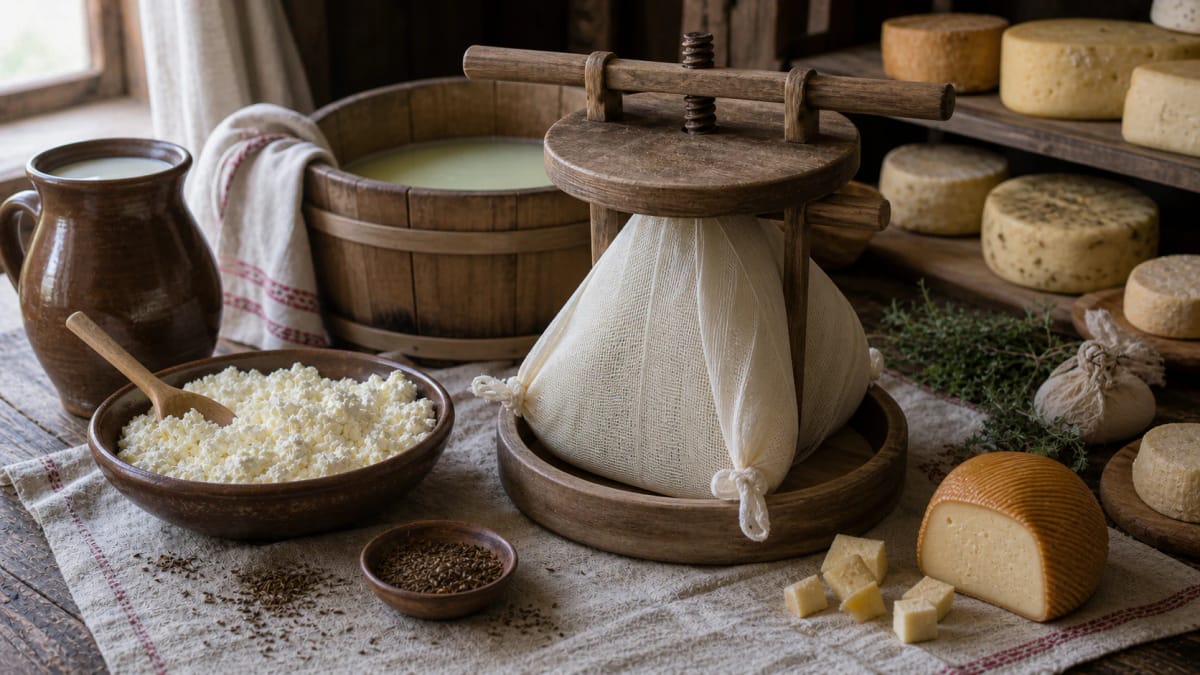
Curd Cheese: A white cheese pressed from sour curd, often triangular or bag-shaped, eaten fresh, dried, baked, or smoked.
Caraway Cheese: Curd cheese flavored with caraway, giving a recognizable aroma and village-table character.
Smoked or Dried Cheese: Curd cheese kept longer by drying, smoking, or other local practice.
Rennet and Matured Cheeses: Džiugas, Liliputas, and other matured cheeses belong to a different technological line than household curd cheese but remain important in Lithuania’s cheese culture.
What Is Cheese Making?
Cheese making in Lithuania has several layers. In the household, the most recognizable form is varškės sūris, curd cheese: milk is soured or coagulated, curd is formed, placed in a sūrmaišis cheese bag, drained, and pressed. Fresh, dried, smoked, baked, and caraway-flavored versions belong to this layer.
Another layer consists of rennet and matured cheeses linked with manor dairies, later dairy industry, and protected names. Džiugas and Liliputas are not the same as household curd cheese, but they show the diversity of Lithuanian cheese making. According to VLE, cheeses are mentioned as food stores already in 16th-century manor inventories (cheese-drying houses, sūrinės, stood beside the farm buildings); in the 16th-18th centuries cheese fermentation technology reached Lithuania from Central and Southern Europe through the manors, and in the 19th century production in the large manor dairies was led by Dutch and German masters invited from abroad.
Lithuanian cheese is therefore not only curd cheese, but curd cheese remains the strongest sign of traditional household cheese making.
Curd and Whey
In curd-cheese making, milk sours or coagulates, forming curd and whey. The curd becomes the body of the cheese, while whey drains through cloth. Moisture determines whether the cheese will be soft or firm.
Fresh milk, souring time, and warmth shape the result. Curd pressed too early may be too wet; curd held too long may become overly sour or crumbly.
Whey was not simply waste in the household. It could be used for food, animals, or other kitchen purposes, so cheese making used milk as fully as possible.
Sūrmaišis and Pressing
A sūrmaišis is a cloth bag or cloth used to hold the curd. It shapes the cheese and allows whey to drain. Because of the bag, curd cheese often takes a triangular, elongated, or knot-shaped form. Older practice used a cloth piece, triangular bag, or sleeve-like bag and then pressed the cheese with boards, stones, or a cheese press. The oldest method of making cheese from sour milk had spread as far as Žemaitija and Užnemunė, where cheese was often made from a mixture of sour and sweet milk.
Pressing is necessary for a firmer cheese. Too little weight leaves the cheese wet; too much can press out too much moisture and make it hard.
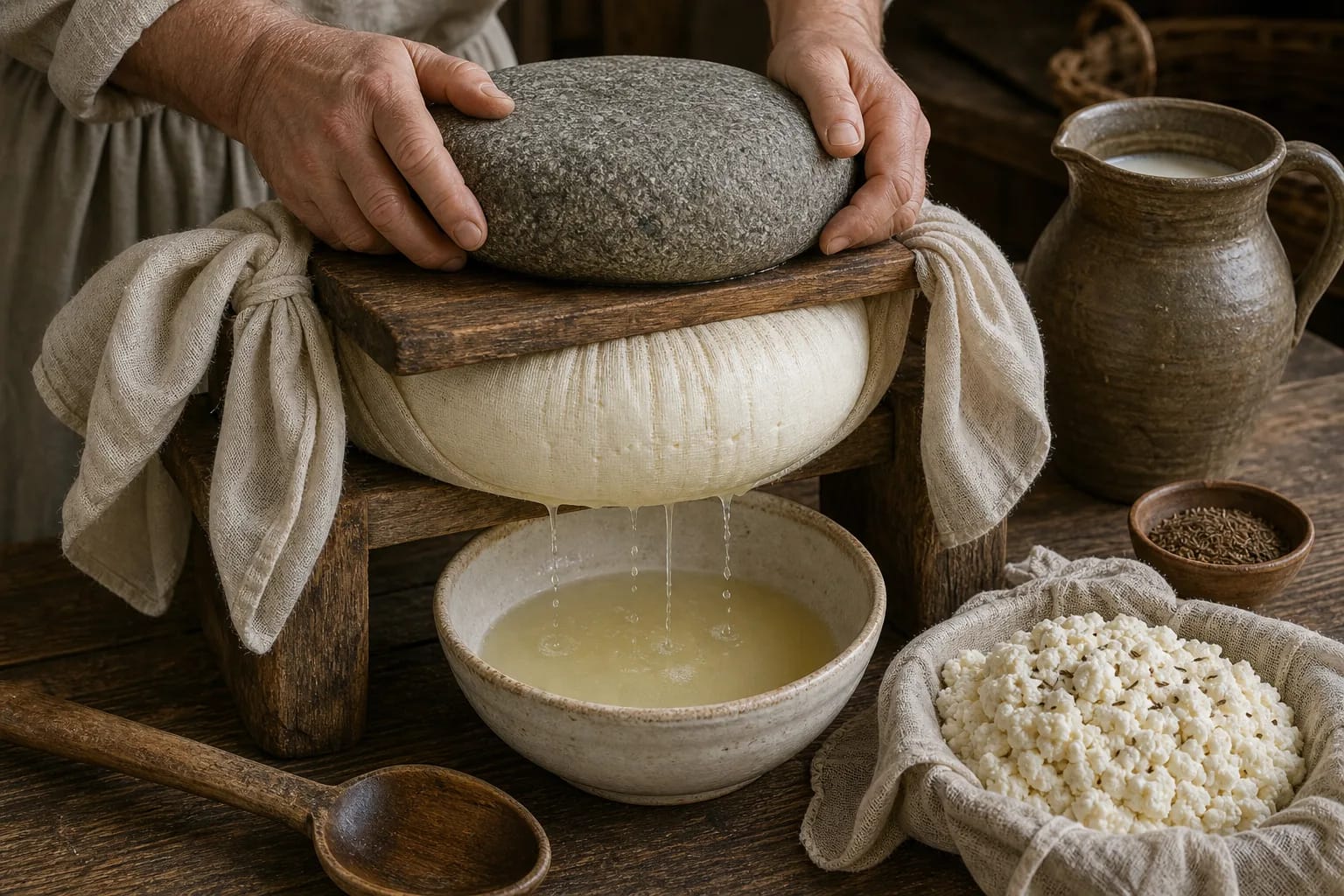
The sūrmaišis shows the link between textile and food crafts. Clean cloth, good weave, and proper tying are as important as milk quality.
Caraway, Herbs, and Flavor
Caraway is one of the most recognizable additions to curd cheese. It gives aroma and makes the cheese feel more festive. Cheese may also be plain, salted, or flavored with herbs and other local tastes.
Additions should not hide the quality of milk and curd. Traditional curd cheese is valued for its clean lightly sour taste, firm form, and correct moisture.
Modern versions may add herbs, garlic, or other flavors, but heritage writing should separate the traditional core from new gastronomic variants.
Drying, Smoking, and Baking
Curd cheese can be eaten fresh, but it can also be dried, smoked, or baked. Drying firms it, smoking adds aroma and longer keeping, and baking or heating changes texture.
Smoked cheese must be prepared safely. A historical smokehouse and modern food safety are not the same, so it matters whether the cheese is meant to be eaten, how it was smoked, and how it was stored.
Dried and smoked cheeses show how rural households adapted food for storage, travel, and feasts.
Rennet and Matured Cheeses
Rennet cheeses are made differently from curd cheeses. They use rennet, cultures, salting, controlled moisture, and maturation; the center of the process is not pressing curd in a bag but managing maturation.
Džiugas is a hard matured cheese with a protected geographical indication. Liliputas is a small matured cheese with its own protected name. Both show that Lithuanian cheese making is broader than village curd cheese.
These names should be used precisely. Not every hard cheese is Džiugas, not every small cheese is Liliputas, and not every white cheese meets the specification of protected curd cheese.
Cheese and the Lithuanian Home Table
Curd cheese was convenient household food: it could be eaten with bread, honey, sour cream, potatoes, or vegetables, taken on journeys, or served to a guest. It suited farms where milk was available daily.
Cheese is also connected with feasts, markets, summer work, and harvest tables. Fresh white cheese on linen cloth is one of the strongest images of Lithuanian rural food.
In contemporary culture it returns through farmers’ markets, gastronomy, education, and certified national-heritage products.
Safety and Modern Production
Cheese making is closely tied to food safety. Milk, cultures, cloths, vessels, temperature, and storage all have to be clean. Traditional craft cannot excuse risky hygiene.
Raw milk, fresh curd, and longer-stored cheeses carry different risks. Cheeses sold commercially must meet legal and food-safety requirements.
Learning the heritage means understanding technology, material, and cultural value without ignoring modern health standards.