- Field
- Lithuanian rural furniture-making, joiner's work, and household folk art
- Type
- traditional craft
- Heritage status
- well attested
- Context
- Lithuanian folk furniture, benches, tables, beds, cradles, shelves, spoon racks, cupboards, towel racks, dowry chests, kuparai, wardrobes, chests of drawers, joiners, carpenters
Lithuanian folk furniture, Rural furniture, Joiner's furniture, Furniture production, Household woodenware
Furniture-Making forms and objects
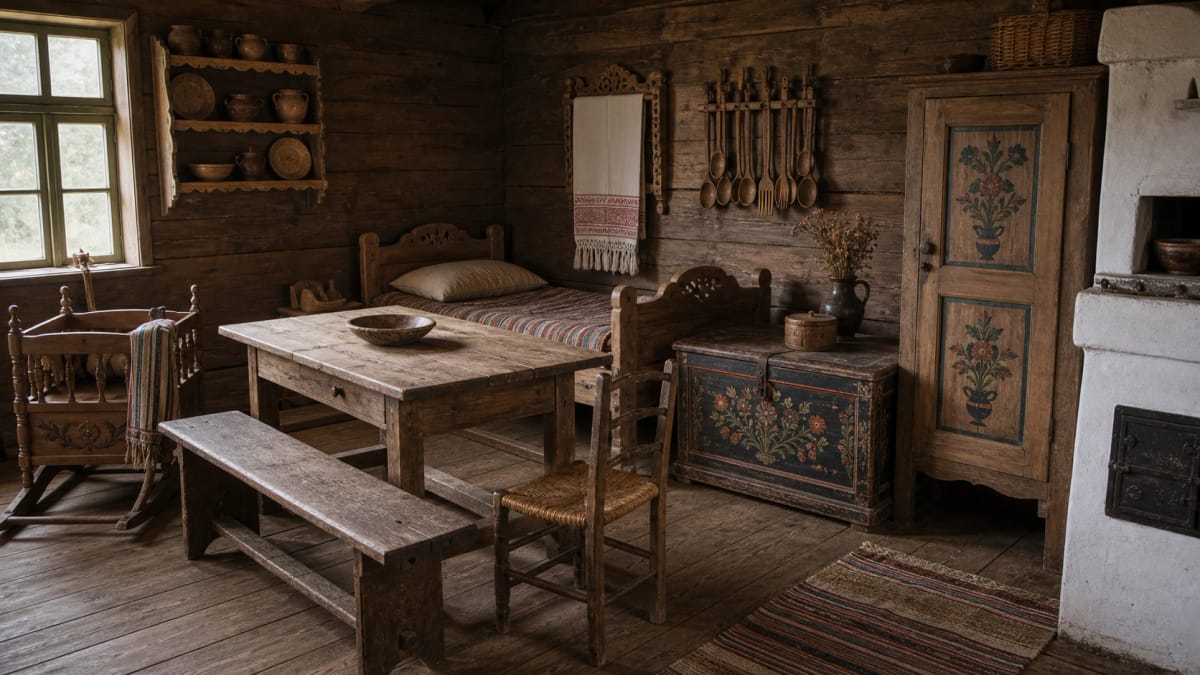
Main room furniture: Benches, tables, beds, chairs, stools, and cradles that organized everyday eating, sleeping, work, and family life.
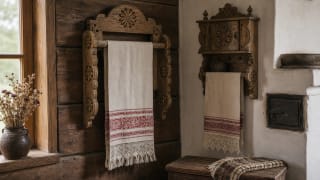
Wall and storage furniture: Shelves, spoon racks, towel racks, small cupboards, and wall cabinets that held dishes, textiles, spoons, ornaments, and small things.
Dowry and value furniture: Dowry chests, kuparai, chests of drawers, and wardrobes connected with textile, weddings, family property, and inheritance.
Decorated joiner's furniture: Furniture with profiled edges, openwork cutting, painted flower motifs, incised ornament, turned details, or woven seats.
What is furniture-making?
Furniture-making is the craft of producing furniture; in the Lithuanian rural context it means making benches, tables, beds, cradles, shelves, towel racks, spoon racks, cupboards, dowry chests, kuparai, wardrobes, and other household objects. It is practical wood culture in which construction matters no less than ornament.
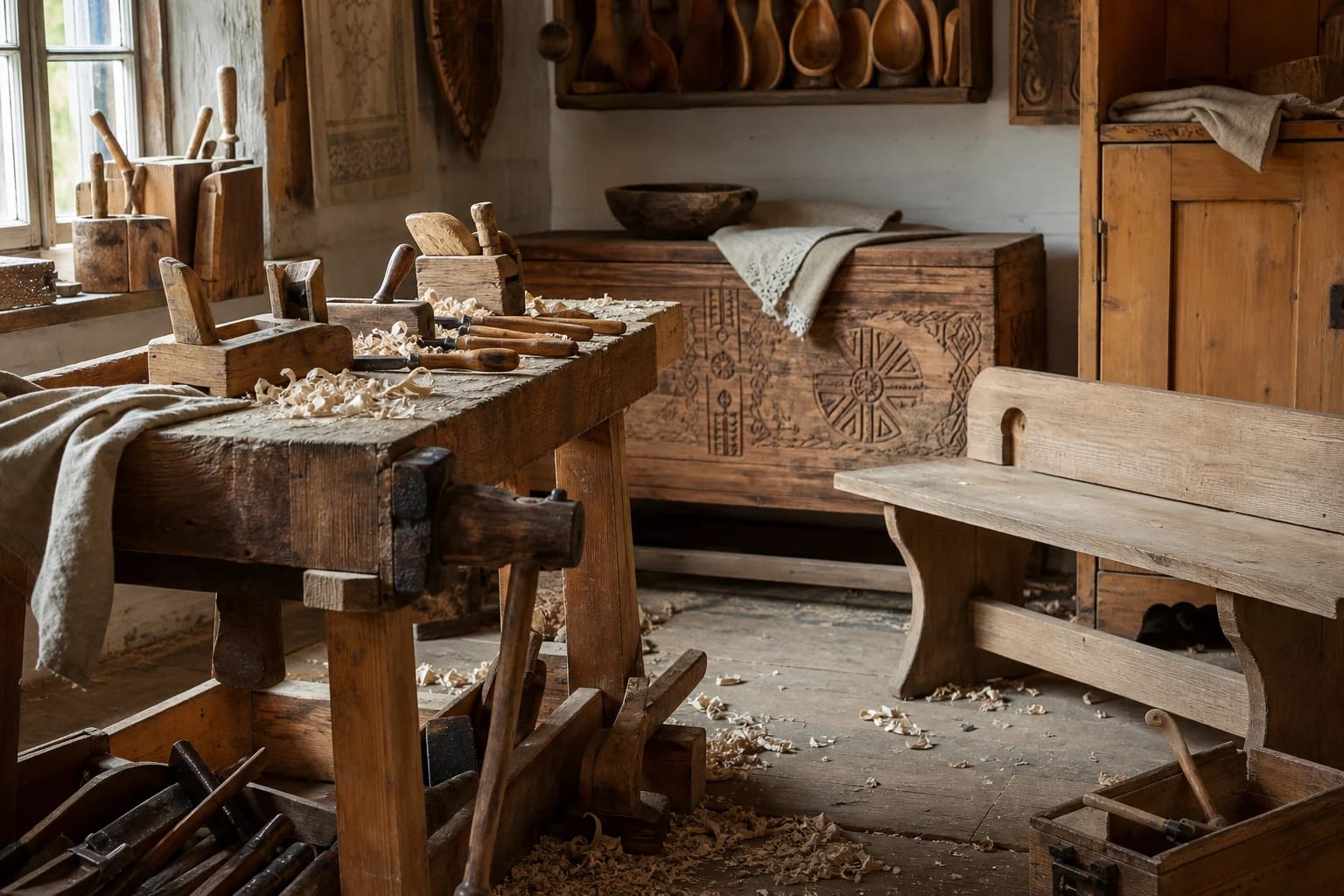
Folk furniture differs from manor or urban furniture. It first had to serve daily life: eating, sleeping, storing textile, hanging a towel, setting dishes aside, rocking a child, or preserving a dowry. Decoration comes only after function is clear.
Furniture-making therefore tells more than a story of joinery technique. It shows how a room was organized, where the family sat, what had the place of honor, where dowry was kept, and how wooden objects worked together with woven textiles.
Masters: carpenter, joiner, and home work
Simpler furniture could be made by the householder or by someone with carpentry skills. A bench, shelf, or plain table needed strength but not necessarily a specialized workshop. More complex furniture, such as wardrobes, chests of drawers, painted chests, and turned chairs, more often required a joiner.
The dailidė is more closely tied to building, logs, structures, and heavier woodwork. The stalius or joiner is associated with more precise board constructions, joints, doors, drawers, locks, turned details, and smoother surfaces.
In rural furniture-making these boundaries could overlap. The same master might repair a house, make a bench, carve a spoon rack, or build a chest. The concrete work matters more than the professional title.
In towns, joiners organized into guilds from the second half of the sixteenth century: King Stephen Báthory granted Vilnius craftsmen a privilege to establish a joiners' guild in 1579; the first joiners' guild in Kaunas was established in 1672, and in Klaipėda in 1752. In the mid-nineteenth century about 30 master joiners worked in Vilnius, with about 90 apprentices and 50 journeymen; training lasted four to seven, sometimes nine, years.
Main room furniture
Benches and tables organized family everyday life. A long bench along the wall saved space; the table was the center of eating, work, feasts, and receiving guests. Chairs were less necessary and often later or more ornate than benches.
The bed, cradle, and bedding places joined furniture with textile. Bedcovers, gūnios, pillows, linen cloth, and other fabrics made a wooden bed habitable. The cradle was both furniture and a rhythmic tool for calming a child.
Shelves, spoon racks, small cupboards, and towel racks organized the walls. They held what needed to be at hand or shown nicely: spoons, dishes, towels, pots, and festive things.
Chests, kuparai, and wardrobes
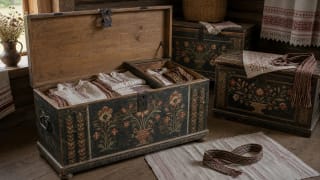
Dowry chests and kuparai are among the most representative rural furniture forms. They held woven textiles, clothing, sashes, documents, money, and family valuables. Because of their wedding significance, chests were often more richly painted or fitted with ironwork.
Wardrobes, chests of drawers, and cupboards spread later and show changes in household life. As homes accumulated more objects, textiles, and dishes, the chest alone was no longer enough. Drawers, shelves, and closed doors organized interior order differently.
Furniture history is not only a list of forms. It shows how rural homes gradually changed from simpler benches, tables, and chests toward more precise joiner's work, wardrobes, chests of drawers, and more decorative interiors.
Construction and joints
The most important quality in furniture is sound construction. Boards must dry properly, joints must hold, surfaces must not catch cloth or the hand, and legs and frames must carry everyday weight.
Different joints and fittings were used: grooves, dowels, board joints, nails, later metal details, hinges, and locks. Simpler furniture could be rougher, but good furniture had to stand steadily and serve for years.
Rural furniture was often repaired. A cracked board was replaced, a leg reinforced, a lock moved, or a surface repainted. Today such repairs are part of an object's history, not only defects.
Decoration: painting, carving, openwork
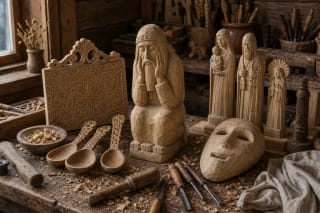
Lithuanian folk furniture decoration is usually restrained and tied to construction. Edges are profiled, shelves are cut decoratively, bed headboards are carved, chair backs are pierced with openwork, and chests are painted with flowerpots or plant motifs.
Painting is especially important on chests, wardrobes, and some later furniture. Flowerpots, tulips, roses, branches, and framed compositions add a festive, representative layer. Samogitian chests often use intense coloring and dark backgrounds (green, brown, black, or blue) with a bright outline, while Aukštaitian furniture tends toward lighter colors, often blue or green grounds. Known nineteenth- and early twentieth-century furniture decorators include K. Adomavičius, J. Jurevičius, M. Kančius, P. Lenkimas, and K. Žulpa.
Decoration should not be interpreted only symbolically. It also shows the master's hand, local taste, color fashion, the patron's wish, and the furniture's place in the home. A spoon rack or towel rack may need only a small ornament, while a chest may become an entire painted field.
Furniture and textile
Rural furniture is inseparable from textile. A table is covered with a tablecloth, a bed with a bedcover, a bench with a gūnia or runner, a towel rack with a towel, a chest with dowry cloths, and a cradle with linen.
Textile softens wood, adds color, and shows when an object is everyday and when it is festive. The same chest may be closed on an ordinary day, but during a wedding or guest visit its contents become a sign of family work and status.
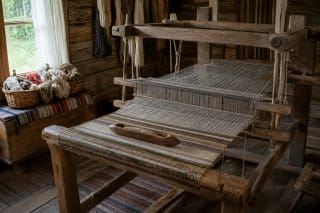
For that reason furniture-making should be read together with weaving and towel traditions. The wooden piece is only half the interior; the other half is linen, pattern, thread, and handwork.
Regions and changing household life
Regional differences in furniture appear in construction, decoration, color, and object distribution. In some places simpler benches and chests survived longer; elsewhere wardrobes, cupboards, chests of drawers, or more urban forms spread faster.
Lithuania Minor, Samogitia, Aukštaitija, Dzūkija, and Suvalkija had different home environments, but furniture forms moved with masters, marriages, trade, and fashion. Region helps orientation but does not lock an object into one area.
At the turn of the nineteenth and twentieth centuries rural furniture changed quickly: factory products, urban forms, painted wardrobes, drawers, mirrors, and more comfortable chairs became more common. Traditional furniture-making did not vanish at once; it adapted.
Restoration and use today
Old folk furniture should be protected from moisture, sudden temperature changes, insects, mold, and aggressive sanding. Paint, old color, locks, hinges, and structural joints are especially sensitive.
Restoration should not make the furniture 'new.' A worn edge, old crack, hand-polished surface, repaired hinge, or darkened finish may be authentic evidence of use.
Contemporary furniture-making can continue the tradition if it understands function. It is not enough to add a sun motif to a modern box; the maker must know what the object is for, how it stands in a room, how it is touched, and what it protects.