- Place
- Švenčionys District Municipality
- Region
- Aukštaitija
- Type
- Neris-basin river and protected-landscape water route
- Coordinates
- 55.05000, 25.81500
Žeimena
A River between Aukštaitija Lakes and the Neris
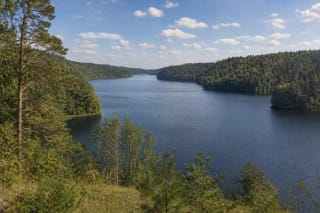
The Žeimena is one of eastern Lithuania's important rivers because it gathers the waters of lake-rich Aukštaitija and carries them to the Neris. VLE identifies it as a right tributary of the Neris, flowing from Lake Žeimenys near Kaltanėnai; the river runs south and southwest and enters the Neris at Santaka, 11 km southwest of Pabradė. Main tributaries are the left-bank Dobis and Mera and the right-bank Kiauna, Luknelė, Lakaja, and Dubinga, so the Žeimena is effectively the drainage line of much of the Aukštaitija lake district.
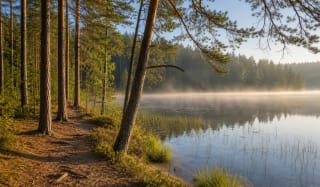
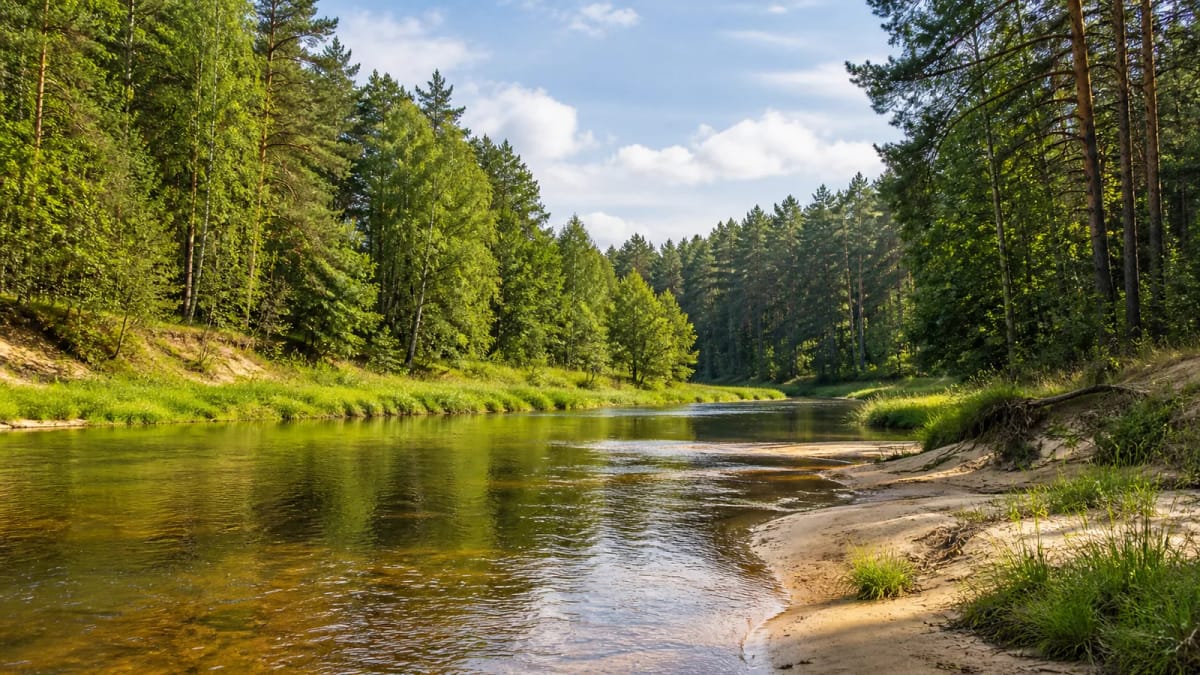
Visitors often know the Žeimena as a canoeing river, but its meaning is broader. It is one of Lithuania's relatively little-regulated and very clear water routes, linking Kaltanėnai, Pabradė, pine forests, riverside villages, and internationally important fish spawning grounds. Its clean, flowing water matters both for salmonid fish and for quiet water tourism.
Length, Basin, and Flow
VLE gives the Žeimena's length as 80 km and its basin area as 2793 km². From Kaltanėnai to Pabradė the channel is winding and 12-40 m wide; below Pabradė it reaches up to 50 m. Depth is 1.2-2.1 m, current speed 0.2-0.9 m/s, average gradient 0.41 m/km, and average discharge at the mouth 24.6 m³/s, rising to 112 m³/s at Pabradė during spring flood.
These figures explain why the Žeimena is considered a relatively calm but living river: a small gradient and stable flow do not eliminate riffles, yet allow even less experienced paddlers to travel. VLE notes that annual water-level variation averages 0.5 m at Kaltanėnai and 1.0 m at Pabradė, so plan routes by season and actual water level, not just a map.
Ichthyological Reserve: Salmon, Sea Trout, and Lampreys
In its lower course the Žeimena flows through the Žeimena Ichthyological Reserve, whose area is 929 ha according to Saugoma.lt. The reserve was established to protect trout, salmon, and sea trout spawning grounds, making it one of the most important salmonid spawning areas in the Neris basin. For this reason the river's clarity and gravel bottom are not only scenic features but conditions for fish survival.
Saugoma.lt also lists protected species including thick shelled river mussel, green club-tailed dragonfly, river lamprey, brook lamprey, Baltic salmon, grayling, barbel, spined loach, bitterling, bullhead, pond bat, and otter. Habitats of European Community importance are protected too, including water courses with Ranunculion fluitantis communities. Visitors should avoid damaging banks, trampling shallows, or disturbing spawning fish.
Landscape Reserve and National Park Section
VLE states that from its source to Dėlynė the Žeimena belongs to Aukštaitija National Park; from Gulbinė and the Mera mouth it belongs to the Žeimena Landscape Reserve; and from the national park boundary to its mouth it belongs to the Žeimena Ichthyological Reserve. Almost the whole river is therefore protected, but under different regimes.
The Žeimena Landscape Reserve protects river-valley forms, sandy exposures, and riparian habitats. In practice, travellers should use existing rest areas and arranged landing places, avoid damaging banks, and keep noise low where the river passes through more sensitive natural environments.
Canoeing on the Žeimena
The Žeimena is popular with canoeists because one route combines lake, pine-forest, and river-valley experiences, while clear water and sandy banks continue through much of its length. Still, do not plan a route only by a convenient map start: check water level, official put-in and take-out places, transport, and protected-area rules.
The best Žeimena trip is slow and quiet. Since the river crosses a salmonid reserve, it is especially important not to deepen shallows, push boats through spawning grounds, or leave litter. In summer, when travellers are most numerous, quiet behaviour is a conservation issue, not just good manners.
What to See by the Žeimena
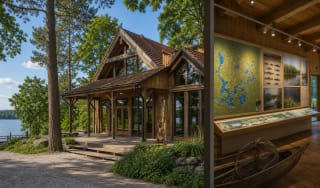
The Žeimena combines well with routes through Kaltanėnai, Pabradė, Labanoras Forest, and Aukštaitija National Park. It is not only a water route but also a link between different protected landscapes of eastern Lithuania, from the lake district upstream to the Neris valley at Santaka.
If you do not want to paddle and simply want to experience the river, choose official bank access points and short stops near Kaltanėnai or Pabradė. This suits families, bird and nature observers, and anyone who wants to see the clear Žeimena without a long water route.