- Place
- Trakai District Municipality
- Region
- Trakai
- Type
- neoclassical Tiškevičiai palace, park, and Trakai lake landscape
- Coordinates
- 54.65971, 24.94365
The manor that makes Trakai look different
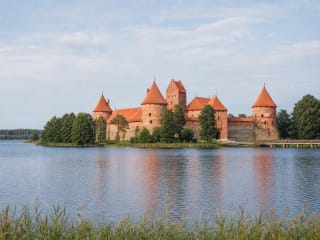
Užutrakis Manor is best understood not only as a palace but as a whole stage of the Trakai lake landscape. The white palace is quieter than Trakai Island Castle, but its view toward Lake Galvė and the castle lets visitors feel the same historical space from the opposite perspective.
For visitors, the site has two layers: you can enter palace exhibitions, concerts, or shows, or choose a slower park walk with terraces, paths, lake shores, and Édouard François André's landscape composition.
The Tiškevičiai family residence
Material from Trakai Historical National Park connects the flourishing of Užutrakis with Count Józef Tyszkiewicz, or Juozapas Tiškevičius. After his father's death in 1891, he inherited Užutrakis and created a family residence here.
In 1897, Juozapas Tiškevičius married Princess Jadwiga Światopełk-Czetwertyńska in Warsaw. Užutrakis became not only a representative estate but also a place of family summers, guest receptions, gardens, orangeries, and daily manor life.
J. Huss's palace
The palace was built in 1896-1902 according to a design by Warsaw architect J. Huss. The Trakai Historical National Park source states that it was decorated in Louis XVI style, so Užutrakis interiors matter not only for plan and structure but for the refined decoration of representative halls.
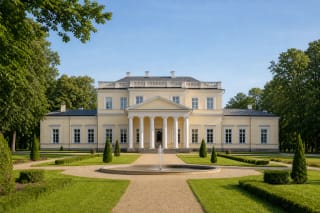
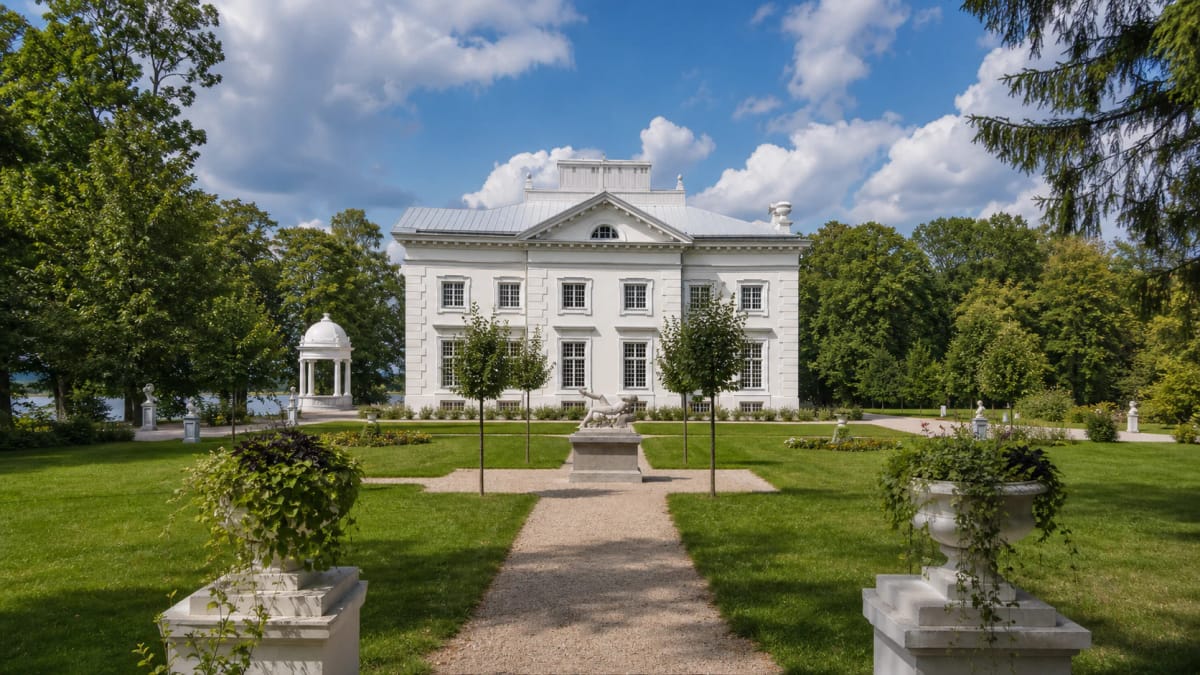
From outside, Užutrakis Palace is restrained: white symmetrical architecture, classical proportions, a central pediment, and a clear garden axis. It works as a contrast to Trakai Island Castle: here the dominant language is not defence but late-nineteenth-century aristocratic representation.
Édouard François André's park
Beside the palace is a park whose author, according to Trakai Historical National Park, was French landscape architect and botanist Édouard François André. Užutrakis belongs to the same Lithuanian group of André parks as Palanga, Lentvaris, and Trakų Vokė.
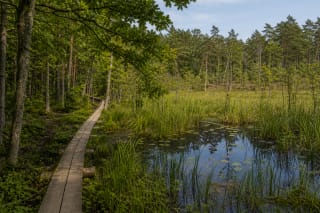
The park's value lies in its relationship with place. André did not work on an empty flat site here, but within Trakai's landscape of lakes, islands, hills, and forest. That means a walk through Užutrakis should be slow: look not only at paths and trees, but at how they open and close views toward water.
The First World War and interrupted daily life
In 1915, as the German army approached, Juozapas and Jadwiga Tiškevičiai left Užutrakis with their children and went to Saint Petersburg. The count died in 1917, and after the war Jadwiga returned to Užutrakis through foreign countries in 1921.
The family story explains why the atmosphere of Užutrakis is not only beautiful architecture. Trakai Historical National Park texts spend much attention on memories of hall order, guests, afternoon gatherings, gardens, and the lake. That helps visitors see the manor as a lived world, not just a restored object.
Restored representative halls
The Trakai Historical National Park description of the representative halls emphasizes that after the Soviet period Lithuania inherited a heavily damaged complex: the manor had survived two world wars, many owners, and the period of Soviet institutions.
By 2008, the exterior, second floor, attic, vestibule, staircases, and basement had already been restored. In 2010, the first restored representative hall, the former dining room decorated in Louis XVI style, was presented to the public.
Later, other halls also returned: the Tapestry Hall, White or Mirror Hall, the countess's boudoir, the smoking room, and the count's study. Today the palace functions as a cultural space for exhibitions, concerts, and events.
Historical Parks Interpretation Centre
On July 1, 2020, the Historical Parks Interpretation Centre opened in the Užutrakis Manor estate. It is located in the restored former distillery building and presents the historic Trakai landscape and the work of Édouard François André.
The centre complements a walk through the park well: before going out into the paths, visitors can understand why Užutrakis greenery is not only a pleasant leisure place but a planned cultural landscape.
How to visit Užutrakis Manor
The coordinates of Užutrakis Manor estate are 54.659707, 24.943648. They are useful for route planning because the manor is on the other side of Lake Galvė from the most visited Trakai old-town sites.
If time is short, choose the palace facade, terraces, and main park axis with lake views. For a fuller visit, add the representative-hall exhibitions, the Historical Parks Interpretation Centre, and a longer walk to the shore viewpoints.
Access to the palace, park, centre, and events can change by season and programme, so check official Trakai Historical National Park and Užutrakis information pages before travelling.