- Place
- Trakai, Trakai District Municipality
- Region
- Trakai
- Type
- Gothic water castle and history museum
- Address
- Karaimų g. 43C, Castle Island, Trakai
- Coordinates
- 54.65249, 24.93392
Trakų salos pilis, Trakai Castle
Trakai Island Castle: why it became the symbol of Trakai
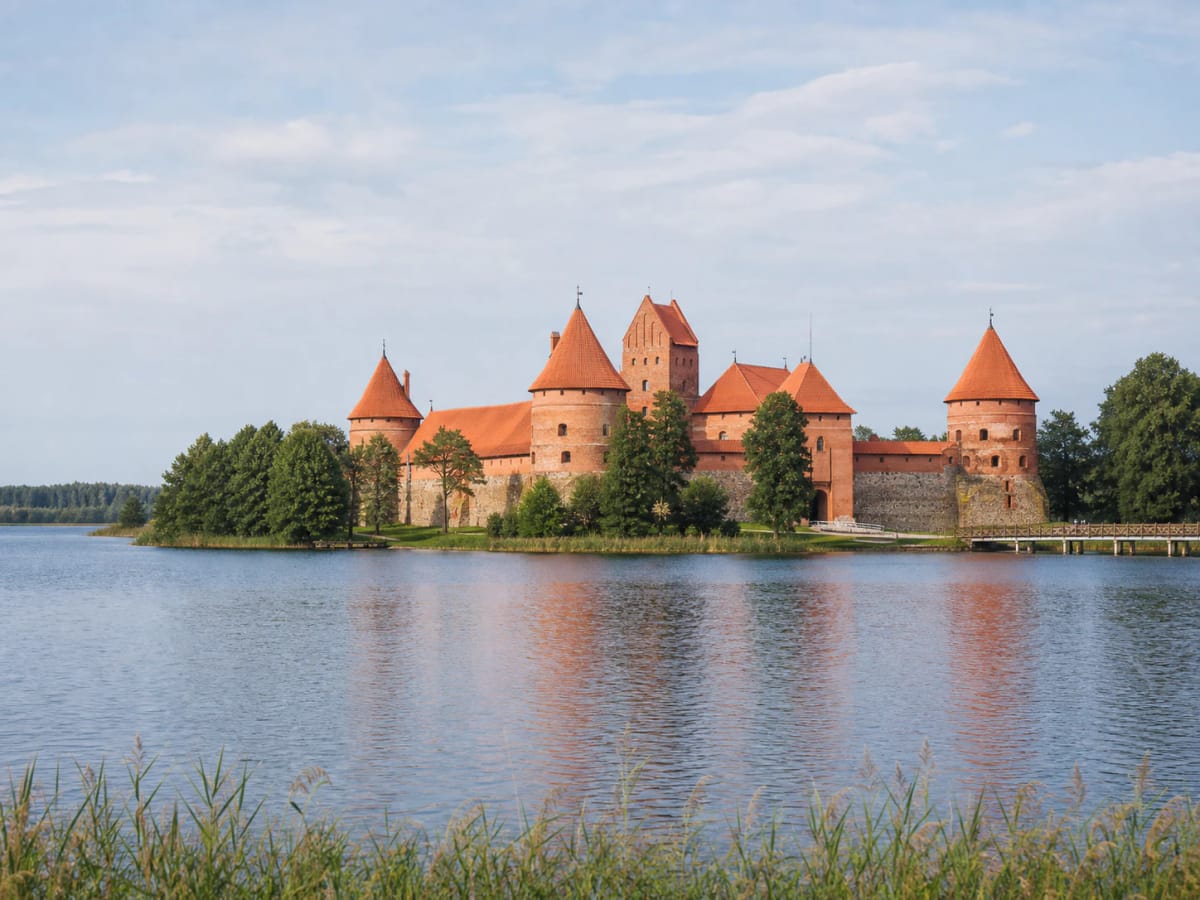
Trakai Island Castle stands on Castle Island in Lake Galvė, so the first impression is not only architectural. The castle is seen across water, with a bridge, red-brick walls, and towers, and the whole composition immediately explains why Trakai became one of Lithuania's most recognizable places.
VLE states that Island Castle stands on Castle Island in Lake Galvė and occupies the whole island, about 1.8 ha. It is one of the two Trakai castles; the other, Peninsula Castle, stands between Lakes Galvė and Luka. Today Island Castle works as a material sign of Trakai's political and military role, not only as a beautiful lake panorama.
Trakai Island Castle, water, and defence
In the fourteenth and fifteenth centuries, the castle was placed on one of Lake Galvė's islands. Historical data says that during construction the lake level was almost 2 m higher than it is today, and the present island was then a group of three smaller islands.
The defensive logic was simple and highly effective: water protected the castle on all sides. That makes Trakai Island Castle a strong place for understanding medieval defence, because here the water landscape is not decoration; it is part of the castle system.
Trakai Island Castle, Kęstutis, and Vytautas
The castle was begun by Grand Duke Kęstutis and completed by his son Vytautas. Vytautas strengthened and modernized the original plan, creating a Gothic brick castle that combined defensive and residential functions.
From 1409, Vytautas the Great moved the state capital here; the Lithuanian Metrica and state treasury were kept in the castle. Vytautas died in the same castle on October 27, 1430, so Trakai Island Castle is closely tied to his political legacy.
Architecture of Trakai Island Castle
VLE describes the palace of Island Castle as convent-type architecture: two three-storey blocks with galleries and a keep, with a stone-paved courtyard between them. Rooms had ribbed star vaults; traces of fifteenth-century frescoes with Byzantine-style features survived on walls and window niches; windows were decorated with stained glass, and a hypocaust underground heating system was installed in the basement.
A defensive wall surrounded the palace, while the fore-castle had a courtyard with three round four-storey towers and a gate tower. A drawbridge connected the palace and fore-castle. The castle was built from stones of different sizes, while the upper walls, corners, and interiors used Gothic-bond brickwork.
Ruins, research, and the museum
In the twentieth century, the castle was brought back from ruins. VLE states that the palace was rebuilt in 1953-1962 according to architect Borisas Krūminis' project, and the fore-castle was rebuilt in 1987 according to Stanislovas Mikulionis' project. Conservation work had already taken place in 1905, 1929-1935, and 1936-1940, while restoration continued from 1951 to 1987.
The Trakai History Museum history page adds that in 1961 the restored central palace of Trakai Island Castle was transferred to the museum, and in 1962 the exhibition opened inside. Later the museum increasingly focused on the Grand Duchy of Lithuania, restoration history, and Trakai region culture.
What to see inside Trakai Island Castle
Trakai History Museum states that since 1962 the central palace of Island Castle has housed an exhibition about the history of Trakai town, the castles, and the Trakai land. This is the main reason not to stop at a shoreline photo only.
Since 1992, sixteen exhibition halls have operated in the western casemates. They display applied-art collections: furniture, pipes, seals, clocks, porcelain and glass, hunting trophies, as well as coins, medals, maps, jewellery, knight armour, and weaponry.