- Place
- Vilnius City Municipality
- Region
- Vilnius
- Type
- Tiškevičiai palace, historicist manor estate, and Édouard François André park
- Address
- Žalioji a. 2A, Vilnius
- Coordinates
- 54.63062, 25.10869
Trakų Vokė manor estate, Trakų Vokė Tiškevičiai Palace, Trakų Vokė Palace
A manor on the edge of Vilnius
Trakų Vokė Manor does not stand in a resort-like lake showcase, but on the south-western edge of Vilnius, in the Paneriai eldership. That matters, because the experience is different from Užutrakis or Palanga: here the representative Tiškevičiai palace meets the railway, the Vokė River, and the everyday life of suburban Vilnius.
The manor estate is valuable as a whole. Visitors see not only the palace, but also the park, ponds, red-brick fence and gate lines, former service buildings, the chapel, and spaces adapted for cultural events. For that reason, it is best to plan more than a brief facade stop and allow at least an hour or two to read the setting.
Tiškevičiai representation
VLE states that in the seventeenth to nineteenth centuries Trakų Vokė belonged to the Zavadskis, Sapiehas, and Dombrovskis, and from the mid-nineteenth century to the Tiškevičiai. It was during the Counts Tiškevičiai period that the manor gained its most recognizable face today.
The palace was built as a representative residence, not merely the centre of a working estate. When exploring Trakų Vokė, it is worth remembering the wider Tiškevičiai network: Lentvaris, Užutrakis, Palanga, Kretinga. In that network, Trakų Vokė stands out because it lies within Vilnius city limits and shows how an aristocratic estate became part of suburban history.
Leandro Marconi's palace
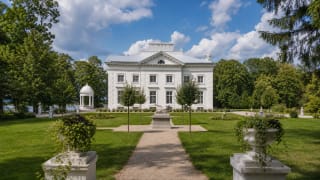
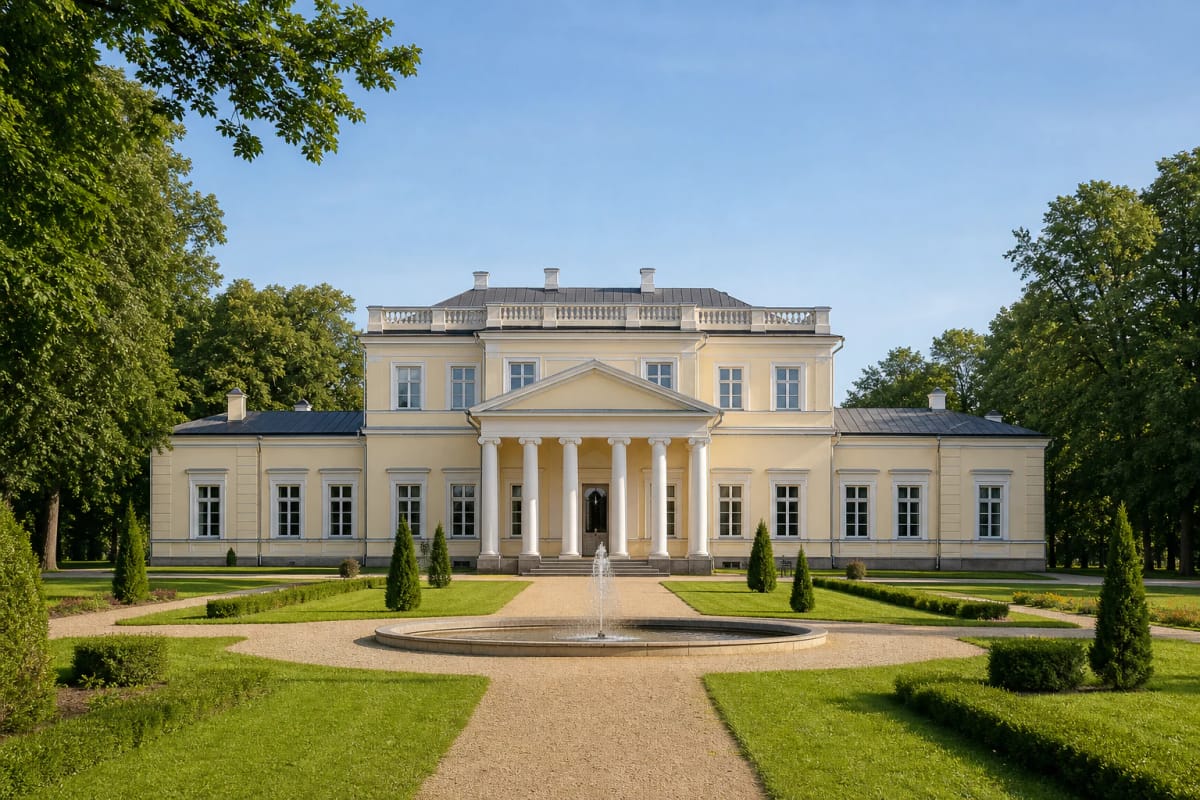
VLE dates the palace to 1880 and links it with architect L. J. Marconi. Research and restoration descriptions of Trakų Vokė Manor usually name Leandro Marconi, whose design was inspired by Warsaw's Łazienki Palace. As a result, the facade feels restrainedly luxurious: the central part has two storeys, a portico, and a belvedere, while the sides are lower.
The neoclassical expression here is not cold. VLE mentions graceful proportions and ornate interiors: the hall ceiling with Classical coffers, Baroque and Rococo plant ornaments on room ceilings, figural reliefs, and an Empire-style vestibule with four columns.
A park shaped by André's ideas
Trakų Vokė Park is one of the site's most important layers. VLE states that the 20 ha park began to be arranged in 1898 according to a design by Édouard François André, is of mixed planning, lies on two terraces, and has three ponds.
In the park, it is worth looking not only for beautiful trees but also for the plan: how the palace approaches open into wider spaces, how water bodies set the rhythm of the walk, and how former manor representation merges with landscape architecture. It is the same André-school logic that can be compared with Užutrakis, Lentvaris, and Palanga.
What survives in the manor estate
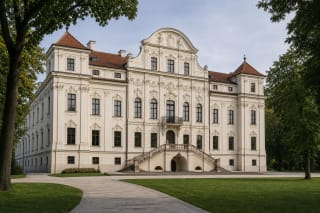
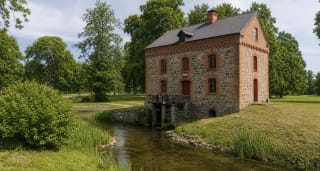
VLE lists more than the palace. A neo-Gothic chapel survives or has been reconstructed, as does the kitchen with laundry built around 1880 and once connected with the palace by a tunnel; there are also an eclectic stable with a strong neo-Baroque character, an office building, a granary, workers' housing, and the steward's house.
These buildings help explain that the manor was a complex organism of economy and representation. The palace created an image for guests, the park formed a scene for aristocratic leisure, and the service buildings ensured daily operation. It is worth walking the wider territory because the palace facade alone does not reveal the whole estate structure.
Soviet period and later changes
During the Soviet occupation, Trakų Vokė was a local administrative centre, the site of the Vokė branch of the Institute of Agriculture and the central settlement of an experimental farm. This changed the social life of the place and the use of the manor setting.
VLE notes that the palace was reconstructed in 1978 to a design by architect A. Lagunavičius. This date matters because the manor's current appearance is made up of the nineteenth-century design, later adaptations, Soviet-era reconstructions, and twenty-first-century conservation works. It is not a frozen illusion of how everything was in Tiškevičiai times.
Revival as a cultural space
In recent years, Trakų Vokė Manor has increasingly operated as a visitor and events venue. The manor estate website publishes information about guided tours, exhibitions, educational activities, rentals, concerts, and conservation works, and the official visitor information reviewed for this entry listed public visiting hours on Fridays, Saturdays, and Sundays.
Because the manor's activity depends on events, restoration stages, and season, it is worth checking the official website before going. This is especially important if you plan not only to walk through the park but also to enter the palace, book a guided tour, or attend a specific event.
How to plan a visit
Trakų Vokė Manor Palace is on Žalioji Square, at Žalioji a. 2A. The best time to come is when you have time for both the interior and the park: from the palace facade, walk toward the ponds and look at the gates, fence, and service buildings of the estate.
If you travel by public transport, check routes toward Trakų Vokė or Vokė station. By car, you are driving to the edge of the city, so the trip is simpler than to many more remote manors, but on event days there may be more visitors around the palace.