- Genre
- Historical-romantic legend
- Source status
- historical and legendary tradition
- Motifs
- Birutė, Kęstutis, Palanga, sacred fire, vaidilutė, marriage
Legend of Birutė and Kęstutis, Birutė in Palanga, Kęstutis and the vaidilutė Birutė
The legend
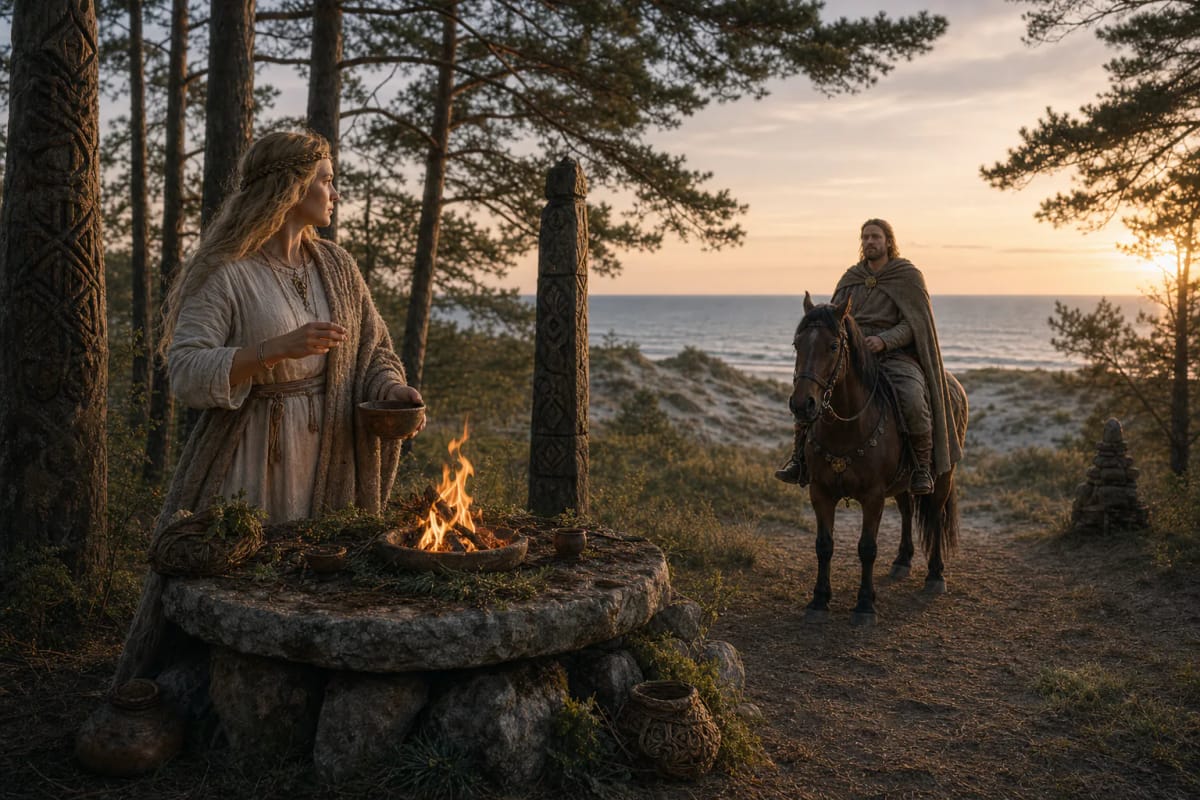
It is told that Birutė lived in Palanga, near the sea and pinewoods. She was associated with sacred fire and local holiness. In some versions she is called a vaidilutė, a female keeper of sacred fire; in others she is simply a noble young woman tied to the coastal sacred place.
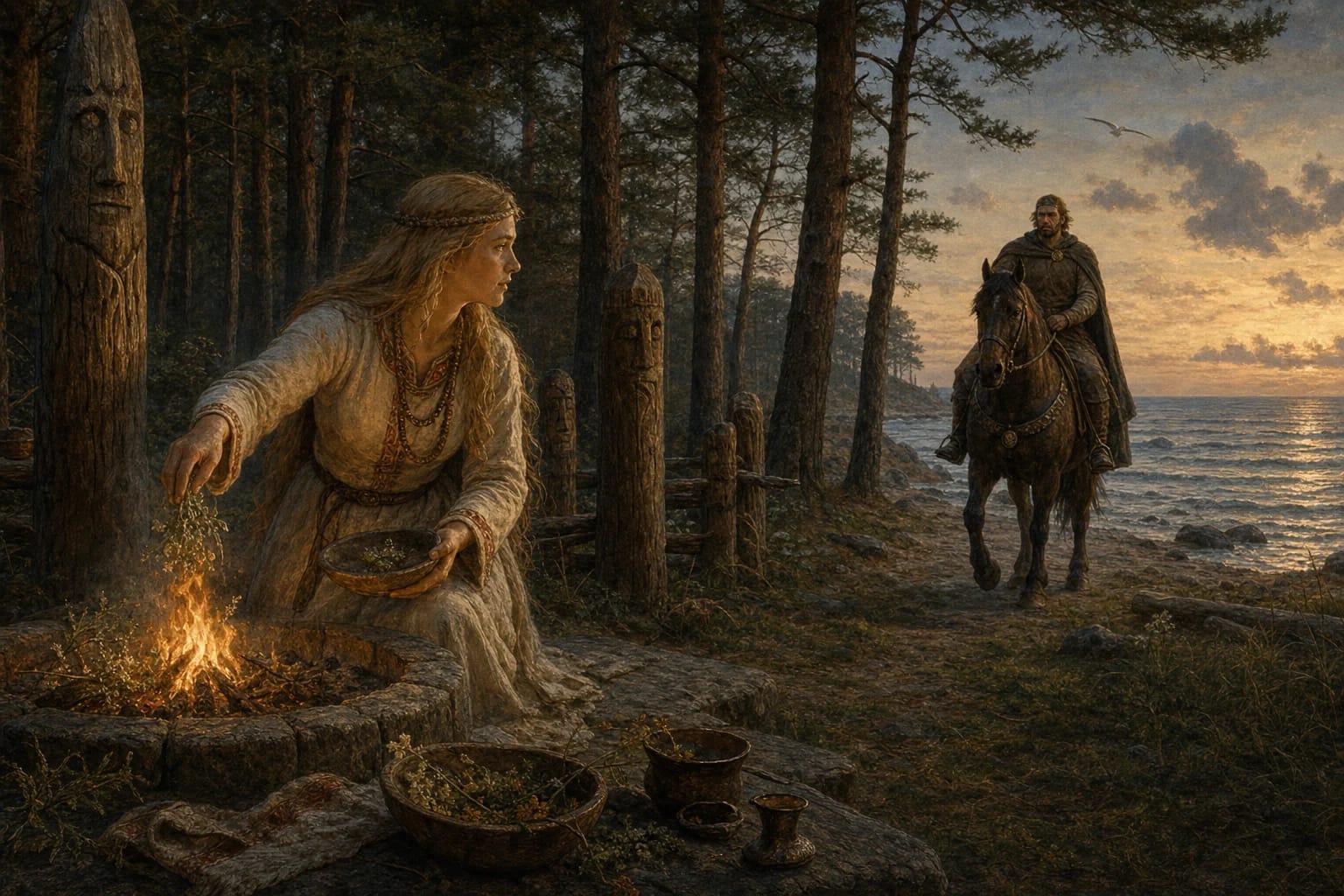
Grand Duke Kęstutis saw Birutė and fell in love with her. The story often stresses the contrast between Birutė's sacred, quiet coastal world and Kęstutis's world of rule, war, and Lithuanian political history.
Kęstutis takes Birutė as his wife, and she becomes a figure of the Lithuanian grand ducal family. Vytautas the Great is born from this marriage, so the legend gains dynastic and political meaning as well as romance.
Interpretation: what does the legend mean?
The story joins love, power, and a sacred place. Birutė gives the history of rulers a coastal, fiery, and feminine layer of sacred memory, while Kęstutis draws her into Lithuania's political narrative.
The sacred-fire motif is central. Birutė is not only a beautiful young woman; she belongs to a holy site. Kęstutis's arrival is therefore both a love story and a crossing of the boundary between sacral place and princely power.
For modern readers, it is important to separate historical Birutė from the romantic legend. The sources support Birutė as Kęstutis's wife and Vytautas's mother, while the vaidilutė and sacred-fire imagery belongs to the legendary and literary layers.
History, sources, and romantic tradition
VLE presents Birutė as Kęstutis's wife and the mother of Vytautas the Great; she died in 1382 or 1383. She came from the Palanga area and probably became Kęstutis's second wife around 1349 or slightly earlier. This historical core must be distinguished from later legendary motifs.
The story of Kęstutis and Birutė appears in the sixteenth-century Lithuanian chronicles, where Birutė is called a vaidilutė. The image of a sacred-fire keeper should therefore be treated as a legendary layer, not contemporary evidence. According to the tradition recorded in Maciej Stryjkowski's 1582 chronicle, Birutė was buried in Palanga, on Birutė Hill.
Later writers strengthened Birutė's romantic image. The romantic ballad Birutė by Silvestras Teofilis Valiūnas (1789–1831), written around 1823 and printed in 1828, became a folk song; Maironis later developed the Birutė and Palanga motif in his 1904 poem Nuo Birutės kalno.
In Palanga, Birutė Hill became an important place of memory and visitation, so the legend lives not only in texts but in a concrete coastal landscape.
Why this legend matters
Birutė and Kęstutis join a personal love story with the memory of the Lithuanian state. Through Birutė, Palanga and the coast enter the history of rulers.
The legend also shows how a historical person can become a cultural symbol: wife of Kęstutis, mother of Vytautas, guardian of sacred fire, and face of Palanga's memory.