- Place
- Marcinkonys, Varėna District Municipality
- Region
- Dzūkija
- Type
- European bison conservation and herd-formation centre with a display enclosure and elevated viewing walkway
- Address
- 130 Kastinio Street, Marcinkonys, Varėna District
- Coordinates
- 54.08560, 24.49532
- Visit duration
- 45-90 minutes for the viewing walkway, keeper's hut, and unhurried wildlife watching; allow the time confirmed by the park if booking an educational visit
- Best time
- early morning from Tuesday to Saturday during keeper hours, when bison are more likely to approach feeding areas; sightings are never guaranteed
Dzūkija National Park Stėgaliai Bison Sanctuary, Stėgaliai bison enclosure
Navigate to 130 Kastinio Street, not to an abstract point inside the forest
The official visitor address is 130 Kastinio Street in Marcinkonys, although the sanctuary lies closer to Zervynos and the Stėgaliai nature complex. Dzūkija National Park gives 54.085604, 24.49532 for the entrance. The centre of the Google place listing is about 65 metres farther north at 54.0861917, 24.4951146, so this page deliberately pins the visitor facilities rather than the middle of an enclosure or a supposed bison location.
There is a gravel-surfaced car park beside the sanctuary. This remains a forest destination, so drive slowly on the final approach, do not leave a vehicle across gates or service access, and do not search for shortcuts along the fence. The park also publishes a GPX route from Zervynos railway station, making a train-and-walk visit possible; download the latest route and check the rail timetable before setting out.
On 15 July 2026, the most recently indexed figure for the exact Google place listing was 4.6 out of 5 from 103 reviews. That clears the 4.5 selection threshold, but both the score and review count can change. Use the listing for navigation; for hours, educational visits, and accessibility, this page gives priority to the park authority's current information.
The timber walkway rises about 3 metres, but it cannot summon a bison
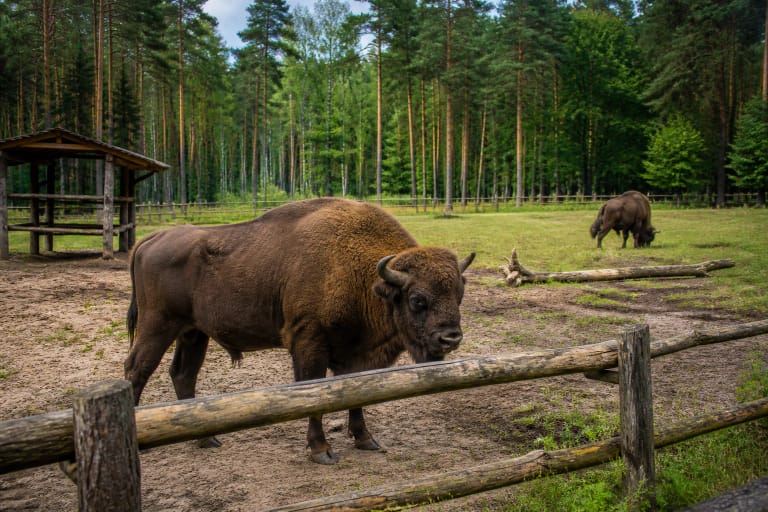
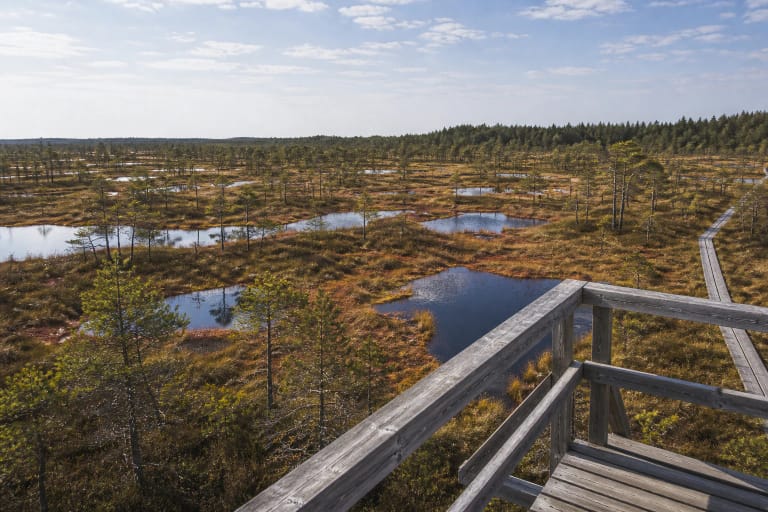
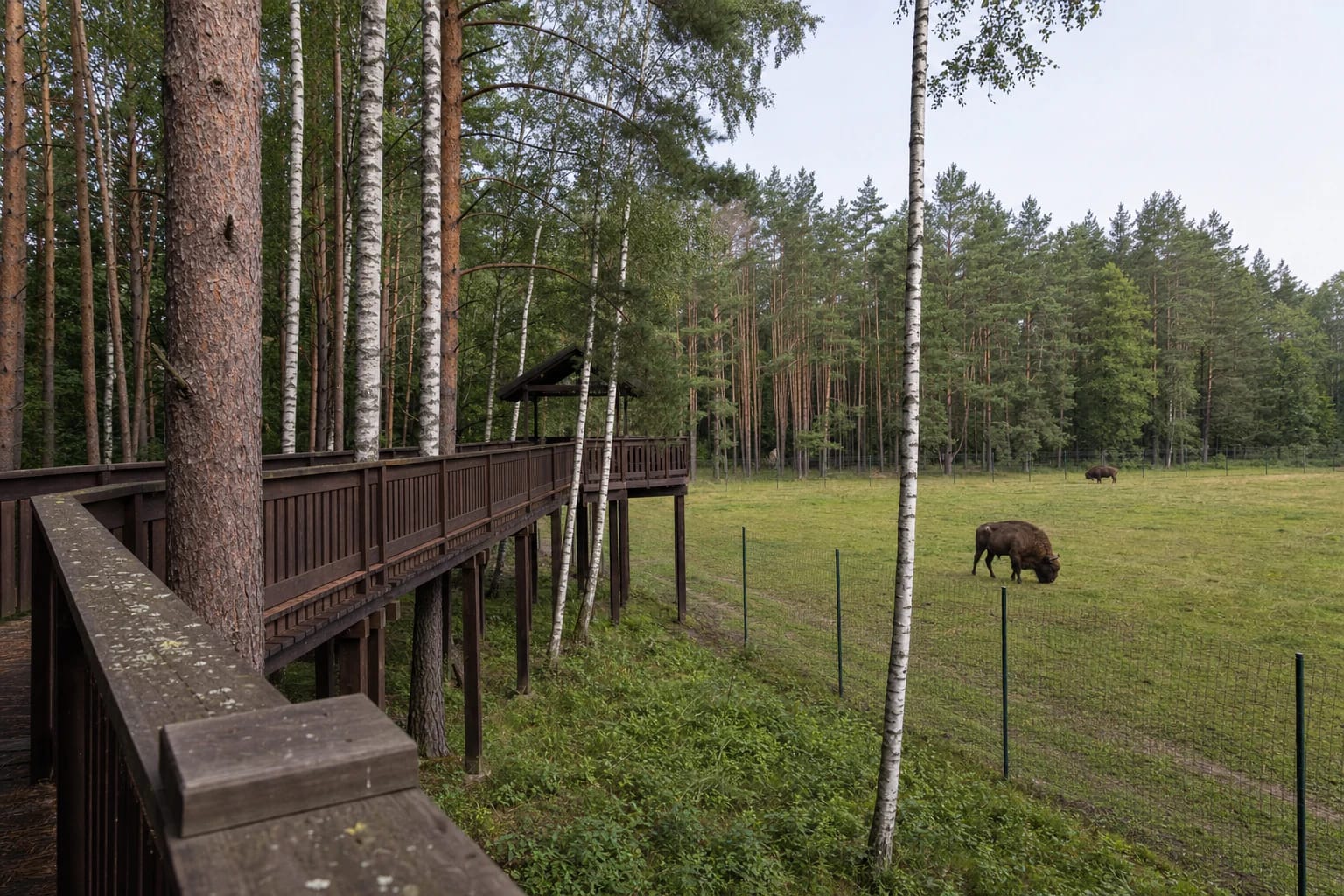
In the visitor area, a timber walkway climbs to roughly 3 metres and ends at a platform overlooking the display enclosure. From here, visitors look across open feeding areas, the forest edge, and deeper parts of the enclosure. The elevation gives a view over lower scrub and the fence while preserving a safe distance. This is an animal-viewing walkway, not a landscape tower: the point is a bison in its habitat, not a panorama over the Dainava Forest.
Lithuania's Ministry of Environment explains that the animals often feed in the morning and withdraw into the woods during the day. Even a huge bull can disappear completely among pines and deciduous trees, so a ticket or a long wait never guarantees a sighting. An early visit during keeper hours, binoculars, low voices, and patience all help. Never bang the rails, call to the animals, or try to lure them with food.
The enclosures contain feeding areas, frost-proof automatic drinkers, salt licks, sand wallows, hay racks, and shelters from the sun. These features support animal welfare and the keepers' work; they are not visitor attractions to enter or handle. Watch only from the designated walkway and platform, never put hands or objects through a fence, and do not follow a free-ranging bison encountered elsewhere in the forest.
Three enclosures across 100 hectares serve display, quarantine, and herd formation
Saugoma.lt puts the sanctuary at about 100 hectares. Its system has three separate enclosures: a smaller display sector where visitors may see bison and larger sectors used for acclimatisation and forming herds. Separate compartments and quarantine capacity let veterinary staff manage transfers, injuries, breeding, and preparation for release into the wild.
This is not a petting zoo. An adult European bison bull can reach 3.5 metres in length, stand about 2 metres tall, and weigh 700-1,000 kilograms; cows weigh 400-600 kilograms. Both sexes have horns. In summer bison eat grass and leaves, while winter food includes bark, shoots, and twigs. Supplementary feeding allows staff to monitor animals, but it does not make them domesticated.
The sanctuary also addresses population genetics. Dense, related groups in central Lithuania faced inbreeding risk and conflict with intensive agriculture. Dzūkija's heavily forested landscape was chosen for a new part of the population, and cows are paired with genetically selected bulls. Possible future contact with populations in Poland or Belarus is a conservation aim and ecological possibility, not proof that such gene flow has already happened.
From the first transferred cow in 2022 to a free-ranging Dzūkija herd
The first cow from central Lithuania arrived at the Stėgaliai nature complex on 21 April 2022. She received a tracking collar so specialists could follow her adaptation. The first twelve bison reached Dzūkija in 2022, and 46 animals were transferred from Panevėžys, Kėdainiai, and Kaunas districts between 2022 and 2025. The sanctuary opened to visitors in 2023.
On 28 January 2026, the State Service for Protected Areas reported 16 bison wintering inside the enclosures. It separately identified four adult bulls in the display enclosure and ten cows aged two to five in the largest herd-formation enclosure; nine had come from the Kaunas area, one was born at Stėgaliai, and the breeding group was being formed around Dunst, a bull brought from Germany. As the published total and named groups are not a simple arithmetic inventory, this page does not guess where the remaining animal was held. Enclosure composition should be read as an operational snapshot on a specific date.
Dunst sired mixed-sex twins in 2024. The protected-areas authority described this as Europe's first recorded case of its kind since 1945; the twins grew up inside the enclosure and were released in May 2025. In January 2026, a herd of twenty bison was living free in and around the national park and sometimes returned for supplementary feed. That is a meaningful conservation result, not an invitation for visitors to track the herd through the woods.
Keeper hours apply to the hut and guided learning, not to the rhythm of wild animals
The official 2026 schedule lists keeper hours as 8:00-17:00 from Tuesday to Friday and 8:00-16:00 on Saturday, with lunch from 12:00 to 12:45. Sunday and Monday are rest days. The keeper does not work on the public holidays listed by the park, and the working day is one hour shorter on their eve. The keeper's hut is available during these hours, so a broad access label on Google is not a promise that the hut or an educational visit will be open.
Educational visits must be booked in advance by calling +370 676 83662 during keeper hours; the authority's general number is +370 672 46388. The official Stėgaliai page publishes neither a separate admission charge nor a fixed price for its educational visit. In 2026, the voluntary Dzūkija National Park visitor ticket cost EUR 1 for a day, EUR 5 for a month, or EUR 25 for an annual family ticket valid across participating parks; an SMS ticket cost EUR 1.35 including the service fee. It supports protected-area care and does not reserve a viewing place. Confirm the programme price and group requirements when booking.
Prices, phone contacts, and schedules can change after this page's review date. Check the official authority page before a long journey, particularly for an educational visit, a public-holiday trip, or access to the keeper's hut. If veterinary work, an animal transfer, or enclosure maintenance is under way, staff instructions take precedence over an ordinary visitor plan.
A lift and an adapted keeper's hut support visitors with limited mobility
The park authority lists a lift from the gravel car park level to the viewing platform for visitors with physical disabilities. The keeper's hut has a ramp and an adapted toilet. This is more useful than a generic accessibility symbol, but the authority does not publish the lift's weight limit, platform dimensions, or independent-use procedure. Call ahead to coordinate assistance if travelling with a powered wheelchair.
For families, the elevated walkway offers a protected viewpoint, but visits with a pushchair, a small child, or someone sensitive to noise are better at quieter times. Adults must supervise children at the rails. Leaving dogs at home is the safest choice: the Stėgaliai visitor page does not state a pet policy, while scent, barking, and sudden movement can disturb wild ungulates.
The sanctuary combines naturally with Zervynos, Ūla Eye, or the Zackagiris trail, but there is little value in rushing through every Dzūkija stop in one day. Allowing 45-90 minutes gives time to wait quietly, read the interpretation, and accept that the animals may choose the cover of the forest. That uncertainty is precisely what separates a living-species conservation centre from a decorative display.